County Residents Press MassDOT For Equal Funding
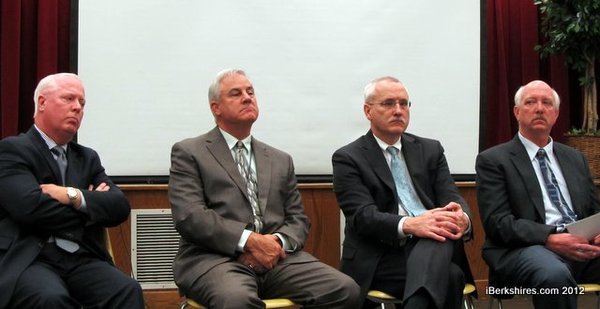
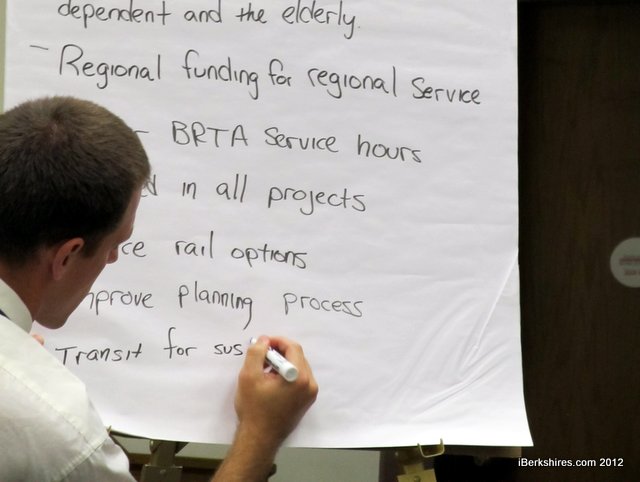 MassDOT staff noted the comments from residents and leaders, which will contribute to a plan for the Legislature in January. |
MassDOT officials came to the Berkshire Athenaeum to get a better understanding of the transportation needs of the future here.
Local reps preached injustice in funding with $27.4 million of Berkshire County dollars (from a penny on the sales tax) that go to the Massachusetts Bay Transit Authority with only $1.8 million coming back to support public transportation — transportation that doesn't run later than 7 p.m. or at all on weekends or holidays.
"For every dollar we spend on the MTBA we get 7 cents back for our RTA and that's not an investment anybody can say is a good idea," state Rep. Tricia Farley-Bouvier, D-Pittsfield, said. "You can't continue to call it a commonwealth when some people are paying for the chair but they're sitting on the floor and that's what is happening with public transportation here."
Farley-Bouvier said on Wednesday she had planned to take the bus to a MassDOT board of directors meeting in North Adams but to make it to the 1 p.m. meeting she would have had to leave at 10 a.m., walk two miles and take two buses. After her day in North Adams, she wouldn't have been able to make it home.
Peter Gallant of Lanesborough held up a penny to the board and said the penny many not mean much in itself, but sending millions of them to a service that noone in the Berkshires can use is "disgusting."
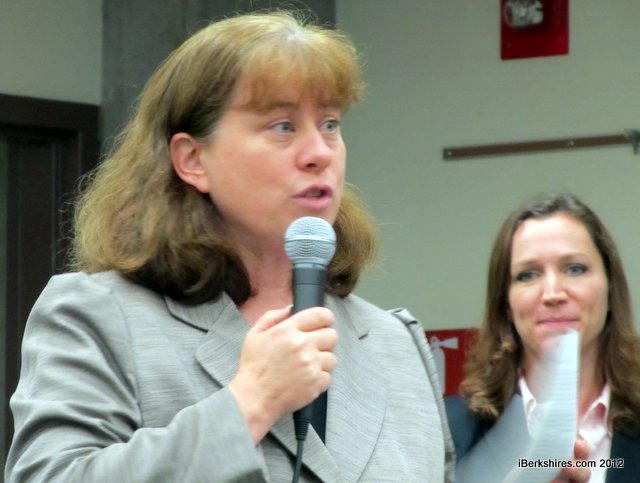 State Rep. Tricia Farley-Bouvier had some harsh comments about the portion of the sales tax from Berkshire County that goes to support a service few in the county will ever use. |
"If we could keep what we have then we can make some really good investments," Pignatelli said, adding that those investments can be more than just increased bus service but investments in repairing roads and bridges as well.
Some 30 residents spoke about transportation needs and about a half dozen of them outlined their daily route filled with hourlong bus rides, multiple transfers and the inability to go anywhere at night.
Many said they would not have been able to make it to Thursday's meeting if it wasn't for special shuttle buses organized y the Berkshire Regional Transit Authority — including one woman who has spinal cancer and has to take a cab in order to get to the nearest bus stop.
That lack of mobility is damaging to economic development, many said.
Leonard Lipton, the city's representative on the BRTA board, said the days of a five-day work week is over and the county needs seven-day service to grow the tourism and cultural economy that has taken over for manufacturing.
"The BRTA Advisory Board believes that fair and equitable funding for RTAs is long overdue," Sandra Lamb, North Adams' BRTA board representatives, said.
But it wasn't just an expanded bus system that residents and local officials pleaded their case for — the county's infrastructure is falling apart, they said.
Jim Lovejoy, selectman from Mount Washington, said the town has roads eroding away that would cost more to repair than the town will ever be able to afford. The town saves its Chapter 90 funds from year to year to do a project and ends up providing only maintenance.
"We don't have enough funding to fix all of our infrastructure," Lovejoy said. "We can't spend that little money and get value for the taxpayers."
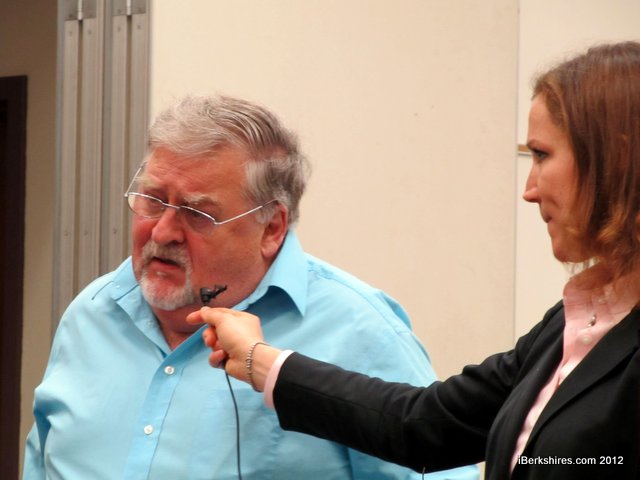 Peter Gallant of Lanesborough called the inequality in RTA funding 'disgusting.' |
Over 25 years, with $2.5 million in just maintenance, the county would need $228 million just for the surfaces let alone fixing the county's 431 bridges at an estimated $1 million each or any sidewalks, he said.
"We've got 11 years of backlog already," Karns said.
Others complained that while Chapter 90 funds have increased, they haven't gone up enough and the funds are not released early enough in the year.
"It is now October and we're trying to get stuff done before the winter. What kind of job can we get done?" asked Christopher Bouchard, Otis Department of Public Works superintendent, about the Chapter 90 funds not being approved until Aug. 1.
"Last year it was increased to $200 million, $45 million was left from past transportation bond bills, we appreciate it. But we're trying to do work with 1980s money. The cost of asphalt was $32 a ton in the late '80s and it is now $80 a ton. This needs to be increased so we can do road improvements such as sidewalks, bike paths. Now we're just trying to keep up doing maintenance," he said.
Sheffield Selectwoman Rene Wood asked for Chapter 90 funds for three years in advance so municipalities can plan their projects and added that while residents in the central part of the county can't access buses at night or weekends, the buses don't run in Sheffield at all.
MassDOT officials had little to say at the meeting but that it was one of 15 they are holding across the state to garner input as the department looks to modernize transportation services and funding mechanisms. In January, the group will have a report to the Legislature about how to meet the funding challenges.
At Pittsfield's meeting was Frank DePaola, highway administrator, David Mohler, director of planning, Peter Niles, District 1 director, Gary Shepard, BRTA administrator and Charles Planck of the MBTA .
"We really need to grow the whole pie," Planck said, adding that the issue is not just equalizing funding but addressing transportatoin needs the entire state is facing.
Tags: Berkshire Regional Transportation Authority, busing, MassDOT, public forum, transportation,