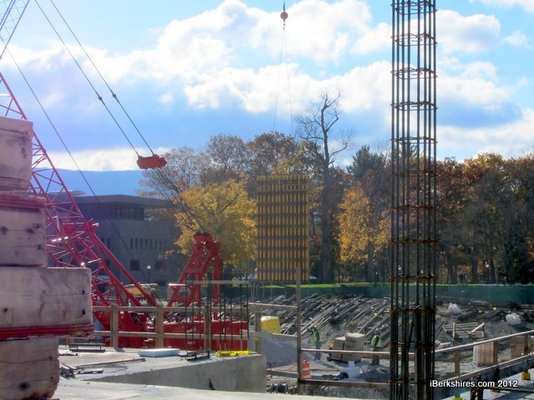
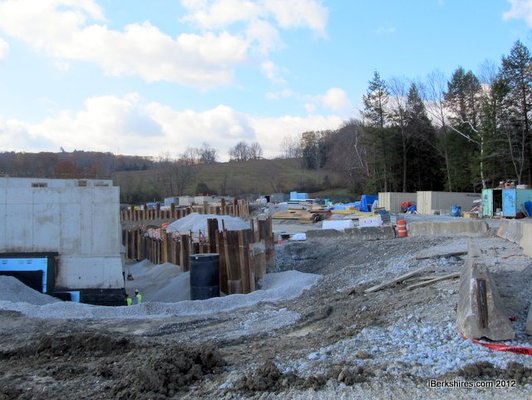
image description
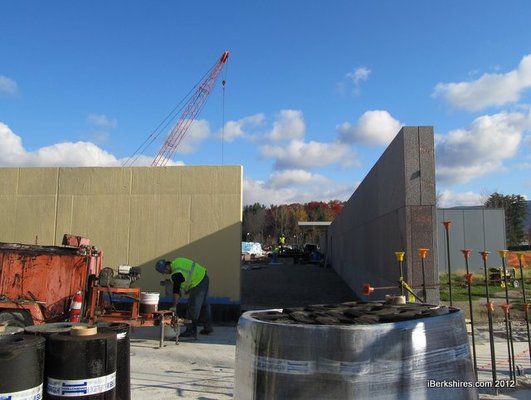
The new entrance looks out at the mountains.
image description
Looking back from the entrace along the granite wall.
image description
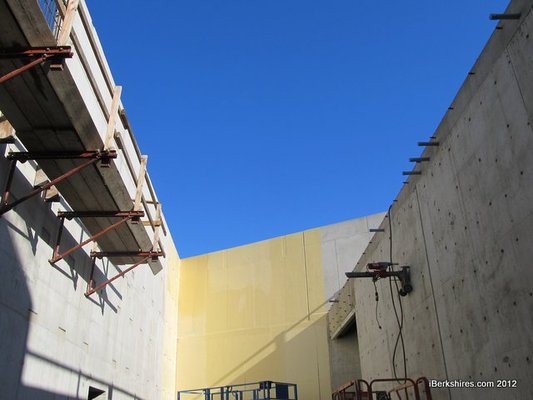
Looking up from the below ground level off the new exhibit hall.
image description
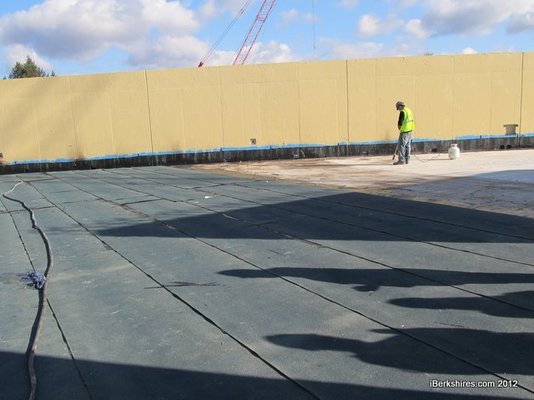
On the upper level, which will be covered with grass.
image description
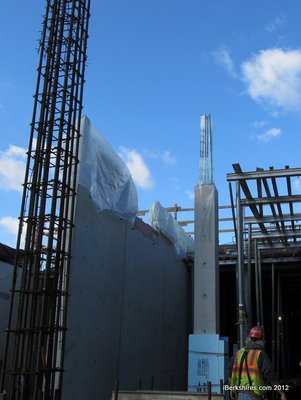
Rebar is covered with plastic to prevent rust from staining the concrete walls.
image description
A form is lowered into position.
image description
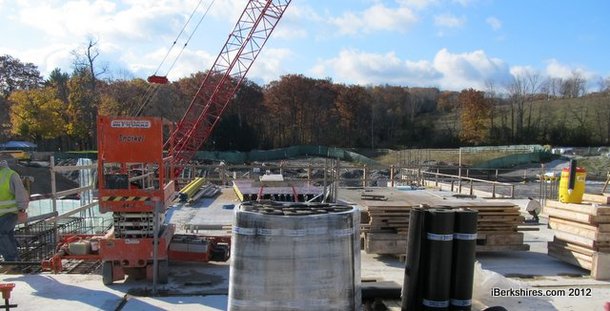
What will eventually be lawn and trails around the center.

Clark Art Expansion Project Beginning to Take Shape
By Tammy DanielsiBerkshires Staff
Print Story | Email Story

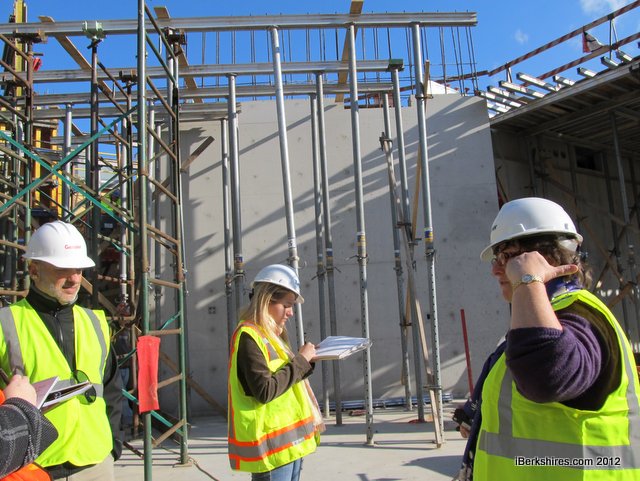
Victoria Saltzman, director of communications for the Clark Art Institute, gives a tour of the under construction entrance and exhibition space on the museum's campus.

WILLIAMSTOWN, Mass. — The site is noisy and cluttered with construction materials, equipment, trucks and crews. It's hard to visualize architect Tadao Ando's proposed epiphany of art and nature in balance.

At least until you walk into the nascent lobby, look past the concrete forms for the reflecting pool, through the space where a wall of windows will frame the view. That's where Ando's vision lies — in the russet mountains, the grazing cows, the blue sky.

The $145 million expansion at the Clark Art Institute is at about the halfway mark in adding some 44,000 square feet including more than 10,000 square feet of gallery space, parking, walking trails, areas for rest and reflection, conferencing, cafeteria, and other features.

Director Michael Conforti believes the unique integration of art and nature will put the museum on the newest list of "1,000 place to go before you die."

"There are five or six very special places like this around the world, where these private collections can be seen in these extraordinary rural environments," he said on Monday morning. "In a new age of global tourism, I see our Clark as having a very significant role, I dare say, a leadership role."

The museum offered a tour of the construction on Monday morning for local media in conjunction with one of Ando's visits to confer on its progress. The internationally known architect and designer, of Osaka, Japan, said he could see his vision emerging from the din of construction.

"The work in progress is part of a larger plan in relationship to the Stone Hill Center [which he also designed] in relation to the landscape," said Ando through translator and fellow architect Kulapat Yantrasast. "Every time I come back, I see slowly the construction move up that linkage on the relationship being established."

For the award-winning designer, the new center will be more than a building — it will be a platform for experiencing art in ever-changing ways by breaking down barriers between interiors and exteriors.

"As you walk around from one art experience to other — in Japanese the 'ma,' the time in between — allows you to refresh your sensibilities," said Ando, who sees art as a nutrient for the soul and spirit. "The artwork is spread out to allow you to really discover from one to other; there's a chance to explore myriad things in between and create a very cohesive art experience that you can't find anywhere else."

The new addition will take advantage of the Berkshires' four seasons, encouraging visitors to keep returning for a different experience.


"I really believe the way we look at the work, the meanings and the importance of the work is really depending a lot on what state or what are your feelings at the time," said Ando. "And because of that to be able to look at the work in this wonderful natural context in the different seasons will allow you to really understand these pieces."

The design radically reorients the museum's entrance from the traditional street facing to one that pulls you into what Conforti described as "totally different campus experience" with a winding drive, lily pond, tree-lined parking lots and a long granite-faced wall blocking the street that both guides you to and prepares you for the main entrance.

The addition will also have its pragmatic functions (updated delivery access, elevators, mechanicals) as well as elements to tie it into the older buildings, such as using red granite from the same Minnesota quarry used for the 1973 building and adding a glass "box" to the original 1955 building. It's also a green building and should qualify for silver LEED certification, based largely on its ground water management system.
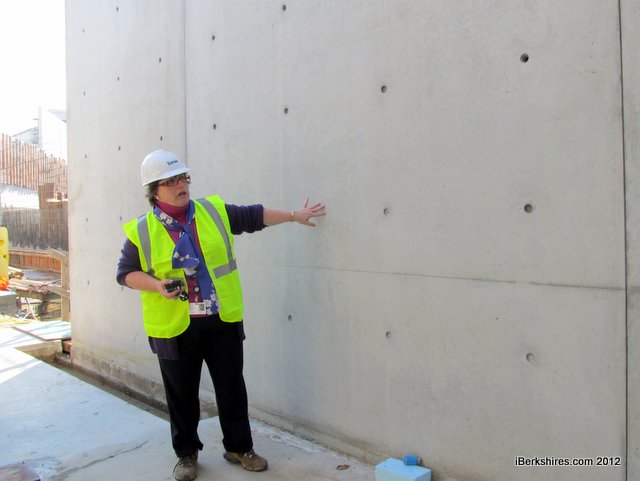


Saltzman explains the process for getting the smooth, clear architectural concrete walls.

Victoria Saltzman, director of communications, led a hardhat tour of the site, pointing out the ways in which light will enter the new structure, the expansive special exhibitions space, and examples of the exacting expectations of Ando in design and construction such the sleek concrete architectural walls. 

"It's big in terms of what we do here," said Saltzman, who added that the museum's initiatives had long outgrown the current structures. "But in terms to make it somewhat modest, and let the land and the architecture do the talking."

With the opening nearly two years away, curators are planning out how to use the new space and looking at how their colleagues are setting up the on-the-road Clark collection for inspiration.

Some 73 paintings and thousands of other works on paper and in the decorative arts have been on a three-year round-the-world trip during the renovation. It arrives in Japan for an extended stay next year; its last stop is Seoul, South Korea, before heading home in 2014. Saltzman said the museums hosting the collection have been given a free hand on display, in turn giving the Clark's curators some exciting ideas.

Saltzman said there was an incredible two-hour wait to get into the Museo Nacional del Prado in Madrid to view the collection on opening day. "It was exciting to see how ecstatic people are to see our paintings," she said.

Museum officials are hoping to brand the Clark as a global destination, attracting tourists to what Ando believes is "the best kept secret in America."

"We have a quality cultural experience but we do it in a more country conscious way," said Conforti, referring to the bucolic nature of some of the Berkshires' venues. At the Clark, it will be "art and nature and great architecture linked in all these ways and we assume more and more people will want to have that experience."


Tags: capital projects,   Clark Art,   construction,   museum,   
If you would like to contribute information on this article, contact us at info@iberkshires.com.

Puppets Teach Resilience at Lanesborough Elementary School

By Breanna SteeleiBerkshires Staff

The kids learned from puppets Ollie and a hermit crab.

LANESBOROUGH, Mass. — Vermont Family Network's Puppets in Education visited the elementary school recently to teach kids about being resilient.

Puppets in Education has been engaging with young students with interactive puppets for 45 years.  

The group partnered again with Bedard Brothers Chevrolet, which sponsored the visit. 

Classes filtered through the music class Thursday to learn about how to be resilient and kind, deal with change and anxiety, and more.

"This program is this beautiful blending of other programs we have, which is our anxiety program, our bullying prevention and friendship program, but is teaching children the power of yet and how to be able to feel empowered and strong when times are challenging and tough," said program manager Sarah Vogelsang-Card.

The kids got to engage with a "bounce back" song, move around, and listen to a hermit crab deal with the change of needing a new shell.

"A crab that is too small or too big for its shell, so trying to problem solve, having a plan A, B and C, because it's a really tough time," Vogelsang-Card said. "It's like moving, it's like divorce of parents, it's changing schools. It's things that children would be going through, even on a day to day basis, that are just things they need to be resilient, that they feel strong and they feel empowered to be able to make these choices for themselves."

The resiliency program is new and formatted little differently to each of the age groups.

"For the older kids. We age it up a bit, so we talk about harassment and bullying and even setting the scene with the beach is a little bit different kind of language, something that they feel like they can buy into," she said. "For the younger kids, it's a little bit more playful, and we don't touch about harassment. We just talk about making friends and being kind. So that's where we're learning as we're growing this program, is to find the different kinds of messaging that's appropriate for each development level."

This programming affirms themes that are already being discussed in the elementary school, said school psychologist Christy Viall. She thinks this is a fun way for the children to continue learning. 

"We have programs here at the school called community building, and that's really good. So they go through all of these strategies already," she said. "But having that repetition is really important, and finding it in a different way, like the puppets coming in and sharing it with them is a fun way that they can really connect to, I think, and it might, get in a little more deeply for them.

Vogelsang-Card said its another space for them to be safe and discuss what's going on in their life. Some children are afraid because maybe their parents are getting divorced, or they're being bullied, but with the puppets, they might open up and disclose what's bothering them because they feel safe, even in a larger crowd. 

"When we do sexual abuse awareness that program alone, over five years, we had 87 disclosures of abuse that were followed up and reported," she said. "And children feel safe with the puppets. It makes them feel valued, heard, and we hope that in our short time that we're together, that they at least leave knowing that they're not alone."

Bedard Brothers also gave the school five new puppets to use. Viall said the puppets are a great help for the students in her classroom, especially in the younger grades. 

"Every year, I've been giving the puppets to the students. And I also have a few of the puppets in my classroom, and the students use them in small groups to practice out the strategies with each other, which is really helpful," she said. "Sometimes the older students, like sixth graders, will put on a puppet show. They'll come up with a whole theme and a whole little situation, and they'll act it out with the strategies for the younger students. It's really cute, they've done it with kindergarteners, and the kids really like it."

Vogelsang-Card said there are 130 schools in Vermont that are on the waiting list for them to come in. Lanesborough Elementary has been the only Massachusetts school they have visited, thanks to Bedard Brothers. 

"These programs are so critical and life-changing for children in such a short amount of time, and we are the only program in the United States that does what we do, which is create this content in this enjoyable, fun, engaging way with oftentimes difficult subjects," she said. "Vermont is our home base, but we would love to be able to bring this to more schools, and we can't do this without the support of community, business funders or donors, and it really makes a difference for children."

The fourth-grade students were the first class to engage with the puppets and a lot of them really connected with the show.

"I learned to never give-up and if you have to move houses, be nervous, but it still helps," said William Larios.

"I learned to always add the word 'yet' at the end," said Sierra Kellogg, because even if she can't do something now, she will be able to at some point.

Samuel Casucci was struck by what one of the puppets talked about. "He said some people make fun of him if he dresses different, come from different place, brings home lunch, it doesn't matter," Samuel continued. "We're all kind of the same. We're all kind of different, like we have different hairstyles, different clothes. We're all the same because we're all human."

"I learned how to be more positive about myself and like, say, I can't do this yet, it's positive and helpful," said Liam Flaherty.

The students got to take home stickers at the end of the day with contact information of the organization.

View Full Story

More Williamstown Stories