'Killing Them Softly': Hard to Take
 Popcorn Column Popcorn Column
by Michael S. Goldberger
|
Weinstein Company
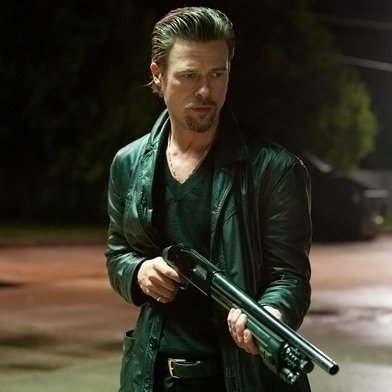
Jackie Cogan, played by Brad Pitt, is the hitman extrordinaire in 'Killing Them Softly.' |
In Andrew Dominik's "Killing Them Softly," an unrelentingly violent meditation on the world of contract killers, French art house meets Quentin Tarantino with a delirious swirl of über naturalism. Almost every assassination is accompanied by the sound of shattering bone. Then the camera switches to the morgue, where an identification tag is tied to the victim's toe.
Slow motion heightens the horror of the deed. But then, by now we're hip to the drill, understanding full well, as Mario Puzo put it in "The Godfather" I and II, that it's just business, and nothing personal. Whew, that kind of takes a load off my mind. But fact is, you can't view this without wondering just how intentional its gratuitous appeal is.
|
|
|
 |
|
| out of 4 | |||
Further confounding us, it's all done quite creatively, an avant-garde texture achieved via some very good performances. Between executions, as if flicked on like a light switch, the story's decidedly fringe personae engage in dialogue and soliloquy that, in addition to creating anticipatory tension, impart an oxymoronic humanity to the doings.
Brad Pitt's Jackie Cogan, who by all accounts is the hitman extraordinaire, tacitly takes hold of the narrative after some small-time desperadoes trying to steal from the big boys prompt his entrée. The physical embodiment of the story's juxtaposing bevy of contradictory elements, his devilishly good portrayal establishes an anarchical aura.
The film is profuse with unsavory people, starting with the most bottom-feeding of criminal elements with whom we're soon vicariously rubbing elbows. Thus it crosses one's mind that, unbeknownst to us, like aliens who metamorphose into human form, these sorts stealthily slither through our everyday lives. It gives you a case of the creeps.
Russell (Ben Mendelsohn) and Frankie (Scoot McNairy), young punks who've been in and out of the pokey since childhood, put the nasty gambit in motion when they bid for a heist planned by Johnny Amato. It's a card game run by Ray Liotta's Markie Trattman, a well liked hood known for his double-dealing ways. Well, you know what hits the fan.
To paraphrase Driver, an agent of those powers that be played by Richard Jenkins, it just doesn't look good if such lowlifes can invade crime's inner sanctums. Where's the justice? Meeting with Pitt's expediter, the lawyerly go-between discusses methodology and price whilst bemoaning the board-room mentality that now grips his higher-ups.
Pitt, who joins the ranks of big league movie hitmen with this splendid conjuration, etches his own niche. Shunning the anomalous compassion Jean Reno styled so well in "León: The Professional" (1994), his philosophical patter takes more of a world view. Suffering no fools, he is a pragmatist, and probably more antisocial than his employers.
Jackie talks economics and pooh-poohs the social contract as television coverage of the 2008 Presidential campaign spews from the backdrop in a cynical contrast implying some very disturbing beliefs. And as the panoply of human scourge is depicted, we remember Dante noted that the hottest place in Hell is reserved for those who stay neutral in a moral crisis.
Chilling via an equivocating pose that only serves to accent his sinister status, Jenkins is Driver, the buttoned-down middleman who connects the two, supposedly different worlds whose interests he facilitates. Perennially attired in a business suit and driving an executive sedan, his deadpan delivery suggests the Bob Newhart of villains.
Rounding out the troika of characters who populate this Chaucer-like parable of human greed and foibles is James Gandolfini as Mickey, the once great triggerman from out of town who Jackie subcontracts for a key assignment. Now part Pagliacci, but mostly buffoon, he is a jaded model of gluttony gone out of control, a study in pathos.
Truth is, there's nothing very pretty to look at here. Even the comedy relief, which comes only in thin strands of sarcastic observation, disallows any opportunity to let your guard down. This is an ugly world, not because it might exist alongside ours, but rather, because it strews through that which we have always assumed is free from harm and evil.
Thus, by design or not, the director has fashioned the filmic answer to the reversible jacket, offering a creative look at society's underbelly to the dilettante who might not always divert his eyes from a car accident, while providing unmitigated carnage for the bloodthirsty. You glance to the left, and then to the right, wondering who slots in where.
Nothing is sacred, not even Thomas Jefferson, who the normally terse Jackie makes the subject of a diatribe disdainfully meant to burst a bubble about the American dream. Distasteful stuff, albeit presented with artistic aplomb, "Killing Them Softly" refuses to let the viewer off easy as it loudly proffers its pessimistic thesis about human nature.
"Killing Them Softly," rated R, is a Weinstein Company release directed by Andrew Dominik and stars Brad Pitt, James Gandolfini and Richard Jenkins. Running time: 97 minutes