Q&A: From Teaching to Painting
|
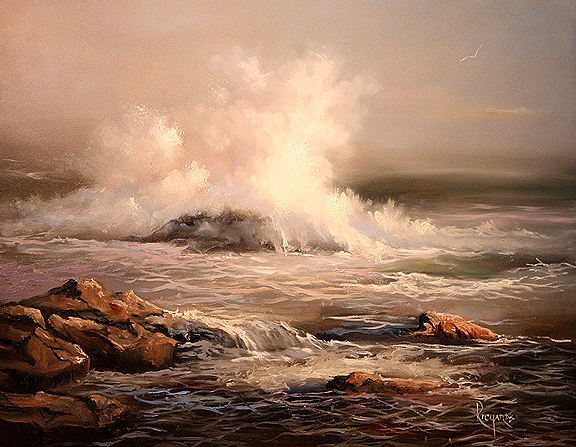
John Richards' 'Down East' of a spot in Acadia, Maine, is among his favorite works. Richards works mostly in still lifes of natural environments. |
WILLIAMSTOWN, Mass. — Works by well-known local painter John "Skeets" Richards Jr. are adorning the walls of the David & Joyce Milne Public Library through Feb. 28.
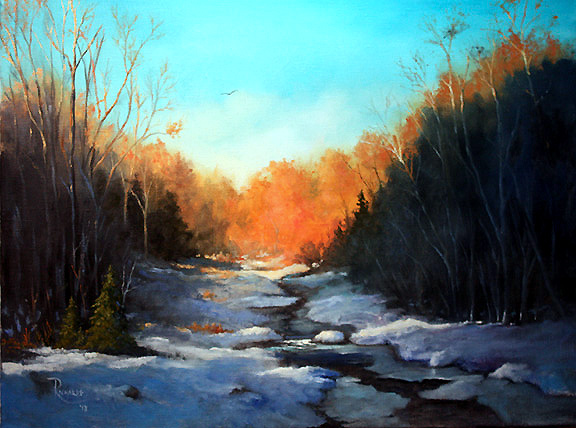
Part of the library's ongoing gallery series of local artists, Richards has turned blank canvases into beautiful still lifes, landscapes and seascapes.
The Adams native graduated with a degree in physics and master's in education from Massachusetts College of Liberal Arts and spent all but one of his 35 years in teaching at Drury High School, retiring on June 30, 2004.
Richards, who has resided in Williamstown together with his wife, Barbara, since 1972, recently answered questions iBerkshires posed about his transition from teacher to painter.
Question: When did you start painting?
Answer: I began painting in the mid-1980s. My desire to paint in oils began as a child but I did not think I had the talent to do it. Then in the mid-1980s, a television "how to" painter named Bill Alexander made painting in oil look easy and I decided to try it. (Alexander was the creator and host of the PBS series "The Magic World of Painting.")
Shortly afterwards, I became very interested in the landscape paintings of the Hudson River School Painters of the mid-1800s, including such artists as Frederic Church, George Inness and Albert Bierstadt.
Q: Was your artwork influenced by those Hudson River School Painters?
A: Their ability to portray nature as they saw it, a wondrous place with intricate details that man is subordinate to, was beyond compare. My style has evolved in this manner. I see nature as our home, a sacred place to be revered and not taken advantage of. You'll see virtually no semblance of modern technical life, such as cars, computers, skyscrapers, etc., in my paintings. I choose to paint scenes that portray serenity and quiet contemplation, much like the days of my youth in Adams. It was a time of dairy farms, Little League baseball, and walks in the wood with my dog.
Q: Are you self-taught or did you study with established artists?
A: I was self-taught until a couple of years ago when I started studying with Leah Lopez, one of America's premier still-life artists; Christopher Pierce, a leading floral still-life artist and Andrew Orr, Northern Vermont artist and member of the Salmagundi Club (a prestigious center in New York City for fine art and artists.)
Q: When and where was your first public showing, and what was it like preparing for it?
 A: At the Williams Inn way back in the early 1990s — it was an art show. The pieces were already completed so preparation was minimal. The solo exhibition I'm now preparing for will be at the Southern Vermont Arts Center in Manchester. I've had some successes there recently, having sold four pieces in the last three exhibitions I've entered. I have exhibited at The Lenox Gallery of Fine Art, Gallery Wright (Wilmington, Vt.), the Housatonic Valley Art League, the former Artisans of the Berkshires, the Deer Hill Inn (Vermont), the Bennington (Vt.) Center for the Arts, and presently have paintings on display at the Berkshire Emporium & Antiques in North Adams.
Q: Where do you create your art?
A: I paint in my studio, which is 12 by 20 room in my home.
Q: Do you work from life, photographs or from imagination?
A: I used to paint primarily from imagination but my studies with artists have taught me that painting from life is the best way to paint. I do use photos at times to supplement.
Q: Do you have a favorite piece of work?
A: My painting "Down East," a seascape of Acadia (Maine) is one of my favorites. I think that the reason I like "Down East" is the coloration and use of light. I rarely achieve what I'm looking for immediately but I did with this one. I'm also partial to the region near Acadia because my daughter and her family live there — we visit often.
Q: How do you choose colors to enhance a painting?
A: My palette consists of Titanium White, Naples Yellow, Cad Yellow Pale, Cad Yellow, Cad Yellow Deep, Cad Red, Alizarin Crimson, Burnt Sienna, Raw Umber, Ultramarine Blue, and Ivory Black. I rarely use a manufactured green, preferring instead to mix my own. Depending upon the painting I'm working on, I might use all of the above colors or just some, with all else being mixes of the above.
Q: What is most important to you when you are creating a painting — the subject or the way it is executed?
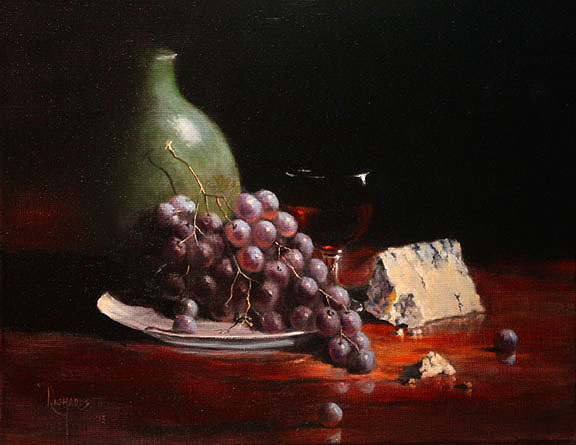 A: For me, execution and portrayal of light are most important
Q: Do you follow a routine?
A: I paint nearly every day and frequently begin early in the morning — as early as 4 a.m. How long I paint depends upon how the painting is progressing. I am getting ready for a solo exhibition which will require 20 to 30 pieces, so I am working more with that in mind.
Q: Do you ever become dissatisfied with the way a painting is going and start over?
A: Yes ... some paintings just don't want to cooperate and I get very dissatisfied. These are ones which Andrew Orr says belong in the "burn pile."
Q: What is the most satisfying aspect of the painting process?
A: The most satisfying aspect is twofold: first, the completion of a created piece which pleases me ... and second, knowing that someone likes the piece enough to purchase it and hang it in their home. Presently, I have paintings for sale at the Berkshire Emporium & Antiques, on Main Street in North Adams and at various exhibits at the Southern Vermonts Art Center in Manchester, Vt.
More of Richards' work can be seen at www.jrichardsjr.com.
Tags: artists studios, Milne Library, Q&A,