Naumkeag Gardens Getting $2.6M Restoration
 |
|
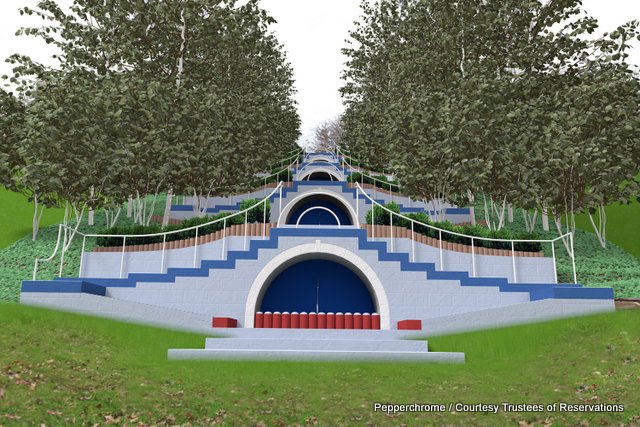 |
The Blue Steps at Naumkeag are being restored, left, as part of a $2.6 million make over of its historic gardens. |
STOCKBRIDGE, Mass. — The first phase of a $2.6-million five-phase restoration effort began last month on the gardens of the hillside estate of Naumkeag.
Visited by thousands of garden, landscape and history enthusiasts each year, the gardens are considered a masterpiece of 30 years of collaborative, creative work between former owner Mabel Choate and America's first modern landscape architect, Fletcher Steele.
The restoration effort is being supported in part by an anonymous donor who has pledged to match up to $1 million in donations.
The initial work includes removal of damaged and overgrown trees, including along the Linden Allee, a pathway modeled after the wooded walks of Germany. Following the removal of the older trees, more than 250 trees of various shapes and sizes will be planted amongst the gardens, following Steele's original tactic of overplanting to create a fuller, richer g gardenscape.
All of the trees and plants are being removed by Mayer Tree Service, processed on site and delivered to recycling facilities and timber mills in the area.
The 125-year-old Naumkeag — a National Historic Landmark owned by The Trustees of Reservations — is a 44-room estate designed by McKim, Mead & White as the summer home of New York attorney Joseph Hodges Choate, an ambassador to the Court of St. James, and his wife, Caroline Sterling Choate, an artist and co-founder of Barnard College. Their daughter Mabel inherited the 46-acre estate in 1929.
A recent video created by the Library of American Landscape History (below) described Naumkeag's gardens as "a playground for the imagination which boasts some of the most vibrant, original and luminous gardens on the North American continent."
The gardens are about to undergo a renaissance under the preservation efforts being lead by Trustees' Cultural Resources Program Director Cindy Brockway and Statewide Curator and West Region Cultural Resources Manager Mark Wilson, and supported by a team of staff, volunteers, artisans and consultants.
Over the last 10 years, several of Naumkeag's signature garden areas, including the Peony Terrace, Chinese Temple and Evergreen Garden, have been restored. But additional aspects of the garden have suffered the effects of time as well as damage from the harsh New England weather. Original plantings have aged or disappeared, trees have become unhealthy and overgrown resulting in obstructed views and certain structural and design features have deteriorated. As a result, The Trustees are increasing the pace of their restoration efforts to bring all eight landscaped acres surrounding Naumkeag back to their former brilliance and original design over the next three years.
"Few properties in the country reflect the American transition to French Modernism better than Naumkeag," said Brockway in a statement. "But after more than 50 years, the gardens need a refresh and a rejuvenation of the intricate details of scale, furnishings and plantings that made Naumkeag a work of fine art. By the end of the project, few landscapes in the country will have seen such a detailed restoration."
Perhaps the most dramatic restoration to occur this spring will be that of Steele's renowned Blue Steps, one of the most famous and photographed garden features in 20th-century American landscape design and a true expression of Steele's belief that garden design should be considered one of the fine arts. The steps be repointed, repainted and re-grouted, and the iconic white birch trees that frame them will be replaced and supplemented with the planting of 40 additional trees.
Phase one is expected to be completed in time for a summer party to officially kick off the restoration project and celebrate the Blue Steps' 75th anniversary.
Other structural, cultural and natural garden and landscape features located throughout Naumkeag will also be restored, replicated and reinvigorated through a total of 16 projects, most of which will include rebuilding, and in some cases reproducing, foundational elements such as fountains and waters systems, masonry, decorative arts and original plantings. The restorations are being based on the original plans, historic photos and other documents.
"Like our recent landscape restoration of the Grand Allée at Castle Hill, we take our responsibility as caretakers of these magnificent National Historic Landmarks very seriously," said Trustees President Barbara Erickson. "The iconic gardens at Naumkeag are one of only a few Fletcher Steele-designed gardens viewable to the public and we want people to be able to experience them in their full and original brilliance."
Tags: gardens, historic preservation, Trustees of Reservations,