Pittsfield PILOT Group Examining Role of Nonprofits
|
Representatives from finance, government, business and nonprofts are looking at a possible program for nonprofits to make payments in lieu of taxes. |
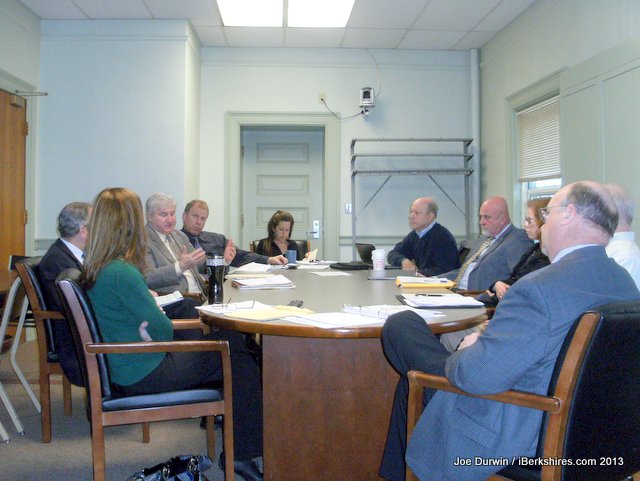
PITTSFIELD, Mass. — Assessing the impact of nonprofit institutions and exploring potential avenues for increasing financial support of city operations are among the goals of a new task force modeled loosely on a program initiated in Boston two years ago.
The new PILOT Study Group, which convened for the first time this week, brings together city officials with representatives of the business and nonprofit community to examine the feasibility of implementing something akin to the "Payment in Lieu of Taxes" program that has so far brought in tens of millions a year in additional revenue in the state capital.
Members of the body also expressed hope their study will create a clearer picture of what economic and social impact different types of nonprofits currently have in the city.
Mayor Daniel Bianchi said he anticipated that part of the group's process would begin by looking at what other communities have done.
"That's not to suggest that we have to follow any models of any other communities," he said on Tuesday. "I know some PILOT programs are very informal, some are structured, and some are more of a handshake."
According to a report by the Lincoln Land Institute, at least 127 municipalities in 18 states have collected payment in lieu of taxes from some nonprofits, with PILOT programs popping up in a steadily growing number of locations particularly in the Northeast since the 2008 start of the recession. More than two-thirds of these are in Massachusetts, in 82 out of 351 communities receiving PILOTs.
City Councilor Melissa Mazzeo, who serves on the new temporary committee and co-sponsored the push for this effort with Councilor John Krol, said part of the impetus for exploring this concept arose out of feedback from residents about how the city budget is funded following recent public discussion of Pittsfield's struggling tax base.
"There's so much misinformation that's out there," said Mazzeo, citing a need to gather a comprehensive base of data about local nonprofits' in kind contributions "so people will know what we have in our community... and I think when we're all done, we're going to find that there are nonprofits that do have monetary contributions they're willing to make."
"This should start by identifying the base of all nonprofits in the city," said member Raymond Costello, who retired from the financial field. "How many do we have, and how much, if any, do they contribute, in terms of dollars. That's part of what we need to know."
Berkshire Chamber of Commerce President Michael Supranowicz will present much of the desired information at the group's second meeting later this month, though he emphasized that it will be a different picture than that of the Boston framework that inspired this process.
Whereas 52 percent of land in Boston is tax exempt, in Pittsfield the proportion is about 17 percent. Supranowicz said most of this $3.8 billion in land consists of city, state or federal property, including all parks, schools, municipal buildings. Some 1.5 percent is owned by religious organizations and 2.6 percent by 501(c)3 charitable organizations, who combined own about $158 million worth of land at 2012 assessments.
Nonprofit representatives in the group pointed out that while their organizations may not contribute to the local tax base directly, in some cases their economic impact and services to the community are far larger than the dollars they would pay in property taxes.
"I think that the idea behind a nonprofit is to build a certain kind of social capital, whether it's a church congregation, or the arts community, or affordable health care," said Van Shields, director of the Berkshire Museum. "It's the idea that there is a product, but it's not for personal profit for shareholders or owners."
"What makes you a charitable organization is your purpose," said Darlen Rodowicz, chief financial officer of Berkshire Health System, citing the local health-care nonprofit as an example. "Our mission is to take care of anyone in Berkshire County, regardless of ability to pay. That line on our mission statement is what makes us a charitable organization."
Supranowicz said just the payroll from employees in the health-care system supported another 2,100 jobs in Berkshire County.
"In the cultural arts organizations in Pittsfield, we have the highest per capita expenditures in the nation, second only to Washington D.C.," he also noted. "That means they're putting more money back into our community per resident than any other place in the United States [after Washington]."
This sector in particular appears to have experienced the largest growth in the city in recent years. A study released last year by Americans for the Arts estimated that the amount of economic activity associated with cultural activity had increased by 40 percent from 2005 to 2010, to around $25 million a year, and about $2.2 million in government revenue.
In addition to more of this kind of data, the committee will also look to incorporate advice from the city solicitor and examine the current two organizations with which the city already has PILOT arrangements from deals struck long ago.
At the end of the process, any new monetary payments to the city made by any local nonprofit organizations would be entirely on a voluntary basis.
"We can't force anyone to do anything," stressed Costello.
Tags: nonprofits, PILOT, task force,