Patrick Joins Wildlife Officials for Black Bear Survey
 |
|
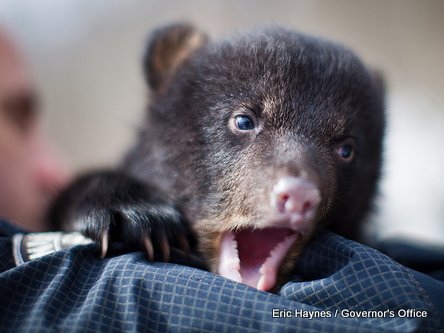 |
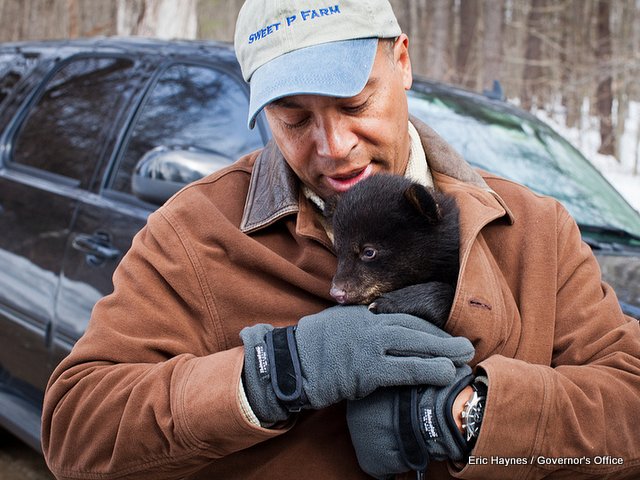
Gov. Deval Patrick holds a cub during Monday morning's expedition to count some of the newest members of the bear population. See more photos on the governor's Flickr page. |
CONWAY, Mass. — In what has become an annual tradition, Gov. Deval Patrick aided in the black bear count on Monday morning.
The governor joined with Secretary of Energy and Environmental Affairs Rick Sullivan, Department of Fish and Game Commissioner Mary Griffin and state wildlife officials on an expedition around South Deerfield and Conway to document the newest members of the state's black bear population.
The team discovered two cubs born approximately four to six weeks ago. The cubs, both male, weighed in at approximately 6 pounds. Based on last year's breeding status, the Conway bear is one of 16 radio-collared sows believed to have given birth this winter.
While newborn cubs are too small to tag or collar, MassWildlife [Division of Fisheries and Wildlife] records each cub's physical condition, weight and gender. Biologists also check the physical condition of mother bears, as well as the condition and fit of their radio collars.
Information gathered at the den in Conway on Monday adds to that compiled through one of longest, continuous studies of black bears in the United States. MassWildlife began the study with the Massachusetts Cooperative Wildlife Research Unit at the University of Massachusetts in Amherst in 1970.
MassWildlife has been solely responsible for the project since 1999 and is currently examining reproductive success, cub survival, adult female survival and human-bear interactions. Numbering only about 100 bears when the study began, the Massachusetts black bear population has grown to approximately 3,000 today.
Although black bears are becoming more common in central Massachusetts and are occasionally sighted in eastern communities, most of MassWildlife's bear research takes place west of the Connecticut River. With the aid of radio telemetry, MassWildlife is currently tracking 16 female bears, also known as sows, to determine adult female survival and cub production and survival — key components of the division's black bear population model. MassWildlife does not collar male bears, but ear-tags them to provide future knowledge about survival and movement.
Contrary to popular belief, black bears don't go into true hibernation in winter. Rather, they sleep soundly in their dens from November or December until early March to mid-April, but may wake up to forage in mild weather.
Black bears are found in 43 states. Those in Massachusetts average 230 pounds for males and 140 pounds for females. They are omnivores — eating a variety of foods from vegetation and berries to grubs, insects and carrion — and are excellent climbers, frequently using trees to rest and to protect their young. Black bears mate between mid-June and mid-July and cubs are born in mid- to late-January. Cubs remain in the den until April and stay with their mother for about 17 months. Females typically have their first litter when they are 3 to 4 years old.
More on the state's black bears can be found at MassWildlife.
Tags: bears, MassWildlife,