Public Safety Secretary Hears Berkshire Problems
|
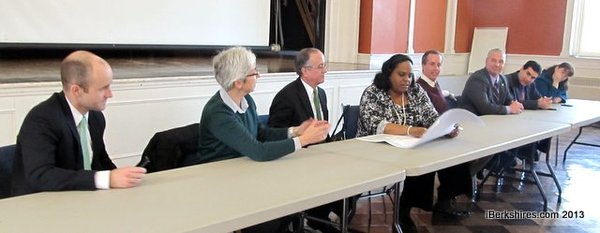
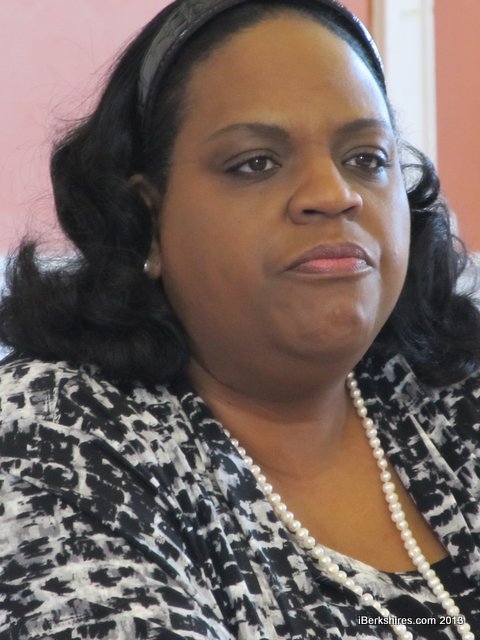
Public Safety Secretary Andrea Cabral heard from local officials and law enforcement. Rep. Smitty Pignatelli suggested she ride along with local police sometime to 'see the other side of the Berkshires.' |
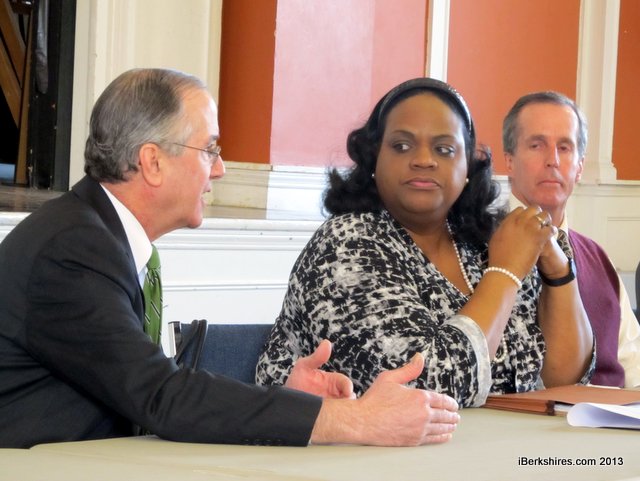
LENOX, Mass. — New Public Safety Secretary Andrea Cabral's first meeting with law enforcement and inspectors in Berkshires was "an eye-opener."
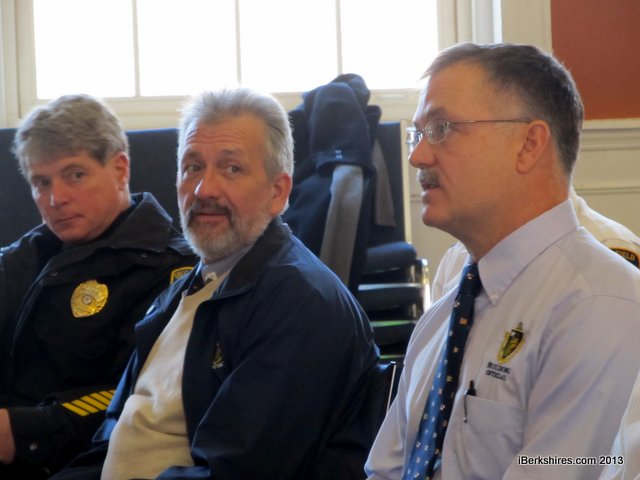
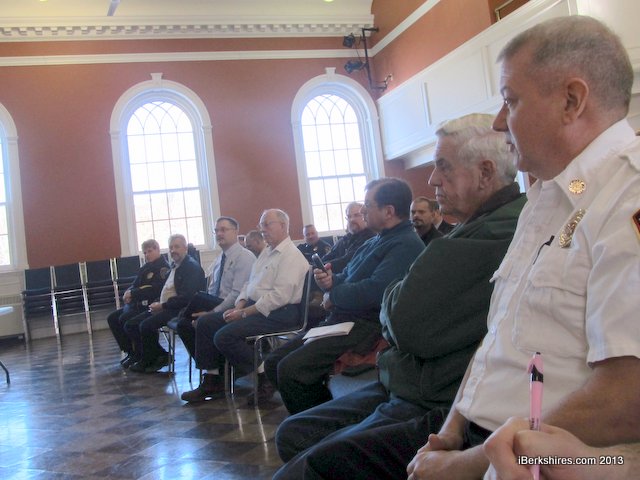
Fire, police chiefs and others spent an nearly two hours with the former Suffolk County sheriff last week to explain the difficulties they have with communications, training, jurisdiction and funding in the largely rural district.
Cabral was responsive to the concerns, asking for more detail and frequently telling them to send her information. At the end of the meeting, she said training and education, review of a contract with Verizon for communications, inspection data and the funding for the county's drug task force had made her priority list.
She said she was not unaware of the difficulties in the rural region through her contacts with state Rep. William "Smitty" Pignatelli, D-Lenox, who hosted the roundtable at Town Hall, and Sheriff Tom Bowler. Still, it was good to hear firsthand that the Berkshires wasn't all vacationland.
"This was a real eye-opener. I'm learning every single day what it means to be doing public safety across the state," she said. "That means you have to go and get to know the areas of the state and not make asumptions based on the area of the state you lived in as to what their issues are."
The Berkshires' geography and rural character has towns with no police force, three or four hundred residents and all-volunteer fire companies; at the other end of the spectrum is a city of of 40,000 — three times the size of the next largest community.
"We're a lot different than the rest of the state," said Pittsfield Mayor Daniel Bianchi. "We're small communities out here and rather isolated. ... Oftentimes we've got to collaborate as agencies to get things done."
Large swaths of the county may have minimal or no police coverage but acting regional in this instance can be difficult.
District Attorney David F. Capeless said officers must see a crime being committed to cross jurisdictions, but that wouldn't apply, for example, if the officer was following a driver he or she believed was under the influence who then crossed into the next town. They'd have to call the police in that jurisdiction — who may be part time or nonexistent.
"We shouldn't have to fight to provide regional aid," said Pittsfield Police Chief Michael Wynn. The towns use workaround for mutual aid but are hoping legislation will clarify the issue, he said. Bills have been filed numerous times with no results.
Cabral agreed "there's always an apprehension in regard to encrouchment" of jurisdiction but hadn't been aware it was an issue for Western Mass.
For both police and fire chiefs, training is expensive and time-consuming in terms of commutes out of the area, overtime to replace them and training and certification that run into the thousands of dollars.
Pignatelli said all but one of the 20 towns in his district has all-volunteer fire companies. Local businesses have been supportive in giving time for volunteers to respond to emergencies but taking four or five hours for training puts a burden on them, he said.
"We need dedicated funding for training," said Wynn.
"It can't be just a problem here, there are firefighters across the state, there are police officers across the state," said Cabral, who added she was working to develop a peace officer training schedule. "The lack of dedicated funding concerns me significantly."
Donald Torrico, building commissioner for Tyringham and Monterey, noted that the police and fire have academies "but we have nothing. ... We are having a real issue with education."
 |
|
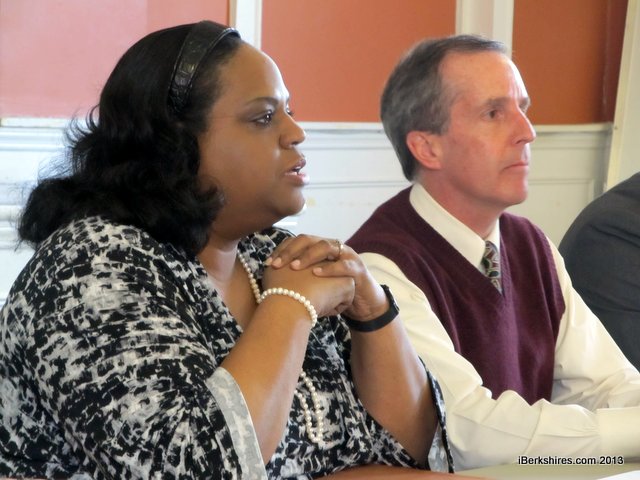
| Cabral asked for more information on a number of issues, including the online permitting process being used by a cooperative of towns. |
 |
A lot of building inspectors are part time and have to take time off work for education, and for some that means missing time as contractors for certification at a job that pays half as much.
Internet education was advocated for as much training as possible for training in all cases, allowing courses to be completed on the job or evenings as convenient, with out-of-area courses focused on hands-on training or testing.
Smaller departments and communities also run into challenges not only in searching out and writing grants, but having the infrastructure in place to implement grant-funded initiatives.
"We need a little bit of flexibility and understanding of the size of our staffs," said Wynn. "There's an assumption that our communities have those resources in place and the regionalization would supplement them."
Cabral compared it to the question of the chicken and the egg: "You're trying to give money to supplement or shore up infrastructure that you find doesn't exist."
She later said, "I think you can scale and have a small-town component of the same grant that is scaled to the population and the other sort of demographics."
There are some bright spots in which the Berkshire County is collaborating in innovative ways to do more with less, such as the Berkshire County Drug Task Force, which Capeless on the spot renamed the Berkshire County Law Enforcement Task Force because its scope has expanded, including its investigations into 11 recent homicides.
The task force is funded through a grant that pays the overtime for local officers assigned to the task force, relieving the cost burden on towns while training officers. "We have a model, and a model that works," said Capeless.
Building inspectors in more than a half-dozen towns have also teamed up to offer permit applications online through a paid service. Cabral thought that was opportunity for the state to step in to provide server backup and negotiate with the vendor, especially since some of towns felt the "buy in" was too steep.
The new secretary told those gathered that her office wanted to help as much as possible, seeing the prospects of regionalization of some services and in providing technical assistance.
"I also heard an enormous spirit of collaboration and cooperation and wanting to be at the table," said Cabral. "I can speak better for Berkshire County tomorrow than I could speak for Berkshire County today."
 |
 |
 |
Tags: public safety, state officials,