Mount Greylock Asking Williamstown for a Little Extra
 |
|||||||||||||
|
The School Committee held a public hearing on the 2014 budget. Williamstown's costs will drop while Lanesborough's will rise. | ||||||||||||
WILLIAMSTOWN, Mass. — The Mount Greylock Regional School Committee on Tuesday decided to ask Williamstown to pay more than its assessment to the two-town junior/senior high school district.
The committee held a public hearing on its proposed fiscal 2014 budget, and that plan includes a reduction of just more than 1 percent in the amount assessed to Williamstown, which shares the Grades 7-through-12 school with Lanesborough.
However, two members of the Williamstown Finance Committee, who attended Tuesday's hearing, confirmed that town revenues for FY14 are expected to rise by 2.4 percent.
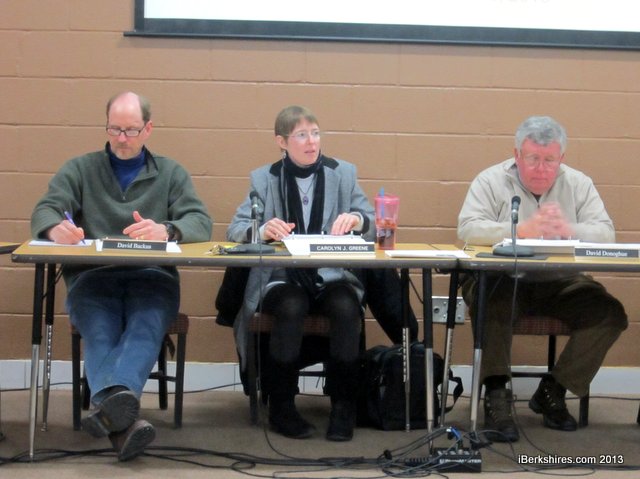
That led School Committee Chairwoman Carolyn Greene to suggest that the district ask Williamstown voters to appropriate the same 2.4 percent bump the town is allotting to other "cost centers," including the elementary school.
"It's actually $110 (the 2.4 percent hike) plus the $50,000 we're decreasing [the assessment]," Greene said. "We talked about it with [Finance Committee Chairman] Charles Fox and Paula Consolini and brought up the idea of a separate warrant article to take that sum. ... I think the Finance Committee in Williamstown is tentatively amenable to that.
"We'd obviously want to talk to [district] legal counsel and town counsel."
The rub is that even if the voters of Williamstown wanted to approve the expenditure, it was not immediately clear on Tuesday night whether the district could accept it.
Massachusetts law dictates how multi-town districts can be funded. The assessments are triggered by a formula that takes into account enrollment and the equalized valuation of property. By a district agreement, Mount Greylock uses a four-year rolling average for the enrollment piece of the equation.
As the figures broke down this year, Lanesborough's assessment is expected to rise by about 1.3 percent, to $2.55 million from $2.52 million for FY13.
Williamstown's assessment under the proposed budget is , a drop of just more than 1 percent from the FY13 assessment of .
The budget for the district ultimately rests on the vote of each town's town meeting.
The proposed additional warrant article for the Williamstown voters will be discussed on Thursday when the school district presents its proposed budget to the town Finance Committee at Town Hall.
If the district wants a chance to ask for that additional $160,000, the clock is ticking. Fox told the school board on Tuesday night that Williamstown hopes to have its preliminary warrant document passed out of committee at its March 28 meeting.
Originally, Greene suggested that the committee ask for money from the town to cover some of the expense the district will need for a feasability study on the 1961 building. The committee on Tuesday formally voted to send its latest "Statement of Interest" to the Massachusetts School Building Authority. If the MSBA invites Mount Greylock to join its funding program, the district's first order of business would be to order such a feasibility study.
Estimates for the cost of the study have ranged from $600,000 to $750,000. The cost would be borne by the two towns and the district itself.
After some discussion, the committee decided instead to propose that Williamstown voters be asked to appropriate the sum to go toward the district's capital budget — specifically outstanding debts for a new boiler and repairs to the building's roof and locker rooms. If some of those bills can be paid by another means, it would free up money in the school district's operating budget to pay its share of a possible feasability study.
The question of whether that money is available hinges on two things: the law and the will of the voters.
"My biggest fear is we end up doing this thing to the point where we do it and we get to the [state] audit and the auditor says you can't do it," committee member Robert Ericson said.
As for the budget as it is drafted, the district plans to spend $10.5 million in FY14, a rise of about $220,000 from its FY13 spending levels. There is a funding gap that can be closed by using "non-appropriated revolving funds," namely the school's excess and deficiency funds and FY14 school choice revenues, according to Superintendent Rose Ellis and Business Manager David Donoghue, who presented the budget. Excess and deficiency funds are, essentially, a surplus account and the equivalent of "free cash" in town bookkeeping parlance.
|
Superintendent Rose Ellis said the budget includes additional positions in guidance and special education. |
The budget allocations for FY14 are largely similar to those from FY13, with some increased staffing.
The budget proposes a net increase of about 2.5 full-time equivalent employees (or FTEs), with the largest increase being an additoinal full-time position in special education and more hours allotted to science, world languages, and visual and performing arts. The English/reading department would see a slight decrease in staffing, from 9.6 FTEs to 9.0 under the proposed budget.
The budget also adds a part-time support staff position in the main office and a full-time position in the guidance office.
"We've been talking about how to support the guidance department," Ellis said. "We used to have three counselors and two secretaries. Three years ago, we reduced one of those positions. We'd like to bring it back but completely redefine it."
The new proposed position would be called a student data coordinator, which Ellis characterized as a "hybrid secretary" budgeted at $25,000 per year. The new position would help facilitate student data collection and help the school make the most of its PowerSchool information software.
In other business on Tuesday, the board heard reports from the Tri-District's curriculum, instruction and asssessment coordinator about an outside assessment of Mount Greylock's science program and an internal effort to coordinate arts instruction at Mount Greylock, Williamstown Elementary and Lanesborough Elementary.
Greene also brought her colleagues up to speed on the activities of the committee charged with studying whether to invite both town's elementary schools into the Mount Greylock distrct. She reported that the Regional District Amendment Committee has been broken into four task groups.
McDonald, Ellis and teachers Lyndon Moors (MG), Stacy Parsons (LES) and Tricia Bitteker (WES) are working on a task group to look at the potential impact of greater regionalization on curriculum. WES Committee Chairwoman Margaret McComish is working with Mount Greylock Committee member Chris Dodig and Williamstown Selectman Ronald Turbin on legal questions (both Dodig and Turbin are attorneys). WES Committee member Dan Caplinger, Lanesborough Finance Committee Al Terranova and Donoghue are looking at finances. And Greene, Consolini, LES Committee member James Moriarty, and Moors are working on community relations.
Dodig noted that the March 18 meeting of the RDAC was attended by representatives from New Ashford and Hancock; both towns tuition their students into Mount Greylock but are not part of the district. Ellis said it is not clear what level of interest either town has in being invited for formally join the district.
Tags: fiscal 2014, MGRHS, school budget,