Environmental Action Group To Identify Roadkill Hot Spots
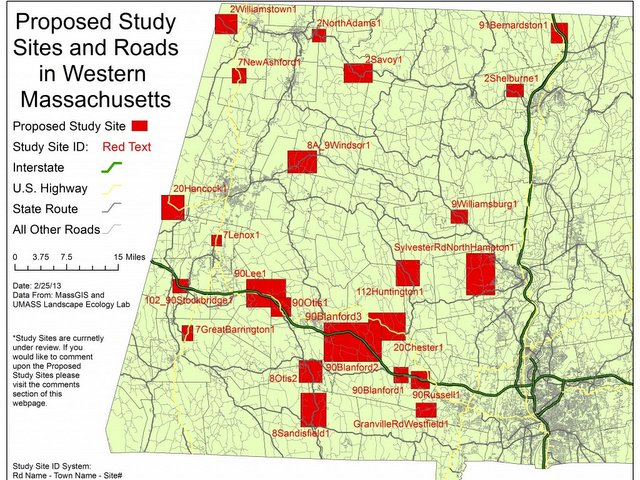
Data collected from MassGIS and the University of Massachusetts' Landscape Ecology Lab has identified some animal crossing hotspots but BEAT wants residents to help pinpoint locations. |
PITTSFIELD, Mass. — The Berkshire Environmental Action Teams wants to find some roadkill.
The organization is embarking on a project to identify where in Western Massachusetts wildlife are crossing roadways in hopes to improve those crossings for the safety of both drivers and the animals.
On Monday, the group will host a public meeting at Berkshire Community College to solicit information from those with on-the-ground knowledge of where wild animals are getting hit the most.
"The first meeting is introducing it to the public. We're trying to get people to talk to us about where they see roadkill hot spots," Elia Del Molino, program manager for Connecting for Wildlife, said on Friday.
The group already has maps identifying where the animals are likely to cross but Del Molino said a few of those areas near where he lives were slightly off. The project looks from I-91 west, so that inherent knowledge is important toward helping fix the problem.
Some estimates put the deaths of animals on the nation's roadways at up to 400 million a year. The U.S. Federal Highway Administration's most recent Wildlife-Vehicle Collision Reduction Study found "road mortality" as the main threat to 21 recognized endangered or threatened species. At least 300,000 collisions with larger animals are reported each year.
According to the state Department of Transportation, most "state-listed reptiles and amphibians are more likely to need accommodation than other species" because their habitats in uplands and wetlands are most likely to be separated by roads.
In another month of so, the group will be doing hands-on surveying of nearly 30 sites where improvements could be made and later they hope — provided grant funding continues — to hire engineers to recommend roadway improvements.
"In some places we can't do anything but in others it is as simple as cutting back vegetation so drivers can see them," Del Molino said. For smaller creatures, accessible culverts under the roads maybe too small and often flooded. Those can be enlarged: "The goal is to create a culvert that won't flood."
But building overpasses as has been done elsewhere is currently out of the question.
The improvements will be "site specific" depending on what the study finds, said Del Molino, and the information will be passed on to the state for future projects.
Additionally, the group is creating an online database for residents to add to when they see roadkill. That data will culminate over time to identify changes in crossings and crossings they may have missed.
The project is funded by the William P. Wharton Trust but Del Molino says the group will need more funding to complete the entire plan. Eventually, he would like to see the rest of New England embark on similar studies.
Monday's meeting starts at 6 p.m.
Tags: environment, roads, wild animals,