Emotions Run High at Williamstown TV Forum
|
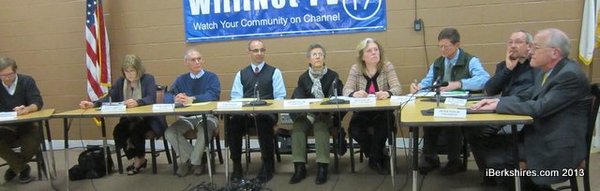
Residents line up to comment or ask questions about the controversy over affordable housing development and land conservation. The forum was aired WilliNet and will be repeated on Channel 16. |
WILLIAMSTOWN, Mass. — Tremus Thompson knows she cannot keep her home, but she would like nothing more than to stay in her adopted hometown.
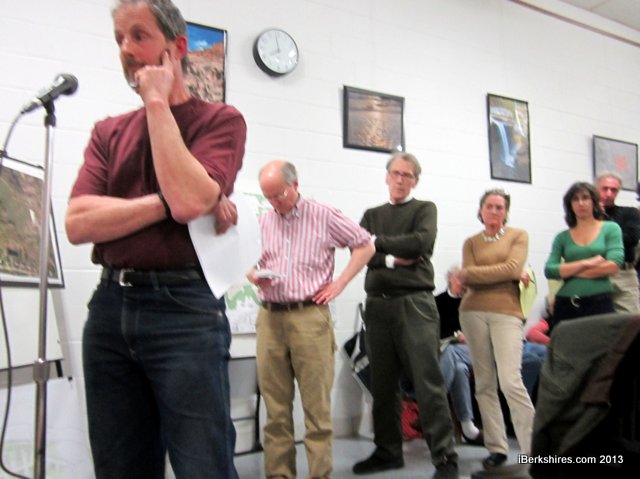
Thompson was one of more than a dozen residents who lined up to address a panel of town leaders in a community conversation sponsored by the local community access television station on Wednesday night.
She has lived in the Spruces Mobile Home Park since 2010, one year before Tropical Storm Irene wiped out more than half the park and started the town on the road to a federal flood mitigation grant that ultimately will close down the rest. Thompson is among the 66 residents who will be removed as a condition of the FEMA grant if, as expected, the town and landowner Morgan Management accept the money.
On Wednesday, she told her story to a jam-packed meeting room at Mount Greylock Regional High School and a live television audience.
"I am one of the families that lost everything," said Thompson, who appeared to hold back tears through much of her remarks. "I believe I saved a couple of pots and pans. ... I believe that taking 10 acres in a safe area - not trying to obscure anyone's view ... I'd like to go out and rake my lawn and plant my vegetables. I'd like to go to my neighbor's house and mow her lawn because she's feeble and can't do it. That's the kind of community we lived in.
"I fell in love with Williamstown, and I don't want to leave it. I'm sorry it's caused so much tragedy for you all that you have to think about, 'I don't want to lose 10 acres,' or 'I want to hay there.'
"I want to stay here, but I don't want to stay here if I'm not wanted."
There was a plenty of anger and frustration on all sides of the issues being discussed at Wednesday's event, but no moment was more emotional than Thompson's appearance at the microphone.
After the meeting let out, she talked about just why she is so emotional about Williamstown.
"The thing that sold me wasn't the Spruces," said Thompson, who moved here from Greenfield with her husband. "The thing that sold me was the police department."
It was October 2010, 10 months before Irene changed life forever for Spruces residents, and Thompson was taking her grandchildren trick-or-treating in a Williamstown neighborhood.
"The police were everywhere," she said. "They were riding around very slowly, shining flashlights, talking to the children. It was amazing how they made you feel so comfortable and safe.
"My daughter and I had never lived in a town like this. And I've lived in some towns."
On Wednesday, April 24, her town will decide whether it wants to make available 10 acres on town-owned land for potential development of subsidized housing that would allow residents like Thompson to have their gardens. The catch is that the land already is producing food — hay that helps keep one of the region's dwindling number of working farms in business.
" 'It's just a hayfield,' some say," Agriculture Commission Chairwoman Beth Phelps said during the panel discussion. " 'It's just 10 acres.' That hayfield is part of the larger circle of life. ... Ten acres supports 3.5 beef cows for a year. Three-point-five beef cows feed 81 people in a year."
The conflict between preserving open space and addressing the town's well-established need for affordable housing has dominated the political conversation in town since last November. That is when Town Manager Peter Fohlin announced the town's application for the FEMA grant and its intention to use part of the money to help develop the 30-acre, so-called Lowry property off Stratton Road.
Advocates of keeping the Lowry parcel in conservation garnered enough signatures on a petition for a special town meeting to force the question of whether the land can be developed. WilliNet, the community access TV station, organized Wednesday's event to help educate the electorate two weeks before that meeting.
|
Conservation Commission member Sarah Gardner said those trying to save farmland were not against affordable housing. |
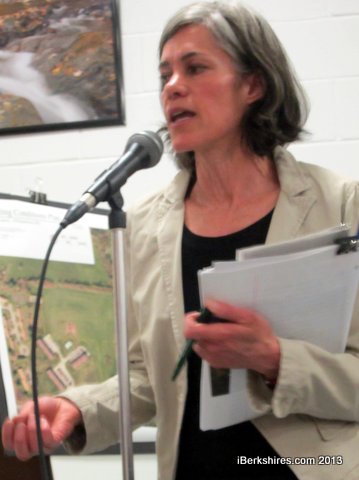
Phelps was by no means alone in advocating to continue the protected status of the Lowry property. Among the speakers who rose from the audience to question the wisdom of development was Sarah Gardner, a member of the town's Conservation Commission, which will take up the issue of the Lowry property in a joint meeting with the Select Board on April 18.
"The vast majority of people in the town are in favor of affordable housing," Gardner said. "I'm tired of hearing the suggestion that those of us who are not in favor of developing farmland are against affordable housing."
Gardner was one of several people in the room pushing for the town to develop housing on brownfield sites — like the former town garage site on Water Street and the former PhoTech site on Cole Avenue — before considering the use of agricultural land.
"I wish we could put Lowry aside for now, and then we could put all of our energy toward developing sites in town," Gardner said.
The chairman of the Affordable Housing Committee and other town officials stressed repeatedly that every town-owned site that can be used for housing is being considered, including the town garage site, which is, perhaps, the most "shovel-ready" site.
"At this point, we don't have specific plans for any site," Catherine Yamamoto said. "We're trying to move them all forward.
"It's not one site versus another site. It's not one site and forget the rest. It's all the sites."
Selectmen Chairman David Rempell took several opportunities to hammer away at the theme that town officials would rather take the Lowry issue to the voters after taking more time to study possibilities on every site, including Lowry and the larger town-owned Burbank property.
But with a special town meeting looming that could forever put Lowry and Burbank off-limits to development, officials are forced to make the best case they can make.
"It is my hope that these available properties can all be assessed," Rempell said. "I would hate to have us remove any of them from the table before we can find out what they can do or might not be able to do. The questions we'll face at the special town meeting on April 24 are going to address how many of these potential properties we can look at and evaluate."
Affordable Housing Trust Chairman Stanley Parese, who made some of the evening's strongest comments, came out and said his aim was to be blunt on the issue.
"We're a community facing a defining moment," he said. "It's not a time to be delicate. It's not a time to be malicious with each other, but [Irene] was not delicate. ... At the end of the day, we will be defined as a community by how we respond."
While Parese strove to keep the focus on the crisis arising from Irene, Main Street resident Tad Ames, whose home overlooks the Spruces, had another take on the concept of crisis and how the Lowry property figures in.
"Conservation is about people," said Ames, who works for the Berkshire Natural Resources Council but was speaking as a private citizen. "It's about clean water, hazard mitigation and growing nutritious food. The Lowry property has prime agricultural soils, the likes of which are being paved over across the country. ... The food supply is a slow-motion crisis. We don't see it because it doesn't have the acute impact of the flood at the Spruces.
"But food and shelter are moral human needs and imperatives for the community. I believe our community can do both."
What was clear at the end of Wednesday's meeting before a standing-room-only crowd was that the community still is not united on how it can do both.
"I'm paraphrasing, but someone said that tragedy is not the conflict of good with evil but the conflict of good with good," Stratton Road resident Anne Skinner said on Wednesday. "It will be impossible to please everyone, but we'll have to see what we can do."
Tags: affordable housing, conserved land, public forum, Spruces,