Williamstown Commission Awaits Opinion on Land Transfer
|
The Conservation Commission approved plans for a Dollar General but have stayed silent on the Lowry land controversy pending guidance from the state. |
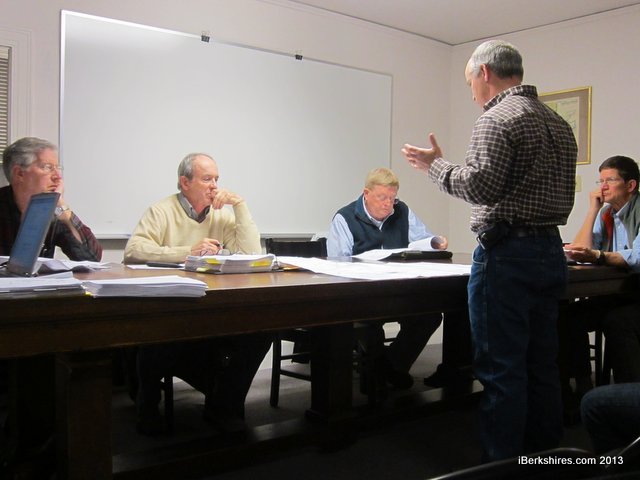
WILLIAMSTOWN, Mass. — The chairman of the Conservation Commission is not saying publicly whether he thinks the town should vote to take a town-owned parcel out of conservation for the purpose of building affordable housing.
But Hank Art is saying he is not sure whether the town can make that choice.
At Thursday's meeting, the panel discussed its efforts to seek clarity on the question of whether the 30-acre Lowry property is covered by Article 97 of the state's constitution.
On March 21, four months after the Board of Selectmen received an opinion from town counsel advising that the land is not covered by Article 97, the Con Comm has contacted the state Executive Office of Energy and Environmental Affairs seeking clarification.
In a letter drafted by Town Conservation Agent Andrew Groff, who staffs the committee, the commissioners asked the EOEEA's Irene Del Bono for "confirmation of [town counsel's] determination from your office."
"So far, we have heard nothing?" Art asked Groff on Thursday evening.
"Correct," Groff replied.
The Article 97 question is significant in light of the looming special town meetings on Wednesday, April 24, at Mount Greylock Regional High School. On that night, the town will face three questions on separate warrant articles dealing with the future of the Lowry property. One will ask whether the town wants that future to be decided by a simple majority rather than a two-thirds "super majority;" the other two ask whether a third of the property should be turned over to the Selectmen exclusively for development of subsidized housing or should all of Lowry (and the much larger Burbank property) be held on conservation "in perpetuity."
If Town Counsel Joel Bard of the Boston firm Kopelman & Paige is wrong, then a vote to transfer Lowry out of conservation on April 24 could be successfully challenged in court.
Abutters to the Lowry property, who have spent the last five months arguing against the town's announced plan to develop the parcel, have their own legal opinion from Pittsfield attorney F. Sydney Smithers that contradict's Bard's assessment.
Art and the Conservation Commission want state officials to weigh in.
"I sent [Del Bono] two more emails saying I really would like some advice in terms of how to Executive Office of Energy and Environmental Affairs views this," Art said. "Today I called her assistant, and she connnected me with the (EOEEA's) legal branch. I talked to Margaret Callahan. She said the letter from Smithers has been received by them. She was aware of some of the outline of what I was talking about and that they were studying this Mahajan case.
"She said she would contact the attorney general's office and get back to me promptly."
Mahajan vs. DEP is the March 2013 Supreme Judicial Court decision cited by Kopelman & Paige's Bard in his latest opinion on Lowry.
Although the Con Comm has authority over the land at the center of the town's most contentious political issue in recent memory, the panel itself has been largely silent on the question.
But that silence is about to end.
On Thursday, April 18, the commission will hold a joint meeting with the Selectmen to discuss the formation of a committee to study plans for the future of the Spruces Mobile Home Park land and to discuss the "use and management of town lands."
Five nights later — and one night before the April 24 special town meetings — the Con Comm will meet to decide how it will advise the town to vote.
"At our meeting on the 23rd, I think it's important for us to have digested what we can digest up to that point and look at all the warrant articles and either vote in support of the article, not in support of the article or not to take a position," Art said. "We would be negligent if we didn't take a position, but the position could be not to take a position."
The Con Comm has been the focus of an intense lobbying effort by residents who favor keeping the land in conservation.
Only four members of the seven-person panel attended Thursday's meeting, and none of them were tipping their hand ... other than Art's assertion that the legal status of the Lowry property is still open to interpretation.
"I'm not objecting to the thought that it could be taken out of our jurisdiction, but I don't think it's as simple as Mr. Bard said it is," Art said. "And if Mr. Bard is correct or if the town votes the (7:25) special town meeting Article 1 and it's a simple majority decision, what is the Con Comm's role in that? Is it a simple majority (of the commission), or does it have to be unanimous?
"And do we have any say?"
Art said he has been reading and re-reading state statutes and Article 97 itself, but he is finding more questions than answers.
"The more I read, the more I get confused," he said. "It is truly fascinating how vague this whole thing is. I'm truly impressed how ambiguous this whole bit of law is."
"That's why you have lawyers write it: so they have lots of work," Commissioner Richard Schlesinger joked.
In other business Thursday night, the commission gave its blessing to a planned addition at 384 Main St. (Route 2) to accommodate a new Dollar General in the building currently occupied by a Subway and a laundrymat.
The commission had been waiting back for an opinion by the commonwealth's Natural Heritage and Endangered Species Program, which reported back that plans for the site would not adversely affect the habitate, Art said.
Engineer Charles J. LaBatt of Guntlow & Associates told the commisison that his client, developer Mainwill Associates LLC, has a date with the Zoning Board of Appeals next week. Pending that, decision, the project is on start to begin this summer.
Tags: conservation commission, conserved land,