Conte School Project Wins Narrow Victory in North Adams
 |
|
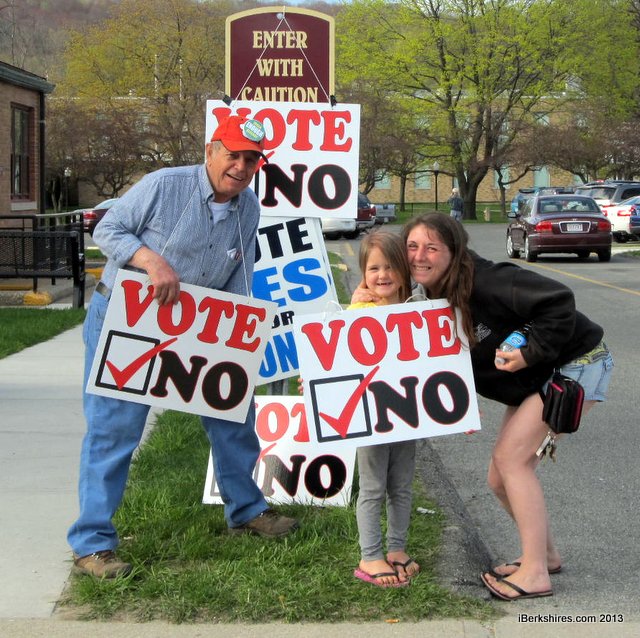 |
Supporters, including Councilors Jennifer Breen and Lisa Blackmer, were at the polls at St. Elizabeth's. Left, outspoken critic of the plan, Robert Cardimino, and Sullivan parent Catrina Therrien urged a no vote. |
NORTH ADAMS, Mass. — Voters gave the Conte School project a thumbs up in a squeaker vote on Tuesday, allowing the city to move ahead with its plans to renovate the historic school.
The unofficial tally had the vote at 1,387 to 1,250, a difference of only 137 votes. There were also at least 8 blank votes.
The vote at 2,645 was low, considering the controversy over the project and the state primary running the same day. There are some 8,700 registered voters in the city; that means only about a 30 percent turnout.
The outcome of Ward 4 had been in some doubt after opponents had talked up the possibility that voting down Conte would put Greylock Elementary School in line for renovation. Ward 4 was the only ward to defeat the project, 362-321, a difference of 41 votes.
The City Council had approved bonding for the $29.7 million project in January but a citizens petition that garnered more than 1,300 signatures put it on the ballot.
A jubilant group of supporters was celebrating at Desperados as the results came in.
"We got a huge win for North Adams today," said Mayor Richard Alcombright, who has pushed for the renovation. He said next the city will let the state School Building Authority know the results and then enter the final design phase. "We'll just go from there."
Alcombright also congratulated those who opposed the project for pushing the charter and the democratic process forward.
"I am thrilled because I convinced my husband we'll buy a house now ... and my two children will go to Conte School," said Lynette Ritland Bond, who spearheaded the Friends of North Adams Schools advocacy group for project.
Bond said she was outside the polling place at St. Elizabeth's Parish Center this morning and saw a lot of people shaking the hand of Robert Cardimino, a key opponent to the project, but as the day went on she saw more families coming in to vote and became more confident.
"The city did the right thing," said City Council President Michael Bloom, who said it was an important project that had a lot of misinformation floating around.
Wilvina and Charles Tokarz were standing outside of Desporados, excited to hear the news.
"We need it, North Adams can use all the progress we can possibly have," Wilvina Tokarz said. Charles Tokarz, who attended the school when it was Drury High School, agreed downtown needs more attention.
City Councilor John Barrett III has said all along there were better uses for the former high school because of its prime location in the downtown district. He voted against the bonding, calling for the city to find a better solution to the district's overcrowding issues, and in effect became the leader of the opposing side.
"It was an uphill battle all the way because of the resources they had," he said, referring to the Friends and the project's endorsements, particularly by Massachusetts College of Liberal Arts President Mary Grant. "If we'd been able to have the money to get our message out ... ."
The close vote did show, he noted, how divided the city was over the issue and he hoped it could come together.
"This is what the people decided and it's the democratic way," said Barrett, but added, "I hope that the City Council and mayor realize they have to communicate better with the people, not just a select group."
It's been hard to get a handle on just exactly how the voters have felt about the project. There have been fervent proponents, reluctant supporters who thought it was the best deal the city could get, and outright opponents who listed a wide range reasons (some contradictory) to reject the school.
"I don't like the general location," said Catrina Therrien, who lives in the Sullivan School district.
She thought the city should be putting more money into the academic structure, or fix both Sullivan and Conte, rather than put it into Conte.
The downtown school, which she attended as a middle school, is in too dangerous a location, she thought, citing possible drug users or molesters.
"If I lived down here, I would be scared," said Therrien, who's hoping her daughter will get school choice to Williamstown. Sullivan, she thought, "is a great location for a school."
On the opposite side was Alcide Bullett Jr., who also had a young daughter with him. Bullett, however, would like
to see her attend Conte as an elementary school.
"I saw the proposals for converting Conte into a school," he said. "I like the central location."
Targeting it as a safety issue didn't make much sense, he said, because the same arguments could be made of other schools, like Brayton, which his other daughter currently attends. "Schools should be a safe place no matter what the location is."
Brayton is too overcrowded and Conte is an opportunity, said Bullett. "We have to do something."
Voting was steady, if not heavy, most of the day. It was difficult to track the numbers because of the state primary that was also being run. Voters could submit two ballots, or just one.
At St. Elizabeth's Parish Center, where Wards 1,2,3 and 5 were located, election worker Ron O'Brien said there had been no difficulty with running the double election. Voters had to sign in twice and sign out twice before casting their ballots.
O'Brien gave the credit to City Clerk Marilyn Gomeau. "I've never seen anyone as organized as her," he said, describing her abilities in running city election as "like a ballet."
"If we can handle this, we can handle anything."As clock ticked down to the polls' closing, two small groups of advocates occupied spots about 150 feet away from one another outside the Greylock School, site of Ward 4's balloting.
Over in Ward 4, Wayne and Susan Goodell, who have lived on nearby Barbour Street for nearly three decades, held signs encouraging voters to vote "No" on the Conte School plan.
They said a key issue for them was what would become of their neighborhood school as the city focuses on a massive elementary school building project downtown.
While closing Greylock was not discussed — school officials consider it the next up for renovation — there are concerns that a declining school population could seal its fate.
"I would hate to see us ever lose this school," Susan Goodell said. "I feel they could have done more here.
"Sitting at our house, which looks right down at the school, we've seen a lot of generations come and go. It would be heartbreaking to lose this."
The Goodells said the infrastracture problems at the westside elementary school have been overlooked in the city's efforts to address building concerns across town.
"Eventually, they'll need to do repairs here," Susan Goodell said.
"We're not hearing about that," Wayne Goodell said. "All we're hearing about is Sullivan is in worse condition, so they're going to move all the students from Sullivan to Conte."
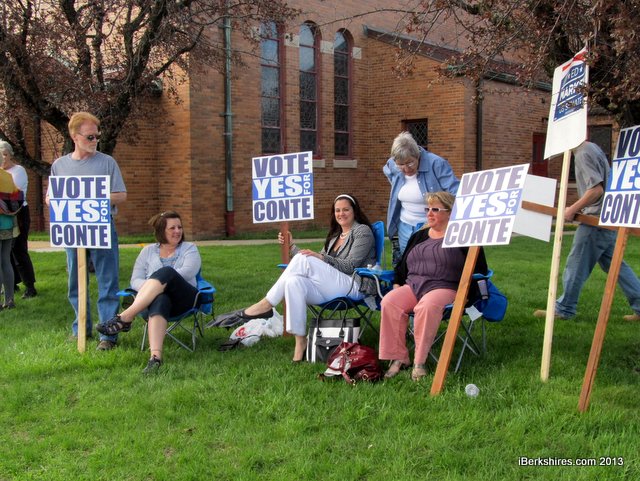
At the other end of the block and on the other side of the issue, Jake Laughner and Kim Seward held signs asking people to vote for the Conte plan.
"I just think it's important," Laughner said. "The way this was presented by the mayor and others familiar with the process, it seems like a very positive thing for the city."
As for the Greylock School, Laughner said he does not expect his neighborhood school to be ignored.
"I think they can do things in parallel," he said.
Wayne Goodell, who had been holding a sign near the school since early Tuesday morning, said he was glad that the people had a chance to make the final decision — whatever that decision may be.
"If it comes out one way or another, so be it, but let the people decide," he said.
Updated at 10:56 p.m. to fix a one-vote transcription error in Ward 3; blanks added in.
|
|||||||||||||||||||||||||||||||||||||
Tags: Conte School, school building, school project,