

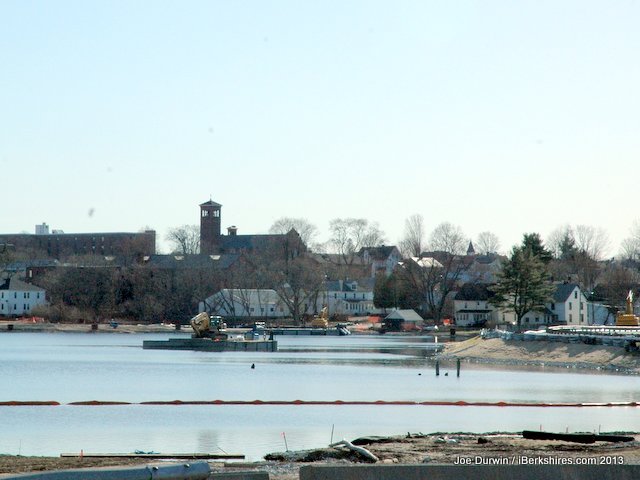
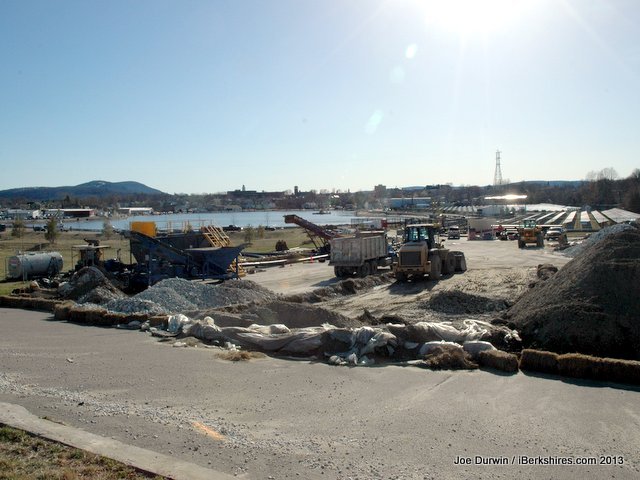
River Council Grills EPA on Silver Lake Cleanup
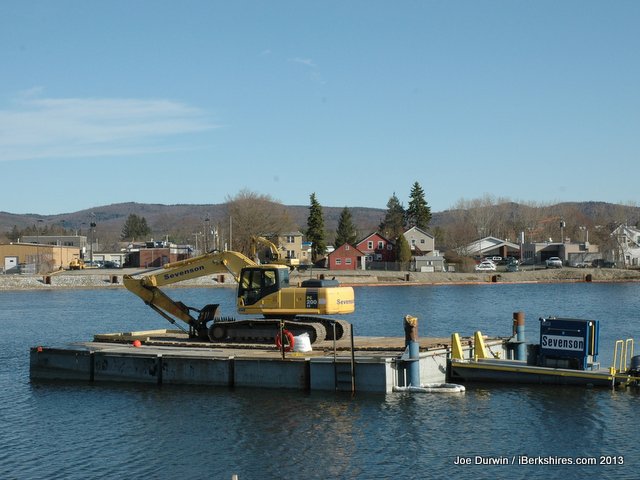 A floating payloader is being used to pull up debris from Silver Lake; disturbing the sediment caused recent spikes in airborne PCBs. A floating payloader is being used to pull up debris from Silver Lake; disturbing the sediment caused recent spikes in airborne PCBs. |
LENOX, Mass. — The U.S. Environmental Protection Agency was taken to task on Wednesday for not doing enough to alert residents around Pittsfield's Silver Lake to airborne PCBs.
The toxic and cancer-linked polychlorinated biphenyls were used by General Electric in capacitor production for years.
"This is really unacceptable," said Judy Herkimer, director of the Housatonic Environmental Action League. "It's another tragedy of the Consent Decree."
Herkimer blasted the EPA for not notifying the public of the spikes in airborne levels, which resulted from sediment being stirred up while removing major debris, including piers, pipes, tree branches and several automobiles. While contamination exceeding the notification levels requires that GE must alert the EPA, Herkimer felt that more effort ought to have been made to notify neighboring Pittsfield residents.
That was one of the issues of the cleanup of Silver Lake that representatives of local environmental groups were critical of at the Housatonic River Citizens Coordinating Council meeting at the Lenox Library on Wednesday.
While a proposed "Rest of the River" cleanup plan is still inching toward a hoped-for Labor Day release, GE has recently completed the removal of large amounts of contaminated sediment and other debris at the Pittsfield source of Housatonic River pollution. The river cleanup is being done under the consent decree signed by GE, governmental agencies and other partners.
The remediation is preparing to enter the next project phase, that of capping the lake bottom, the council was told in a presentation by David Dickerson, who manages the EPA's involvement in the cleanup. While some parties involved in the public vetting of the process have long been skeptical of the capping plan, particulars of the most recent work provoked additional concerns from several members of the council.
That included Dickerson's reports that work at the lake was temporarily halted two weeks ago when testing revealed airborne PCBs exceeding alert and notification levels, first on April 24 and then again on May 2, resulting in a halt from the latter date until May 7.
Dickerson said that while the levels were not considered dangerous, this information was uploaded to the EPA's website, and that the city of Pittsfield and the Pittsfield Economic Development Agency were contacted as well. On April 25, the EPA's Facebook page for the Housatonic River cleanup also posted several photos of cars plucked from the lake as part of the difficult debris removal process.
"Levels above the action levels, 24 hours a day, over a long term, years or decades is what has to happen before there is a significant human health risk," said Dickerson.
Herkimer was having none of it.
"I am stunned at how many actionable levels you've had, and you stand there and you give us the pat answer of how many decades of exposure and how many micrograms per kilogram of air intake people have to have before it adversely effects them," she responded. "Guess what? They've been living there four decades being adversely affected, breathing in volatized PCBs."
A similar incident of raised levels occurred in September 2012, at which time the EPA instructed GE that it must implement improved work practices and increased air monitoring at the site of the work. They can be read here and here.
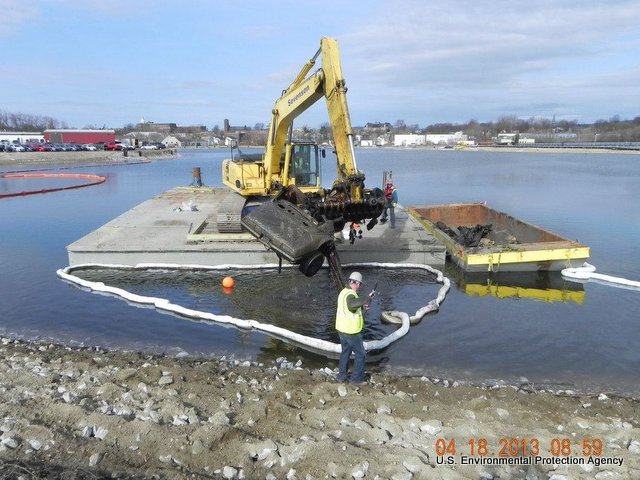 One several automobiles pulled out of Silver Lake. One several automobiles pulled out of Silver Lake. |
Berkshire Environmental Action Team Executive Director Jane Winn questioned the appropriateness of the EPA presenting developments on the remediation, instead of GE, which used to offer the updates as project manager of the work being conducted by contract with Sevenson Environmental Services.
"What GE is doing, GE should be presenting," said Winn. "This makes it look like the EPA and GE are the same thing. I think there should be a greater degree of separation."
"We do oversee the project, and we want it done well also," answered Dickerson.
GE Project Manager Andy Silfer spoke up that he was there to answer any questions as well, but that they felt it was best that the EPA present the public update on the project.
"We're here at the table," said Silfer.
Dickerson said that in addition to soil sampling, continued air monitoring will be conducted throughout and after the remediation. Additional measures meant to minimize exposure levels include use of a vapor suppresant foam on the removed sediment, and efforts being made to minimize the amount of time the contaminated soil is stored on the ground before it is exported from the area.
To date, more than 16,500 cubic yards of contaminated sediment has been removed from the lake. The toxic refuse is stored temporarily at GE's building 65 in Pittsfield, before being shipped by truck or rail to a licensed landfill site in Michigan.
The next phase to be conducted over the summer will be the installation of a 14-inch cap composed of sand and composted material, which will be held down with stone armoring along the shoreline, the course of action recommended in a 2006 pilot study by Sevenson Environmental Services.
Final conclusion of the plan for the remediated lake includes a 2,000 foot walking trail shrouded in 1,000 native trees and plants.
Tags: cleanup, EPA, GE, PCBs, Rest of the River,