Williamstown Panel Green-Lights Weston Field Renovation
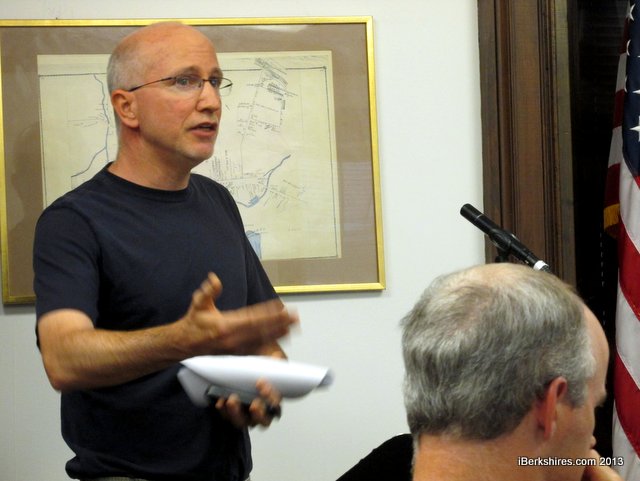 Paul Lovegreen, who lives near Weston Field, said the college and town should address the flooding problems in the area first. Paul Lovegreen, who lives near Weston Field, said the college and town should address the flooding problems in the area first. |
Earlier this month, the Conservation Commission voted unanimously to approve the project with respect to its stormwater management plan.
The commission OK'd the plan after it was reviewed by Marlborough engineering firm Comprehensive Environmental Inc., which suggested some minor modifications.
"I have to say the design was fairly well prepared to begin with," CEI's David Nyman told the Conservation Comm. "It provided information with respect to all the applicable stormwater standards you folks are responsible for reviewing."
The panel accepted the evidence presented by CEI and local engineer Guntlow & Associates that the new work at the athletic field — including the construction of two new buildings — will not exacerbate an existing flooding problem in that part of town.
Two residents, including a homeowner on nearby Meacham Street, pressed the panel to use the Weston Field application as an opportunity to force the college to take steps they said are the responsibility of the school.
"I feel the commission should not approve the Weston Field project without dealing with the root cause of the flooding on Latham and Meacham streets," Dr. Eric White said. "We have a $20 million project to fix the athletic fields, and 20 yards away we have the root cause of the problem not being addressed."
Paul Lovegreen, who owns a residence near Weston Field, said the college should be required to address flooding issues related to the piping of Christmas Brook below Williams property. Lovegreen and White both argued that the problem with the brook was worsened by recent resurfacing of the parking lot beside Towne Field House.
Engineer Charles J. LaBatt of Guntlow told the commission that the parking lot project did not affect runoff into the brook, which is an issue the college is aware of.
"I know it may have seemed prudent to [solve the problem] before paving the parking lot, but all of the best solutions for that project don't include [the brook] continuing along its current path," LaBatt said.
Lovegreen expressed frustration with the pace with which the college and town are addressing the flooding issue, which is only getting worse.
"My house has flooded four times in eight years," he said. "This has become a two-year storm incident, not a 10-year, not a 50-year, not a 100-year. Two years. This last storm (this spring) was worse than Irene. We have no heat to heat our house right now going into the winter because we don't have a place to put a furnace. We get hit with 6 feet of running water in our basement every time this occurs.
"I wouldn't believe anything these people have to say. And if they're going to do it, why can't they do it before they do the football project?"
Lovegreen said his aim was not to obstruct the Weston Field project, per se.
"I'm not against football," he said. "This isn't about not having football and not having a top-notch athletic facility. I'm not trying to quash anything like that. I own a business (Tunnel City Coffee) in town that will reap the benefits of something like that.
"What I want to see is a resolution to a probem that the town and the college are skirting because of money."
The commissioners expressed sympathy for Lovegreen's situation and advised him to keep pushing for a resolution. But the panel also made it clear that the exisiting flooding problem was outside of its purview when considering the Weston Field application.
Before the panel even opened up the hearing to comments from the floor, Chairman Philip McKnight specifically asked Nyman whether the Weston project would increase the runoff onto Meacham Street or into Christmas Brook. He received assurances that there would be no more runoff onto the street and that while the brook could see a higher volume of water, the rate of runoff will be slower.
After listening to Lovegreen's concerns, McKnight suggested that Lovegreen continue to raise the issue in other venues.
"Given the jurisdiction of this commission, we are limited in what we can do," McKnight said. "It is in fact at this point not our responsibility (to address the pre-existing condition). I believe your recourse will be to the town leadership, as I'm sure you know and I'm sure you can try."
Tags: athletic complex, conservation commission, flooding, football, Williams College,