image description
image description
A tent was set up behind the Crane mill for the event.
image description
image description
State Sen. Benjamin B. Downing
image description
Students from McCann Technical School attended the event.
image description
MassDevelopment President Marty Jones

Governor Sees Manufacturing 'Renaissance'

By Tammy DanielsiBerkshires Staff
Print Story | Email Story
Gov. Deval Patrick gets a tour of the Crane stationery division in North Adams. Timothy Bizony explains the letterpress process to the governor.

NORTH ADAMS, Mass. — Manufacturing's "quiet renaissance" needs to start making more noise, says Gov. Deval Patrick.

Patrick and a host of state officials marked "Manufacturing Day" on Friday with a tour of the region's oldest continuing manufacturer — Crane & Co. — and announced new initiatives to continue the revolution toward advanced manufacturing.

"Because we are making more of the things we invent in the commonwealth, manufacturing is making a comeback," the governor told a crowd of the company's stationery division workers he said were examples of the kinds skilled jobs created by the industry.

Crane stationery is not only surviving in digital world, it has consolidated and expanded its operations in North Adams, said Crane Chief Executive Officer Stephen Defalco, with the purchase of William Arthur Stationery, and now employs more than 250 people.

"We have positioned Crane as a company that integrates best practices, design and engineering to innovate solutions of uncompromising quality," he said. "Our industry is driven by design, cost and customer service. It was clear without a new approach our competitiveness would continue to erode."

More than half the company's revenue now comes from outside the United States, he said. From its "humble beginnings in the Berkshires," the company is now a "fast-moving international force."

The nearly 250-year-old paper company had proven that with the right skills, technology and efficiency, it could become an international player, said Patrick.

"Precision manufacturing has been in the midst, or advanced manufacturing as it's sometimes described, has been in the midst of a quiet renaissance. We think it's time to make that renaissance a whole lot less quiet. "

One way of making some noise is the new partnership between the state's community colleges and Massachusetts Institute of Technology to create and implement online training resources. The initiative will expand availibility of advanced manufacturing training to not only Massachusetts students but those far beyond its borders.


"This collaboration expand and enhance our ability to train students from high school through college for advanced manufacturing careers," said Patrick. "This pilot program has the potential to transform how manufacturing education is delivered in the 21st century."

Berkshire Community College President Ellen Kennedy said the governor's support and interest in the role of community colleges made the partnership possible.

"This pilot with eight community colleges collaborating with MIT will serve as a national model, developing online teaching modules to broaden the learning experience for so many of our students," she said. "More opportunity, more jobs and more companies choosing to expand or locate in Massachusetts. That's what this is all about.

I'm a customer. I'm thrilled to be here .. you have cost me a great deal of money.

— Gov. Deval Patrick

"Community colleges are passionate about transforming the commonwealth's work force and the ways we teach and the ways in which students learn."

The state will also host another round of "AMP It Up," the federally funded Advanced Manufacturing Program grants, for high school and community college partnerships. BCC and Taconic High School partnered in the last round with the purchase of high-tech manufacturing equipment at the high school and expanded course offerings.

The governor said the state had to invest in and then build on its platform of education, innovation and infrastructure to compete internationally. Massachusetts has more than 7,500 manufacturing companies employing a quarter-million workers.

While his statement that the average wage was $75,000 evoked laughter from Crane workers ( he joked "it was going to create some problems" for DeFalco), the governor still insisted that manufacturing jobs "are good jobs and good wages for good people. There is a future in manufacturing. It won't be like it used to be but nothing else is either."

Also speaking were Mayor Richard Alcombright, Secretary of Housing and Economic Development Gregory Bialecki, MassDevelopment President Marty Jones and MIT Dean Vijay Kumar. The governor was to hold a closed Cabinet meeting at Massachusetts College of Liberal Arts, followed by the opening of MCLA's Center for Science and Innovation.

State Sen. Benjamin B. Downing, D-Pittsfield, said the morning's events and the MCLA ribbon cutting "highlight was it is best in the Berkshires, what is best in Massachusetts."

"We know, as the governor rightly said, that tomorrow won't be like yesterday but we also know that we are not powerless to shape what tomorrow will look like ... we know that if we make those investments we can create opportunity."


Tags: Crane & Co.,   Deval Patrick,   manufacturing,   
If you would like to contribute information on this article, contact us at info@iberkshires.com.

Becket Looks to Wind Power for Energy Savings

By Breanna SteeleiBerkshires Staff

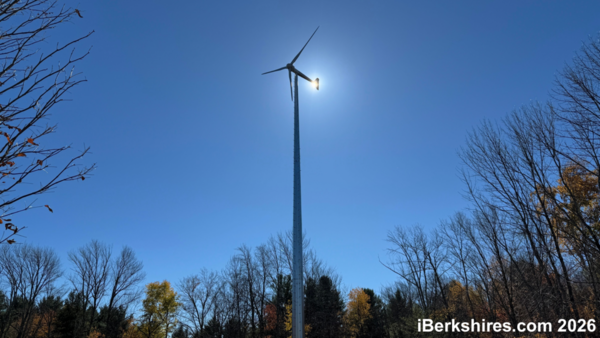
The single turbine is a low maintenance and has a 50-year life. The town went with wind power after finding a solar installation would be too difficult. 

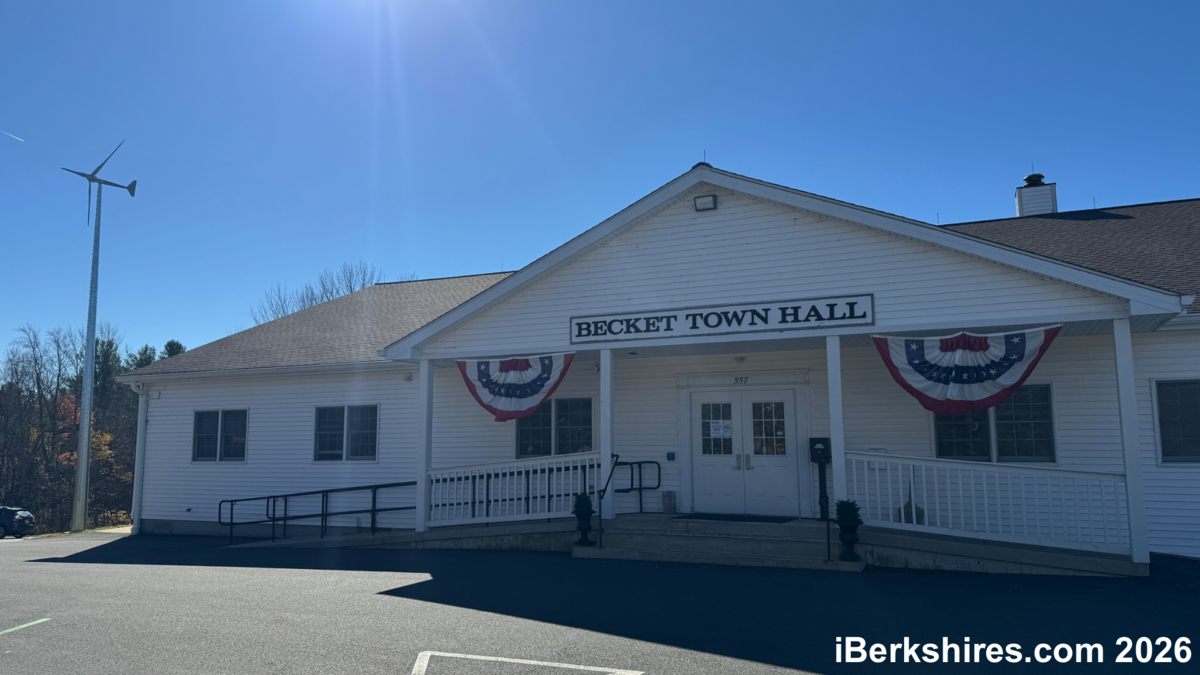
BECKET, Mass. — The town unveiled a wind turbine Monday that will reduce electricity costs and show the benefits of renewable energy produced by wind.

Residents, town and state officials gathered outside the Town Hall for the ribbon cutting on a project first conceived nearly a dozen years ago.

The wind turbine stands 100-feet tall next to Town Hall and is from Oklahoma manufacturer Bergey Wind Power. It has a 50-year life and is a direct-drive permanent-magnet design, meaning it has no gearbox, making it low maintenance.

According to Garth Klimchuk, chair of the Becket Energy Committee, the town started discussions about a wind turbine in 2014. The turbine is expected to generate about 36,000 kilowatt-hours. Klimchuk said Town Hall uses about 24,000 kilowatt-hours, with excess power expected to go to the Highway Department. This is expected to save $9,000 annually from the electricity cost.

"This turbine is just going to be such a good thing for the town. It is really incredible. Zero-cost electricity. Zero cost to the town. Carbon free. Just a huge, huge milestone for us," he said.

The town received a grant from the state Department of Energy Resources totaling $139,500. The remaining funding for the project will come from a direct-pay investment tax credit under the federal Inflation Reduction Act. If the town does not receive the funding, voters at the annual town allocated $100,000 just in case, but Klimchuk said the town will only need about $60,000 to $70,000 if necessary.

"It's going to help the community. Hopefully, it'll lower our tax bills. And as we look at everything going around around the world right now, energy volatility has been with us for a long time. It's going to stay with us for a long time," said state Sen. Paul Mark. "So any move we can make as a community, whether as Becket specifically, as Berkshire County as a whole, but anything we can do to bring some of the reliability into our own hands, to produce a bit on our own, and just guarantee that in a renewable, safe way moving into the future, I think is going to pay off dividends."

The town has spent more than a decade reducing municipal energy consumption in a variety of ways including HVAC upgrades and LED street light conversions, bringing it to a Level 2 Green Community status.

While solar had been considered, interconnection constraints and limited grant opportunities made it harder to achieve. But the high elevation of Town Hall and a Small Wind Site evaluation done in 2023 and 2024 found the site was perfect for a turbine with favorably high winds.

State Rep. Leigh Davis praised the project as an example of a small town addressing a larger energy challenge through persistence and collaboration. She stressed that the single turbine represents a practical step toward reducing reliance on fossil fuels and said Becket's effort could serve as a model for communities across the commonwealth. 

"You hear about all these kind of big wind farms and solar farms and all these ways that we're gonna you know create green energy, but at the same time what we're not being sensitive to the landscape, and what I appreciate about this is that this is it's a single turbine, but it represents so much more," she said. "You're right. It's really adding to the ability for this town to contribute to green energy and to bringing our reliance on gasoline fuels back down to solving big problems."

Mark Rabinsky, deputy director of DOER's Green Communities Division, said the state supports municipalities with technical assistance and grants, and that reducing municipal energy costs can leave more resources for other local priorities. He presented the turbine as an example of state support working alongside local knowledge and decision-making. 

"I think that this is a really a great example of what green communities can do," he said. "I'm obviously a really big fan of the green communities program, but I think that connection between the state, what we're doing at the state, and that local level, and relying on the local knowledge here with Becket is a true testament to what we're doing."

Select Board Chair William Elovirta thanked everyone for being here and shared his memories of first coming tp Becket in 1946 before utility electricity arrived. His family and neighbors used small 32-volt generating plants and batteries. He recalled utility workers installing poles and wires by hand around 1947.  

View Full Story

More South Berkshire Stories