Williamstown Voters Reject Fire Station Land Purchase
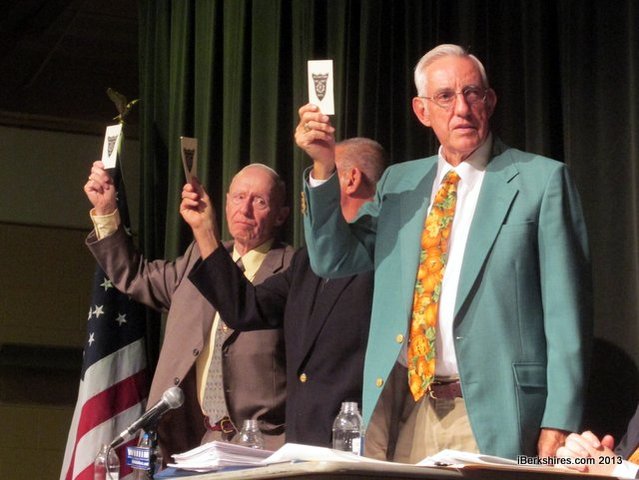
 Voters in favor of the Fire District's acquisition of the Lehovic property, including Fire Chief Craig Pedercini at right, hold their ballots aloft at Tuesday's meeting. Voters in favor of the Fire District's acquisition of the Lehovic property, including Fire Chief Craig Pedercini at right, hold their ballots aloft at Tuesday's meeting. |
Updated: Second half of the article has been posted, beginning as the 12th paragraph, at 11:06 p.m.
WILLIAMSTOWN, Mass. — Fire District officials Tuesday night fell 13 votes shy of gaining voter approval for the purchase of a 3.7-acre Main Street parcel where the district hoped to build a new fire house.
At a special district meeting at Williamstown Elementary School, the vote was 151-94 in favor of acquiring the so-called Lehovic property, but that margin failed to meet the two-thirds "super majority" needed to approve the acquisition.
About 62 percent of the 245 voters in attendance cast ballots in favor of buying the land. In order to achieve a 67 percent majority, officials needed to persuade 164 of the voters in the school's auditorium.
"I'm saddened because we're going to lose the land," said John Notsley, the chairman of the Prudential Committee, which oversees the Fire District.
Notsley said he knows of at least two other parties interested in buying the land owned by the estate of Kurt Lehovic.
Fire officials began in 2008 looking for sites in town where they could replace their current Water Street station, which is too small to meet the town's needs. Besides lacking adequate meeting and training space or reasonable facilities for the department's current equipment, the most often cited need is for space to accommodate a tanker truck to facilitate fire-fighting in areas of town not covered by town water and hydrants.
"Since 2006, most of the new construction has occurred outside the hydrant system," Notsley noted during his introductory remarks at Tuesday's meeting.
The Prudential Committee asked voters to approve spending a total of $975,000 on the project on Tuesday. The majority, $575,000, was to go to the purchase price of the land; the remainder — to come from the district's free cash — was destined to be spent tearing down the existing structures on the lot and filling in the land to raise buildable acreage out of the 500-year flood plain.
"No land is perfect," Notsley said after the meeting. "There is a lot of fill, I'll grant you. But, 'location, location, location.' My father always said ... 'They don't make anymore land.' And it's true.
"We scoured the town for the last few years until we came upon, if you will, the Lehovic site. While nothing's ideal, it was the location. The first four minutes of a fire are the most critical. They claim every minute past that, a fire can double."
And the Lehovic property — with its proximity to the majority of town residences and the homes and workplaces of the volunteer firefighters — provides the best option to optimize response time, officials say.
Tuesday's meeting featured about 80 minutes of discussion, moderated by former Town Moderator Stanley Parese, who filled in for Fire District Moderator Corydon Thurston. Thurston, citing his work on the plan to acquire the Lehovic property and his status as a call firefighter, recused himself from the highly contested meeting.
No one at the meeting argued that the Fire Department does not need a new facility.
In fact, the land purchase's two most outspoken critics each took pains to say they believe the town needs a new fire station.
But Charles Fox and Dan Gendron, both members of the town's Finance Committee, argued that the town needs to take a coordinated approach to several different capital projects on Williamstown's agenda.
"Like you, I take my public calling seriously," Gendron told the firefighters in the room. "No, my role is not as dangerous, but I do serve the community, as you do.
"I'm looking at any and all expenditures and the ability to pay for those expenditures from taxing the populace of Williamstown."
Gendron said in his estimation, a new fire station, a new police station, a new high school and major renovations to the public library (a project that already has been scaled back considerably since it was announced several years ago) would cost in the neighborhood of $30 million.
"How can we pay for this without affecting the demographics of the town?" Gendron asked rhetorically. "I see a smaller scale project would work for both the town and the district."
Likewise, Fox said he and others in town had urged the Prudential Committee to slow down its efforts to acquire the land and build a new station.
"We are all concerned about all of these possibilities," Fox said. "And I believe in a new fire station. ... And I believe in a new police station. ... The high school has demonstrated we desperately need a new high school. It would be inappropriate and unwise to embark on a course of action that doesn't take [all the projects] into account."
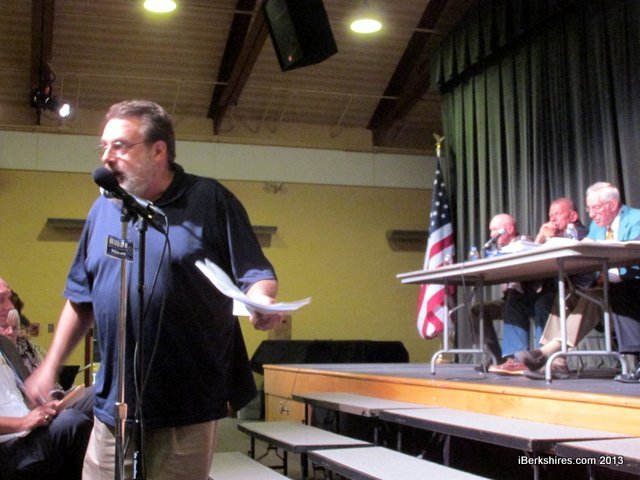
Hugh Daley rose to the microphone to ask why voters were being asked to approve "phase one" of the fire station project — land acquisition — without hard numbers to consider for the total cost of the project.
"We are making a $975,000 down payment on a project we don't know the full cost of," Daley said. "We should be talking about the full cost in a one-time special Fire District meeting.
"I would have preferred for the district to come to us with a single budget ... so we know if we're talking about $5 million or $15 million. We have no idea."
The land deal was not without its supporters on the floor of the meeting. Two voters rose to say essentially that opponents were being overly pessimistic about the funding obstacles — particularly in the face of the pressing need for a new station.
"The community requires a new high school, the community requires a new fire station, the community requires a new police station, the community requires affordable housing," Paul Harsch said. "[Firefighters'] task is the preservation of our lives and our property.
"Who is to say which of these vital community priorities is more vital than the other. There is no way to put one above the other, and attempting to do so leads to negative and divisive thinking."
Harsch, a local realtor, argued that the site of the current fire house could be returned to the tax rolls and increase the town's tax base, whereas the Lehovic property generates relatively little in the way of property taxes. And Harsch said the town's two largest non-profits — Williams College and the Clark Art Institute — likely would be part of the funding solution when it came time to build a station that would serve their needs along with town residents.
Donald Dubendorf said the issue before the voters was not whether the Fire District should consider a joint public safety building with the Police Department — as some have argued. The issue, Dubendorf said, was whether the district would be allowed to take advantage of the opportunity to move forward.
"It would be a mistake to say we make no moves whatsoever because we don't know the end game," Dubendorf said.
"Not too long ago, we built this [elementary school] building. And in doing so, what we said is, 'We care.' I think tonight, we ought to start caring [about the firefighters]."
For the elected body in charge of governing the Fire District, it is back to square one, Notsley said.
"At this point, I don't know," he said. "I really don't. We can go back to the drawing board. At this point of the game, I just don't know what the options may or may not be."
There was consolation in the fact that the majority of voters supported buying the land for a new station.
"It showed the support, certainly, for the Fire Department and the firemen," Notsley said. "A two-thirds vote is a tough vote to get, there's no question about that. And we understood that."
"But there was this email campaign that was kind of negative and it was more or less, 'We want our school and to hell with the PD and the Fire Department.' I'm kind of sad about that. ... But, hey, we gave it a shot. We gave it a good shot. Just not good enough."
In fact, the land purchase's two most outspoken critics each took pains to say they believe the town needs a new fire station.
But Charles Fox and Dan Gendron, both members of the town's Finance Committee, argued that the town needs to take a coordinated approach to several different capital projects on Williamstown's agenda.
"Like you, I take my public calling seriously," Gendron told the firefighters in the room. "No, my role is not as dangerous, but I do serve the community, as you do.
"I'm looking at any and all expenditures and the ability to pay for those expenditures from taxing the populace of Williamstown."
Gendron said in his estimation, a new fire station, a new police station, a new high school and major renovations to the public library (a project that already has been scaled back considerably since it was announced several years ago) would cost in the neighborhood of $30 million.
"How can we pay for this without affecting the demographics of the town?" Gendron asked rhetorically. "I see a smaller scale project would work for both the town and the district."
Likewise, Fox said he and others in town had urged the Prudential Committee to slow down its efforts to acquire the land and build a new station.
"We are all concerned about all of these possibilities," Fox said. "And I believe in a new fire station. ... And I believe in a new police station. ... The high school has demonstrated we desperately need a new high school. It would be inappropriate and unwise to embark on a course of action that doesn't take [all the projects] into account."
Hugh Daley rose to the microphone to ask why voters were being asked to approve "phase one" of the fire station project — land acquisition — without hard numbers to consider for the total cost of the project.
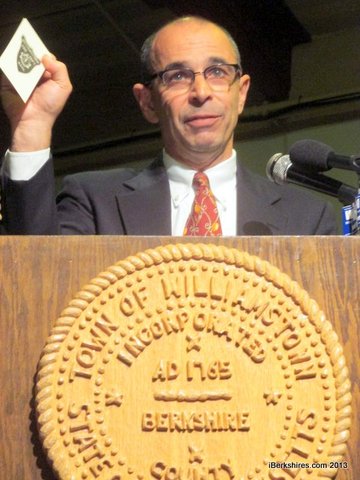
 Local realtor Paul Harsch spoke in favor of the land purchase. Local realtor Paul Harsch spoke in favor of the land purchase. |
"I would have preferred for the district to come to us with a single budget ... so we know if we're talking about $5 million or $15 million. We have no idea."
The land deal was not without its supporters on the floor of the meeting. Two voters rose to say essentially that opponents were being overly pessimistic about the funding obstacles — particularly in the face of the pressing need for a new station.
"The community requires a new high school, the community requires a new fire station, the community requires a new police station, the community requires affordable housing," Paul Harsch said. "[Firefighters'] task is the preservation of our lives and our property.
"Who is to say which of these vital community priorities is more vital than the other. There is no way to put one above the other, and attempting to do so leads to negative and divisive thinking."
Harsch, a local realtor, argued that the site of the current fire house could be returned to the tax rolls and increase the town's tax base, whereas the Lehovic property generates relatively little in the way of property taxes. And Harsch said the town's two largest non-profits — Williams College and the Clark Art Institute — likely would be part of the funding solution when it came time to build a station that would serve their needs along with town residents.
Donald Dubendorf said the issue before the voters was not whether the Fire District should consider a joint public safety building with the Police Department — as some have argued. The issue, Dubendorf said, was whether the district would be allowed to take advantage of the opportunity to move forward.
"It would be a mistake to say we make no moves whatsoever because we don't know the end game," Dubendorf said.
"Not too long ago, we built this [elementary school] building. And in doing so, what we said is, 'We care.' I think tonight, we ought to start caring [about the firefighters]."
For the elected body in charge of governing the Fire District, it is back to square one, Notsley said.
"At this point, I don't know," he said. "I really don't. We can go back to the drawing board. At this point of the game, I just don't know what the options may or may not be."
There was consolation in the fact that the majority of voters supported buying the land for a new station.
"It showed the support, certainly, for the Fire Department and the firemen," Notsley said. "A two-thirds vote is a tough vote to get, there's no question about that. And we understood that."
"But there was this email campaign that was kind of negative and it was more or less, 'We want our school and to hell with the PD and the Fire Department.' I'm kind of sad about that. ... But, hey, we gave it a shot. We gave it a good shot. Just not good enough."
Tags: fire department, fire station, land sales, special meeting,