Nuclea Starts Manufacturing Breast Cancer Test
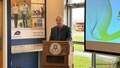
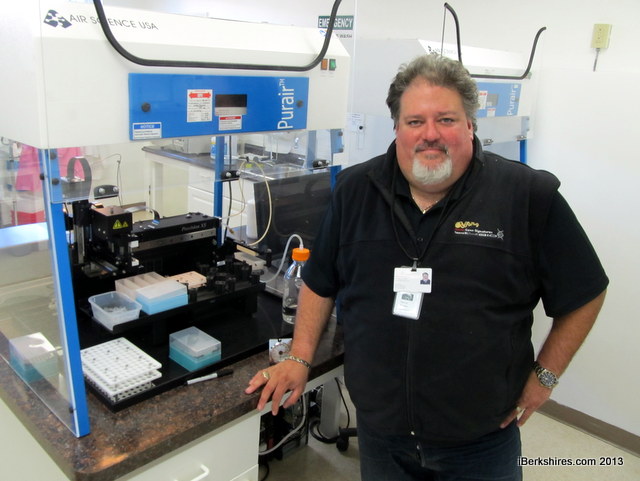 Pat Muraca, CEO of Nuclea, detailed how the test is done the company's Pittsfield headquarters. Pat Muraca, CEO of Nuclea, detailed how the test is done the company's Pittsfield headquarters. |
The company has always had a focus on research and development of pharmaceutical testing but with a recent purchase of Wilex Inc. it's now in the manufacturing business.
In that purchase, Nuclea acquired a manufacturing facility and the rights to a blood test administered to breast cancer patients.
Two weeks ago, the company manufactured its first batch of the test under the Nuclea banner and has set goals of $5 million in sales by the end of next year.
"This is the first step. It is a big deal," said CEO Pat Muraca on Friday.
The HER-2/neu test is a mix of the patient's blood with antibodies to measure the activity of the proteins produced by the epidermal growth factor receptor. That gene helps control how a body's cell grows and, in breast cancer, the test shows the cancer's aggressiveness.
"If the level of protein is elevated, that means you have an aggressive breast cancer," Muraca said.
The test is administered similarly to allergy tests by mixing the blood with the antibodies and measuring the reaction.
Particularly, the test will help identify patients diagnosed with Stage 1 breast cancer who could have a higher likelihood of having it spread. Muraca said 20 percent of those diagnosed with Stage 1 cancer have it metastasis.
"We don't know quite why," Muraca said. "You need to have a biomarkers to identify those patients."
Muraca knows the product well. In 1997, he was part of a team working on a similar test of the genes while working for the developers Oncor. That test was more invasive, he said, while this one requires only a blood sample and the laboratory equipment to measure.
"This test is what got me interested in Wilex," he said.
The test is pretty common, Muraca said, and Nuclea sells the antibodies to pharmaceutical companies, hospitals, doctors and research laboratories. The antibodies are distributed in the United States, Canada and the European Union, he said.
"There are two paths. We can sell these in a kit-based package but we also have the ability to do the test in house," Muraca said.
The company has the laboratory equipment at its Elm Street headquarters and can test blood samples upon request from doctor's offices.
Giving the product an additional boost, the test is now being covered by Medicare Part B insurance, meaning the company is now being reimbursed.
"The HER-2/neu test has been around for quite some time and this is a new test with it so it wasn't hard to get the approval," Muraca said.
While development of these types of tests aren't new to the company, the marketing, sales and manufacturing of the test is. The company plans on spending $3.5 million in marketing and sales to boost those numbers.
Meanwhile, Nuclea will continue developing its own products which could then be manufactured in house.
Tags: breast cancer, life sciences, medical, Nuclea,