Pittsfield Sets 2014 Tax Rates; Average Bill Up $83
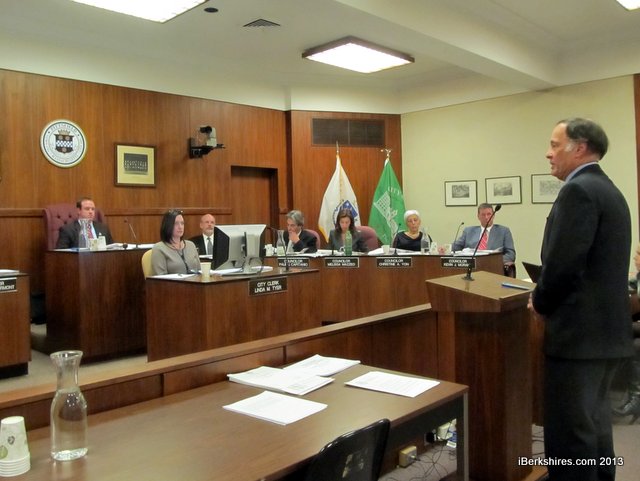 Jeffrey Cook pleaded for the City Council to lower the burden on commercial property owners. Jeffrey Cook pleaded for the City Council to lower the burden on commercial property owners. |
PITTSFIELD, Mass. — The City Council opted to raise the residential tax rate by 2.82 percent and commercial by 1.65 percent for fiscal 2014.
The council debated for more than an hour Tuesday night on how to divide the $70.3 million needed from taxes for the budget.
After an 8-3 vote, the council set the residential rate at $17.15 per $1,000 of assessed value and commercial at $35.17.
The vote added an additional shift in the tax burden to residential property owners than what Mayor Daniel Bianchi proposed.
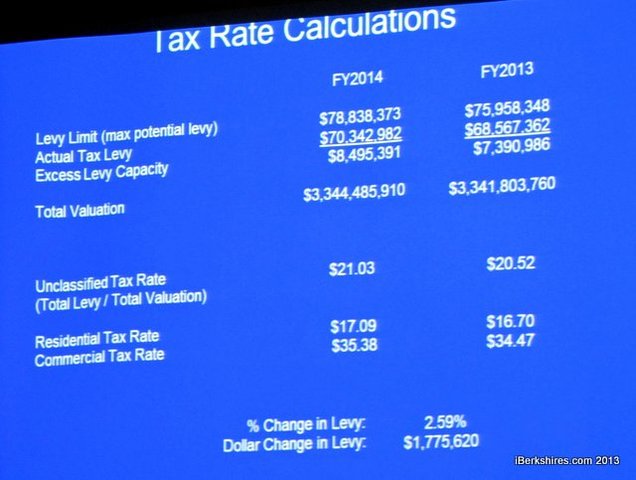
Bianchi requested a 1.682 shift factor, which would have set residential rates at $17.09 and commercial at $35.38. But the council opted to shift more to the residential owners.
According to Assessor Paula King, the levy amount is $8,495,381 under the Proposition 2 1/2 levy limit, further below the limit than in previous years.
The raise in the rate is mostly attributed to an increase of about $2 million needed to support the budget with property evaluations increasing by about $2 million.
King said the average single family home is assessed at $177,766 and the tax rate will add about $83 to the average tax bill and about $289 to the average commercial bill.
The rate did not pass easily as the council was divided on how to shift the burden. The amendment, made by Councilor at Large Barry Clairmont, to shift more than the mayor's proposal to residents passed by only one vote.
Supporters said the city needs to make a stronger effort to support the business community.
"We have to make sure we are business friendly and, frankly, we are not. The numbers don't lie," Ward 6 Councilor John Krol, who made a failed motion to shift even further to the residents, said. "We have to have a sense of urgency."
Supporters of shifting more to the residential side and lowering the business rate said it will increase the number of jobs and attract more businesses.
"I want to make sure Pittsfield thrives after I'm gone and in order for that to happen, we have to have businesses here," said Councilor at Large Churchill Cotton.
Business leaders and representatives from the Berkshire Chamber of Commerce agreed, voicing concerns with the raising rates.
 The City Council debated the tax shift for more than an hour on Tuesday night. The City Council debated the tax shift for more than an hour on Tuesday night. |
Connie Boyle, president of the Berkshire Hills Country Club, said his taxes have increased 400 percent since 2003. The increase in assessed value was because the club built a new structure and the tax rates have continued to go up.
Meanwhile, Boyle says the company does not use the services the taxes go to support. The company doesn't vote, doesn't have children in the schools, pays for its own trash, sewer, and water and plowing, he said.
"It is causing businesses a great deal of hardship," Boyle said.
Commercial realtor Barbara Davis Hassan said the biggest deterrent she encounters is concerns with the commercial rate.
June Roy-Martin of the Berkshire Chamber of Commerce said the city has the 8th highest commercial rate in the state, which is scaring away businesses.
"We have to give the businesses a break because without them we don't have jobs," Clairmont said.
While the rate was cited for being higher than in other communities, Bianchi said the assessed value of the commercial properties are some of the lowest in the state, therefore the tax bills are still lower here. Meanwhile, there is an aging population and there are many retired residents living on fixed incomes who are struggling to pay their bills, he said.
The mayor said his proposal sought a fair rate to not overburden residential taxpayers.
"We have to be sensitive to the demographics of the community," Bianchi said.
Ward 7 Councilor Anthony Simonelli, who voted against Clairmont's motion to shift more to the residential side, said that while he understands the need to attract businesses to fill empty storefronts, he also sees homes falling into disrepair. He said a business can raise prices to make up for the difference but residents can't.
"I'm not in favor of shifting the burden to residential in favor of business," he said. "What we have to do as a council is to be a little more diligent when the budget comes."
 Councilor Melissa Mazzeo said the city needs to do a better job at controlling the costs Councilor Melissa Mazzeo said the city needs to do a better job at controlling the costs |
Ward 5 Councilor Jonathan Lothrop voiced in favor of the mayor's shift because the overall percentage of the levy is in line with previous years.
Under the mayor's proposal, 64 percent of the levy will be paid by residential owners, which is about the same as five years ago.
"I'm just not convinced that at this point in time, we want to make that big of change in where we are," he said, adding that the city has become more business friendly since then.
Ward 1 Councilor Christine Yon expressed frustration with the city's rejection of Waterstone Reality's proposal for a retail business at the William Stanley Business Park.
Yon said up to a half-million dollars would have gone into city coffers through that proposal, which will now have to be paid by the current businesses and households.
"That would have raised $300,000 in commercial taxes and another $200,000 in personal property taxes. That's a half-million dollars and people spoke out against it," she said. "That was a significant amount of money and our community scared them away."
As with most tax classification hearings, both residents and the majority of the councilors pleaded for the city to lower the overall budget. But Tuesday's decision was only on how to divvy up the tax levy needed to support the budget the council approved in June.
"We need to start figuring out where we can cut some costs," Ward 2 Councilor Kevin Morandi said.
Tags: property taxes, tax classification,