Legislators Take Student Debt Testimony in Pittsfield
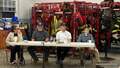
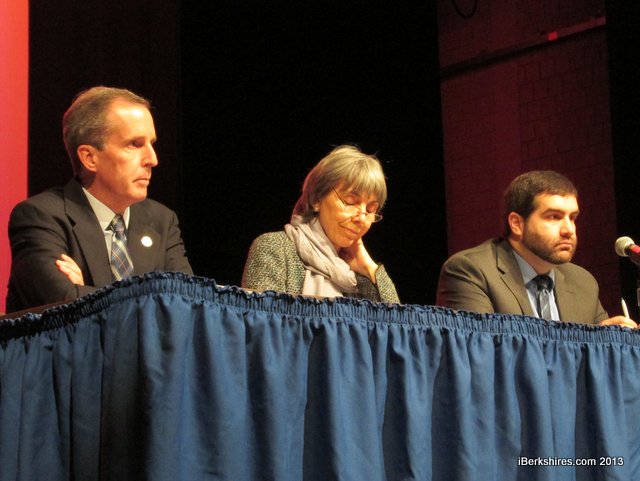 State Reps. William 'Smitty' Pignatelli, Denise Provost and Paul Mark were among the legislators who were at Berkshire Community College on Monday to hear testimony about student debt. State Reps. William 'Smitty' Pignatelli, Denise Provost and Paul Mark were among the legislators who were at Berkshire Community College on Monday to hear testimony about student debt. |
PITTSFIELD, Mass. — When Massachusetts College of Liberal Arts student Brendan Peltier was a senior in high school, he applied to only private colleges.
Then his grandmother asked him to take a look at state schools. After reviewing financial aid packages, MCLA stood out as affordable.
Peltier comes from a family with a twin brother and a single father — so $50,000 or more per year for a private school was out of the question.
But he now raves about the education he is getting at MCLA — not just in the classroom but also because he can afford to take leadership roles outside of the classroom instead of working.
"Not only am I receiving more knowledge and resources but I am paying less," Peltier told a legislative subcommittee at Berkshire Community College on Monday morning. "I am taking out manageable loans that I can pay back after I graduate. I will have fewer loans in my four years than I would have in one semester at most of the colleges I applied to."
Listing an array of hands-on experiences he is receiving at the college, Peltier believes he is receiving the skills he needs for future jobs or graduate school. However, some of his friends at the larger, private schools can't say the same.
Peltier told the lawmakers looking to craft bills to help student debt that his friends are working full time to pay tuition bills at their private schools and will still be loaded with debt upon graduation. His friends don't have much time outside of the classroom to pursue leadership or learning experiences.
Education is important for the entire state, he said, asking the lawmakers to continue investing in higher education and reach out to high school seniors to show them the benefits of public education.
State Rep. William "Smitty" Pignatelli, who does not sit on the committee but attended the hearing, said high schools are too much in competition with each other. Schools are pushing their students to go to expensive, larger schools instead state schools so they can brag about it when trying to raise attendance, he said.
"We should be encouraging students to go where they can afford and where they'll get a good education," the Lenox Democrat said. "I think our high schools have a greater responsibility in where these kids are going and how they are affording it."
Simply, Pignatelli says students are graduating with up to $100,000 in debt by the time they earn their master's degree and are taking jobs requiring the degree that pay $35,000 a year. The math, he says, doesn't work.
But with costs going up and financial help being eliminated, more and more loans are being taken out — adding to student debt. This year at MCLA, the average graduating senior is in debt $25,420, according to MCLA Executive Vice President Denise Richardello.
Richardello said 91 percent of full-time students apply for financial aid and 75 percent of the student body demonstrate the need. But, the school isn't meeting 100 percent of the need because of cuts to financial programs.
"The less money coming in, the more students have to borrow to make up the difference," Richardello said. "These cuts demonstrate the limiting of funds available for students."
Meanwhile, the state is helping private institutions more than they are the state colleges, in some aspects. According to Berkshire Community College Director of Financial Aid Ann Moore, somewhere around 60 percent of taxpayer money eyed for financial aid grants — much like the federal Pell grants — are going to students enrolled at private institutions — some with significantly sized endowments.
Moore says more and more students at BCC are looking for and qualifying for financial assistance but the various funding sources have been reduced over the years. President Ellen Kennedy said the more students have to rely on loan programs, the less of a public benefit education becomes.
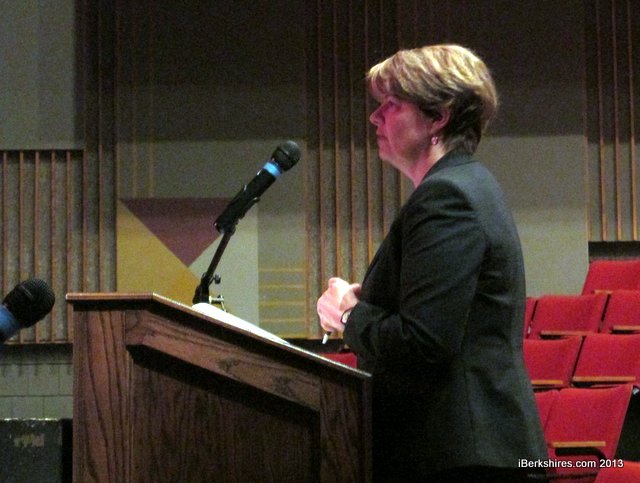 BCC President Ellen Kennedy told the panel that higher education is a public good but that the public benefit is decreased as debts increase. BCC President Ellen Kennedy told the panel that higher education is a public good but that the public benefit is decreased as debts increase. |
Kennedy said there was a switch in thought in the 1980s from being education being a public good to being a luxury for some to better themselves.
When that "switch" happened there was a significant reduction in helping students pay for higher education.
And now, more students are staying with their parents after they graduate because they can't afford the loan payments, fewer graduates are able to pay for cars or homes or other purchases.
Graduates are overburdened with debt so that higher education is not being the support to the economy and civics as it used to be, she said.
"They can't do all of the things that normally happen at the end of an educational opportunity," Kennedy said.
In just the last decade, Kennedy said the number of students needing financial assistance has grown 550 percent. And still students are ending up with $4,000 to $6,000 in debt for their associate's degrees.
"There are declining amounts of money available to them for need-based," Kennedy said.
Being saddled with debt doesn't bode well for future students, she continued, because by 2020, reports show that 80 percent of new jobs will require a college degree.
"There absolutely is a public benefit to investing in higher ed," state Sen. Benjamin Downing said. "We erode that benefit by turning to debt."
The state did freeze tuition and fees at state schools through the 50/50 plan in the budget. By increasing taxpayer spending on public institutions, the schools in turn kept the tuition and fees level.
Westfield State University professor Ken Haar said that was the best thing the state could do to help reduce the debt burden and hoped the Legislature would do it again.
"Nothing is going to make a bigger dent in student debt than curbing the cost," Haar said. "It will go a long, long way toward reducing student debt down the road."
Haar said some $100 million statewide was saved by students because of that freeze. However, Westfield State student Stone Koury says the debt burden is still too much. His roommate is moving out of their apartment because otherwise he would have had to take out another loan and another friend is leaving a student leadership position to work full time.
"The problem of student debt is rooted in a lot more things than just going to school and the costs of it," Koury said, particularly the way the loan systems operate.
Pignatelli told the committee that the state needs to expand loan forgiveness programs.
Others testified that the costs of such things as books continually go up and the resale value is nearly nothing, and that publishers are "bundling" books with compact discs and worksheets to drive up the cost even though many of the students will never use the extra items.
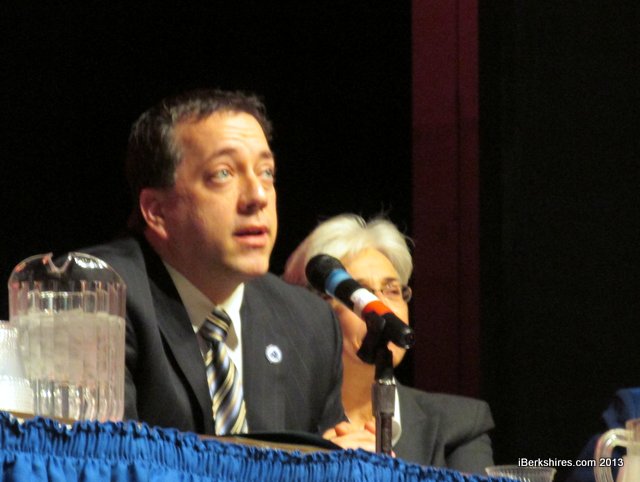 State Rep. Aaron Vega, of Holyoke, said student debt loads are of particular concern to his district because of the number schools. State Rep. Aaron Vega, of Holyoke, said student debt loads are of particular concern to his district because of the number schools. |
Also adding to the cost is that students are unable to graduate in the typically allotted time — furthering the debt burden. Moore said it is impossible for a student dependent on Pell grants to finish in two years because of a 12-credit limit.
"The system is rigged in such a way that at a community college, they are forced to take more than two years," she said.
Monday's hearing was the last of seven held across the state by the subcommittee as members prepare to craft legislation aimed to reduce student debt.
"This tour of public hearings across the state has been a tremendous learning experience," state Rep. Denise Provost, of Somerville, said. "I certainly have the sense that there are many unsustainable features of the system."
Provost said the hearing provided more insight on prospective legislation, and she now has a better understanding of aspects that contribute to debt loads — such as health care, textbooks and transportation.
"Now that we understand some of the moving pieces, we are able to keep an eye on everything on Beacon Hill," she said.
State Rep. Paul Mark, D-Peru, who chairs the subcommittee, said that while the hearings are over — and many couldn't make Monday's because of the threat of bad weather — "this doesn't end today." He wants people to get in touch with the committee to provide input.
Legislators hearing the testimony were: subcommittee members Mark, Provost, Rep. Aaron Vega and Berkshire representatives Downing, Pignatelli, Rep. Tricia Farley-Bouvier and Rep. Gailanne Cariddi.
Tags: college costs, higher education, legislators, public hearing, state grant,