PEDA Moves Forward With Re-Envisioned Life Sciences Center
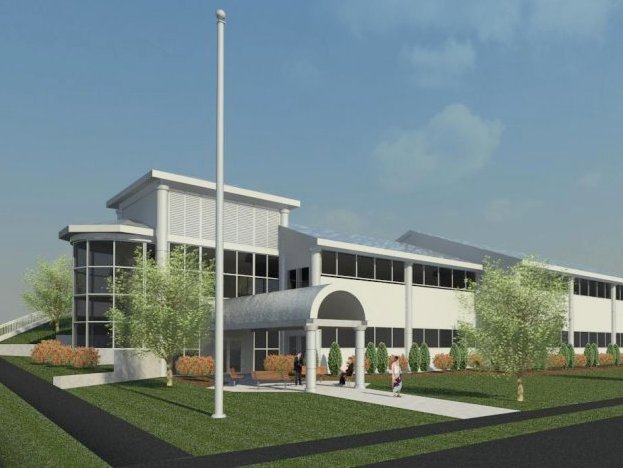 PEDA voted to move forward with funding Phase 2 of a life-sciences complex, envisioned in this artist's rendering. PEDA voted to move forward with funding Phase 2 of a life-sciences complex, envisioned in this artist's rendering. |
Planning consultant Rod Jane told PEDA's board he will be submitting a report to the city this week on the results of efforts in Phase I, which was launched this summer with $55,000 in grant funding from the Massachusetts Life Sciences Center to study feasibility and start developing a working business plan. A $6.5 million dollar earmark was established in 2008 for the hoped-for center.
"The reception has been very positive, from industry and research institutions alike," said Jane. "We have letters of support from virtually every key industrial player in the region."
Jane said he'd met with 70 different companies and organizations as part of the first phase project, which along with pertinent input from the MLSC helped shape the emerging plan.
"We got away from the startup incubator model," Jane told the board. "Essentially, the feasibility study showed that that has not worked west of Worcester."
Instead, the proposed center should focus its mission strategy on growing the existing industrial base in the Berkshires, having the center "accelerate and enable growth within that industry."
In particular, the development would focus on small- to medium-size businesses that are already in, or supplying products to, the life sciences, and use of the facility by larger companies such as SABIC as a venue for further innovation within their product ranges.
"I think the MLSC likes that because it fits the region," said Jane, who noted that support from that institution is crucial to success of the project.
The second phase will delve deeper into potential partnership commitments from companies and research institutions, and generate more specific financial projections for the business plan. This process will take another 90 days, at which time the Phase 2 information will come back to the PEDA board and the MLSC.
"It will still remain a catalyst for attracting startups, but the attraction is based on a mentoring model," said Executive Director Corydon Thurston. "The collaboration of our existing companies creates the kind of value that would attract a startup to come here."
This model, said Thurston, is one that is looked on favorably by the MLSC, which he described as "excited" to be working with Pittsfield on such a project.
To expedite the completion of feasibility study in order to return to the state for a larger request in the spring, Thurston asked the board to approve advancing the $64,000 needed for Phase 2 out of its own funds, saying he is confident this will be reimbursed out of future lump sums from the MLSC.
Director of Community Development Douglas Clark agreed that this is a viable business model for a project of this kind, and this step will help show Pittsfield's commitment to the MLSC.
"They really take this as a sign that we really believe in the project," said Clark. "I don't think there's a huge risk, but there's some risk. They want to see that we have some skin in the game."
"I think that's the approach to take," concurred Mayor Daniel Bianchi, who sits on the board, citing positive feedback on the probability of continued support from the MLSC as the project advances. "We're on the right path."
Bianchi noted that funding this out of PEDA's own resources was a preferable, less time-consuming process than a provision in the regular city budget cycle.
"It's not a loan, it's just bridge financing a gap with the hope that we get it back from the state," summarized board member George Whaling.
• In other business, Thurston told the board that despite additional hang-ups, reconstruction of the long awaited bridge connecting Tyler Street and East Street through the quasi-public business park will be completed more-or-less on schedule.
Unforeseen right-of-way issues arose with the bridge's connection to Woodlawn Avenue, which need to be resolved with some eminent domain transfers PEDA hopes will be approved at the next City Council meeting later this month. Once this is completed, the state will begin to advertise the job, for a project that at one time was hoped would be finished for summer 2013.
"The construction schedule will not be impacted," said Thurston. "Even if it was a fall bid, it would still be a spring construction project."
Tags: life sciences, PEDA,