'Inside Llewyn Davis': More or Less 4th Street
 Popcorn Column
by Michael S. Goldberger
|
CBS Films
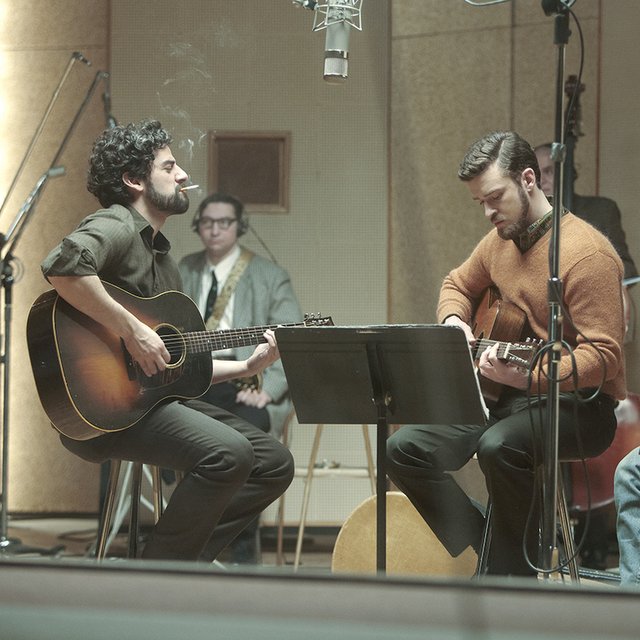
The film follows the life of struggling musician Llewyn Davis (Oscar Isaac), left, who in this scene is recording with Jim Berkley (Justin Timberlake). |
Watching the Coen brothers' "Inside Llewyn Davis," about the Greenwich Village folk music scene in the early '60s, my memory was nostalgically jogged. I'm fairly sure that, whilst trying to become a famous poet, changing the world and looking for everlasting love, I loped into a bistro where Bob Dylan was pretty much pursuing those same goals. Back then, his sound seemed to emanate from every crevice of the landscape. It was the score of the times. In the movie, Oscar Isaac's Llewyn Davis is the would-be icon.
But gosh, he's certainly not having an easy time of it. As the self-styled troubadour shuffles from one potential breakout gig to the next, the winter of 1961 heartlessly reminds him that it is traditional for true artists to suffer. He's doing his best to please the stereotype.
|
|
|
|
|
| out of 4 | |||
It's cigarettes, coffee and hearsay by day — who's playing where and when? — followed by the mystique, dreams and wine that accompanies that evening's performance at whatever hangout will have you. And then the nightly challenge, especially for Llewyn, who has very little safety net, is where one can crash.
He had a partner, but doesn't like to talk about it. He had a girlfriend, too, but Jean, portrayed by Carey Mulligan, also a singer, has joined the leagues of disenchanted friends, lovers and acquaintances. Oh, she's pregnant, but then, it's not that simple.
I wanted to like this movie much more than I did. While Llewyn Davis's musical renderings are reasonably emblematic of the era, I was waiting for another sound — the one with which a generation had essentially identified itself. But then in all fairness, that's my conceit, the natural resistance to have anyone write the epitaph of your own very precious time and place.
Truth is, insofar as recreating the mood, atmosphere and temper of an era, the Brothers Coen are spot on accurate, and rather uncannily so considering they were but 2 and 4 years old when their Llewyn Davis was making like a rolling stone. But then, as Dickens once noted, just like any other period, it is the best of times, the worst of times, the, uh, well, you know.
Hence, if you can do without an exact recreation of the Village and the period you knew, rest assured the Coens do with it what they do best: analyze, define, deconstruct, philosophize, and tap it for all the weirdness and whimsy that is therein contained. This includes a hypothesis or two about the vagaries and wiles of trying to make a success in showbiz and the very nature of talent itself.
Of course, the writer-directors populate their beautifully textured vista — judiciously shot with evocative use of real and re-created architecture — with all manner of eccentric, absurdly normal and melancholically thought-provoking characters. John Goodman, an archetypal favorite taken right off the shelf of oddball personae the filmmakers love to pepper their films with, is discomfortingly bizarre as Roland Turner, an obese, self-styled know-it-all with whom Llewyn hitches a ride to Chicago. Some trip, man.
Roland is a punctuation mark — a constant no matter the social whirlwind, going about his agenda…a reminder that not everyone cares or agrees that, to reclaim a phrase, the times, they are a-changing. Similarly, Max Casella as Pappi Corsicato, the owner of a landmark Village club where folkies hopes to get discovered, is a common opportunist with his own seedy version of the casting couch.
Bombarded by these realities as he unfolds them, surprised by his naiveté, and unsuitably clothed for the cruel, cold streets he tramps, Llewyn seeks some warm harbor — a definition to his odyssey, a friend, an ally, for gosh sakes, maybe even a sign. But almost everyone — save for a dilettantish, Upper West Side sociology professor and his wife always quick to give him shelter from the storm — seems fed-up with the singer.
Sure, they have reason, but then, they're hardly altruists themselves. While his sister Joy (Jeanine Serralles) begrudgingly offers him an occasional bed and meal in her Queens row house, she inevitably seizes the opportunity to bitterly rebuke him. However, it occurs that, just as with the majority of his so-called friends, Llewyn plays but an infinitesimal part in her discontent. It's just dog blaming dog, for whatever solace that brings. Good thing the peace-love epoch awaits just one rung up the decade.
All this philosophical, historical and psychological stuff noted, the ever-present questions begging an answer throughout the film are, A: Is the protagonist truly talented? And B: Whether he is or isn't, does it much matter insofar as his chances for success are concerned? The inquiry is cynical if not pessimistic and strongly indicative of the intelligently puzzling thoughts that might be gleaned from a look "Inside Llewyn Davis."
"Inside Llewyn Davis," rated R, is a CBS Films release directed by Ethan Coen and Joel Coen and stars Oscar Isaac, Carey Mulligan and John Goodman. Running time: 105 minutes