Minimum Wage Increase, Broadband Top Downing's 2014 Priorities
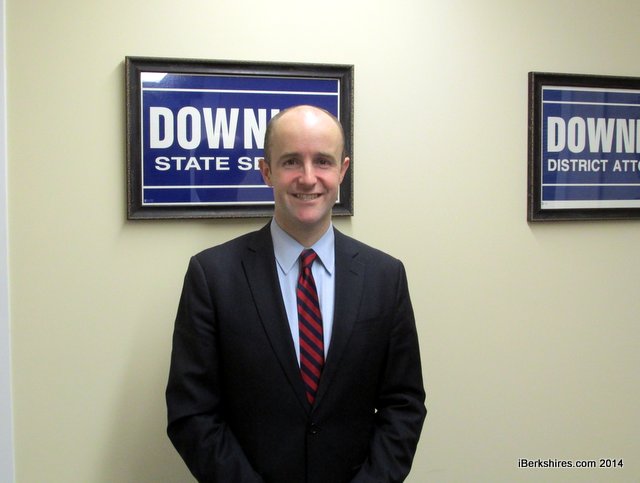 State Sen. Benjamin Downing's focus for 2014 will focus on ways to lower the poverty rate. State Sen. Benjamin Downing's focus for 2014 will focus on ways to lower the poverty rate. |
PITTSFIELD, Mass. — At the end of 2013, the state Senate passed a bill to raise the minimum wage to $11 an hour.
This year, state Sen. Benjamin B. Downing is going to do everything he can to make that law.
"What I would say is my biggest priority is that we have a minimum wage bill the Senate passed at the end of the session. I spoke on the Senate floor in favor of it and it is something I feel is incredibly important," Downing said earlier this week during an interview about his priorities with the Senate returning to session.
Downing says the bill will raise the wage over a series of steps and index it to the inflation rate in the Northeast. Raising the minimum wage is the first step needed to tackle the issue of poverty, he said.
"When you look at the poverty rate in Massachusetts, it has been going up each year for the last six years. In particular over the last six years, child poverty has gone up 25 percent. Certainly there are any number of causes for it and any number of solutions for that," Downing said. "But, one of the simplest and most straightforward ways to start to address it is to make sure that an hour's pay, a day's pay, and month's, a week's, a year's pay more accurately reflects the work they put into it."
The value of the minimum wage has declined because it hasn't been linked to inflation, Downing said. Meanwhile, Berkshire, Franklin, Hampshire and Hampden counties have above average poverty rates. While he sees raising the minimum wage as the first step, he says other efforts will center on turning those numbers around.
Another priority is to advocate for higher education funding in the state budget. He says the state needs to do everything it can to make higher education affordable and effective to increase the chances an individual has to get a job.
"I am happy that last year's budget, for the first time in a long time, recognized that investing in public higher education needs to be a priority here in Massachusetts," Downing said. "For too long, it hadn't been. We had at best given lip service to our campuses and not making the investments we needed to."
Simply put, Downing said, "higher education means jobs here in the Berkshires."
But there is still a lack of middle-class jobs. Even with a growing state economy and "strong safety nets" the poverty rate is still growing, he said, and much of that is because of the lack of opportunities.
"We really need to do more intentionally to create middle-class jobs and opportunities for people," he said.
One way to do that is to finish expanding broadband across the state — a project Downing has been working on since he took office seven years ago. Now, through the Massachusetts Broadband Institute, the state and federal government have built a high-speed Internet system across the state's anchor institutions (schools, town halls, etc.).
MBI is working on finding a way to connect that "middle mile" to all businesses and homes in the state.
"It is something that has been and remains a priority and until it is solved, I am going to put as much energy into it as I can," he said. "You can't talk about economic growth in the 21st century without having access to high-speed, affordable Internet. For too long, communities haven't had it."
The House of Representatives passed a $40 million bond bill to finish that work and it will now come to the Senate. Downing says he wants to accompany that with another bill that would give incentives to cable companies to expand in rural areas.
While it has taken seven years to get this far, Downing said getting all of the funds to finish is a priority for this year because it is Gov. Deval Patrick's last year. Patrick has taken the lead — including adding capital money to the project — in expanding broadband, Downing said, and he can't be sure if the next administration will feel the same.
"It's a part of what will be Gov. Patrick's legacy here in Western Mass and it is part of really solidifying the foundation for economic growth in the smaller communities," Downing said. "I want to get that work done before we have to convince the next administration to do it."
It isn't just in the bills and the votes he plans to cast, he is also trying to just raise awareness and discussion about poverty and hunger. Downing wants the Legislature to really look at the issues.
"People advocate to address poverty by saying we need to do more of what we are doing. But that's wrong. What we have been doing hasn't worked," Downing said. "We need to look at every program out there, ask what is working, what isn't, what should we do more of and what we do we need to do less of."
Downing voted for welfare reform legislation, though he said he doesn't believe the bill is perfect. Nonetheless, he hopes to further the conversation about the various ways to reduce poverty.
"Just having a program doesn't solve a problem and too often a government program just manages a problem," he said.
He said there are other ways to address the issue and cited a program in Cleveland that looks at contracts for service that are currently being imported for large institutions and helps start local businesses to provide those services. He said that type of relationship between the city of North Adams with a 60 percent poverty rate and Williams College and the Massachusetts College of Liberal Arts could prove to be effective.
As for his committee work, as chairman of the Telecommunications, Utilities and Energy Committee, Downing said he will be taking a good look at newly filed solar regulations. The administration is looking to increase the megawatts derived from solar from 400 to 1,600 and filed legislation dictating how much of an energy company's power it should make up.
"We want to make sure that program is as well constructed as it should be," Downing said. "That's not just important to the environment. It is also important for the economy. We know that clean-energy jobs have grown, even in tough economic times, has grown in excess of 10 percent each year."
He also said he wants to build in ways to encourage residential ownership of photovoltaic arrays rather than leasing options. The Solarize Massachusetts program has irked local solar companies who say the program discourages residents from using their business. By, encouraging the ownership model, Downing says it will help local businesses who do not provide the leasing option.
Downing also believes that the long-awaited bottle bill will finally pass. The bill adds a deposit to water bottles and Downing sees that as a good step in encouraging recycling and helping the environment. He has previously voted in favor of the bill but House leadership stopped it from moving forward.
"It is my hope that this is the year the bottle bill is ultimately passed and signed into law," he said.
He will also be pushing three other bills he sponsored. One will require coaches to be trained and certified in cardiopulmonary resuscitation. Downing has reached out to the American Heart Association and the Massachusetts Interscholastic Athletic Association and a plan to offer free regional trainings to the coaches.
"Oftentimes with athletes, the first responder is going to be coaches, who are the closest," Downing said. "Having someone who can administer CPR can be a live saver."
Another bill would require that all newborns be given a pulse oximetry, or pulse ox, test. The non-invasive test measures blood/oxygen levels and can determine the likelihood of a heart defect.
"Knowing within the first few hours, the interventions are far more effective," Downing said.
The last of the three bills he sponsored and is pushing to be passed this year is one he wrote with state Rep. William "Smitty" Pignatelli, D-Lenox, which would give the Department of Public Health more authority to regulate drugs like Suboxone. Suboxone is used in opioid addiction treatment but is often diverted into the community, Downing said.
He hopes the bill will make it much harder for the drug to be administered improperly.
Tags: Ben Downing, broadband, legislation, Legislature, minimum wage, poverty, State House, State Senate, substance abuse,