BRPC: Berkshire Population Declining Rapidly
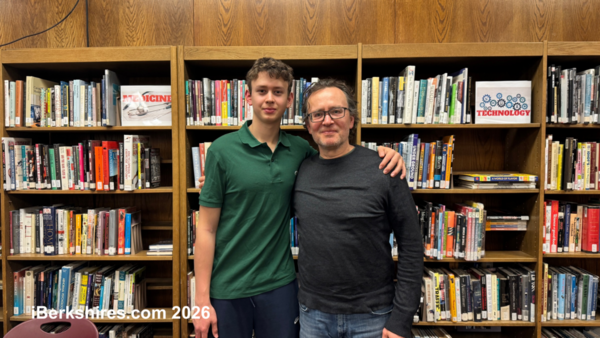
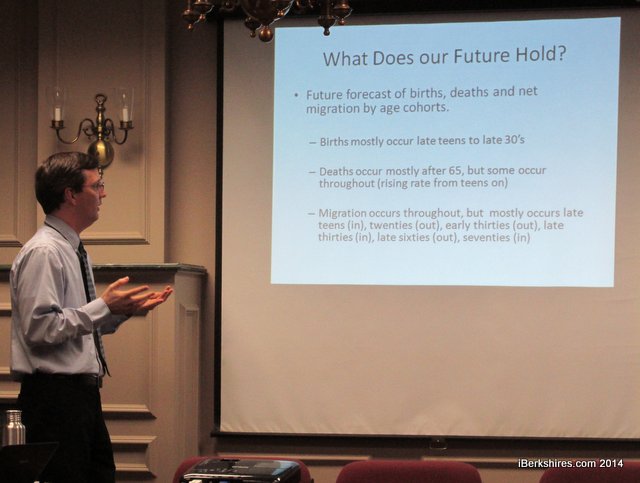 Mark Maloy presented the study on Thursday to the Berkshire Regional Planning Commission. Mark Maloy presented the study on Thursday to the Berkshire Regional Planning Commission. |
PITTSFIELD, Mass. — The Berkshires have been losing population at a rate of 450 per year and when the baby boomers start to die off, that number will accelerate.
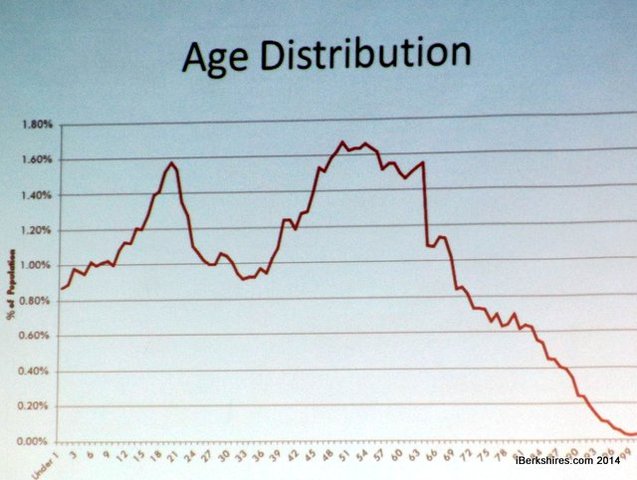
BRPC Planner Mark Maloy presented a study Thursday night showing that the county has a gap in the age bracket behind the baby boomers worse than state and national averages.
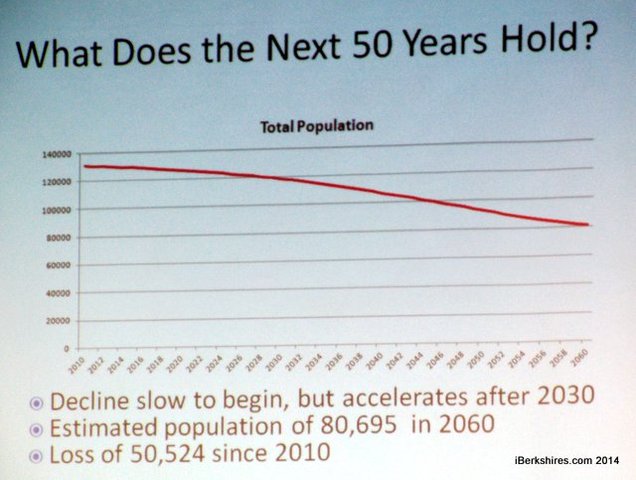
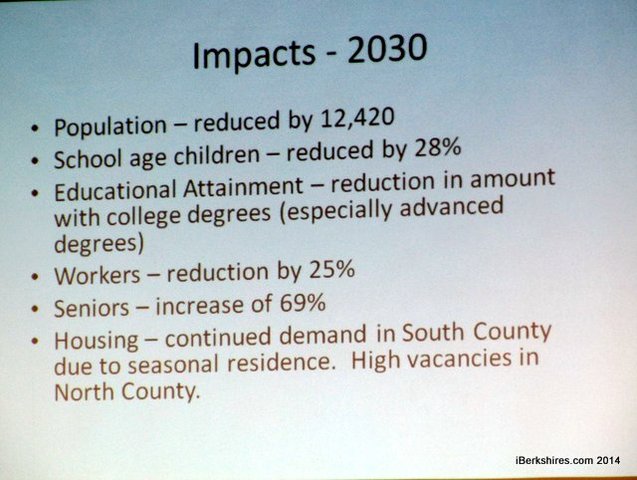
Thus, at this rate, when 2030 comes, the population is expected to be 12,420 people fewer — a number he feels is manageable but one towns should be aware of and set plans to curb.
"Really the only thing to do is to change that migration pattern," Maloy said. "We need 800 more people every year in the 20-30-year-old age bracket to prevent this decline."
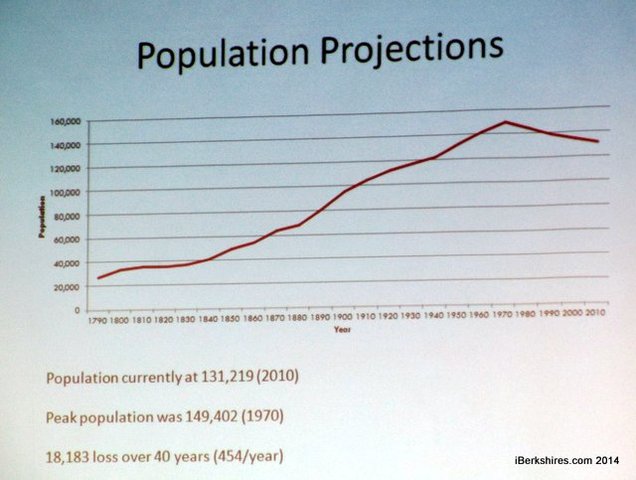
Since 1970, the population in the Berkshires has declined from 149,402 to just 131,219 in 2010. In 50 years, the population trends show the county would be down to 80,695 if the decline continues.
Th declining population has been widely known concern in the Berkshires for local officials and business leaders, but the magnitude has been somewhat cloudy. Maloy says the current trends need to change in order to avoid problems in the future such as housing.
There are about 1,288 births per year but 1,519 people are dying per year — decreasing the population by some 250 per year.
"Births have been declining while deaths have been staying relatively stable," he said.
While 2,977 people per year are moving into the Berkshires, people are moving out at a rate of 3,262 per year. The age brackets show a massive gap in people in their 20s and early 30s. For people in their 40s, the county seems to see that group moving back.
"We have a much older population. We have a higher percentage of people over 50 than the state and the nation," Maloy said.
Without the 20-30s age bracket, the numbers of school-aged children will drop significantly, Maloy said. By 2030, the trend shows a 28 percent decline in school-aged children.
"We've already seen a 15 percent reduction in school population," he said, adding that in 10 years there are 3,000 fewer students enrolled.
Maloy said there will be a reduction of 25 percent of workers while an increase of 69 percent in the senior bracket by 2030.
Coupled with those changes, Maloy said the number of residents with college degrees have been reduced significantly.
A main reason for that, Maloy said, is because there is a lack of opportunities. After earning a college degree and getting experience in the Berkshires, there is often nowhere else to move up. That lack of college graduates is already causing problems for businesses looking to hire.
Pittsfield Planner C.J. Hoss added that it isn't just the opportunity, it is the pay. While the Berkshires have long been known for a lower cost of living, that is only true for housing. While an apartment rental may be lower than in other regions, other costs such as groceries, are not more inexpensive here and salaries aren't keeping pace.
"At City Hall, we lose a lot of good, professional people that we'd like to keep," Hoss said, because they can get paid more elsewhere.
These trends are spelling "doom and gloom" for everywhere from Pittsfield north (except Williamstown). Housing will become an issue because there will not be enough people to fill the homes. Maloy says at this rate, it will be difficult for homes to be sold, so values will be down and there will be abandonment.
Meanwhile, South County is seeing a lot of second-home owners and wealthy retirees. So the demand for housing and new construction in the part of the county is expected to continue.
The trend is alarming but can be changed. BRPC Executive Director Nathaniel Karns said a focus on retaining students could curb the exodus. With the baby boomers moving onto retirement, there will be an array of manufacturing jobs opening up — all of them start at $40,000 a year, he said.
"We can do some things to overcome some of it," Karns said. "I think we need to change some messaging that we are giving our kids."
He added that both North Adams and Pittsfield's push to develop their downtowns will also help keep the 20-30 age bracket.
Lanesborough representative Jack Hickey said the dropping population is not just a Berkshire County issue. He said there are many programs employed in other states that could help curb the trend here. But, it is getting the elected state officials to tell those in Boston that those program are needed here.
"This is a problem that is not unique to Berkshire County. It is traditionally spoken about in the entire rust belt of this country," he said. "Our problem is that our counterparts in Boston and Worcester don't see the problem. They don't have the problem. They are not aware of it."
Karns said Maine and Vermont are both seeing similar trends and have raised concerns.
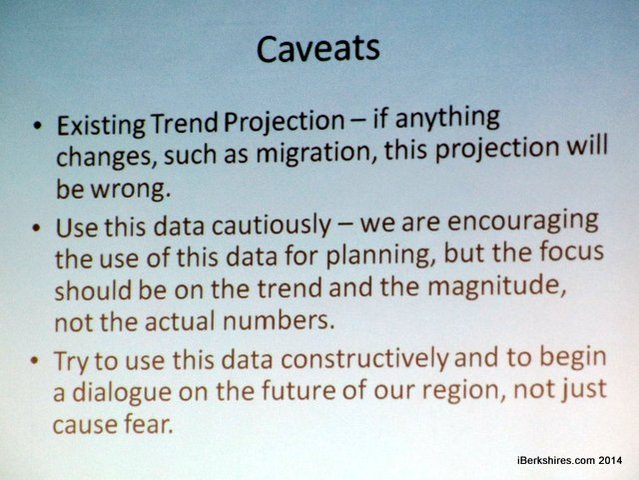
Maloy said that while the trends are going downward, anything can change those numbers — such as the influx of people.
"The focus really should be on the trend and the magnitude and not the specific numbers," he said.
Tags: demographics, population,