Pittsfield's New Crime Analyst Already Detecting Criminals
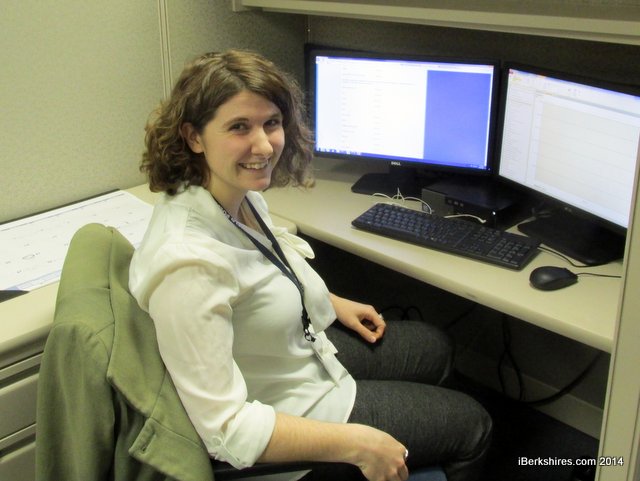 Amanda O'Connor is changing law enforcement in the city with just some clicks on a computer. Amanda O'Connor is changing law enforcement in the city with just some clicks on a computer. |
PITTSFIELD, Mass. — Criminals often think they are too smart to get caught.
Well, not if they meet Amanda O'Connor, a military-trained intelligence officer with a psychology degree from one of the nation's top colleges.
O'Connor is the Police Department's first crime analyst who was hired not to chase down the bad guys, but rather to get ahead of them.
"It's a lot about looking for patterns and knowing how to map them out so you can see them, see what's going on," O'Connor said on Friday. "Intel is all about finding out every little bit of information that you can possibly get because it is all basically a piece to a puzzle."
In just her second week, the Sheffield native is already making a difference. She began by looking at daily report logs and developed a system to sort them by an array of criteria — from locations to types of crime.
She found a report of a residential breaking and entering and found a similar one a different officer had investigated in the past. She looked into it further and found many instances of burglaries with the same items being stolen. O'Connor then ran the information against a database of items sold to pawns shops and found the items were being sold to the same place by the same person.
"Now we know what their target is and where they are fencing the goods. So we call and say next time he shows up, let us know. We wouldn't have been able to make that catch two weeks ago," Police Chief Michael Wynn said.
But that is just "scratching the surface" of her capabilities, Wynn said. The department will be adding more databases and O'Connor will not only be able to both spot trends — such as an increase in robberies — but will have more tools to research locations or people for individual cases.
"The patterns we are looking for are human driven so it comes down to behavior analysis. What are the things that drives somebody?" Wynn said. "Basically, our hope is that we will be able to use some of this data to start predicting behavior."
O'Connor can research a suspect to find out who they associate with, where they'd likely be at certain times, what they've done in the past and reasons behind the crimes — information that would previously take officers days to find.
"Things that would have taken us days in the past to do a hard data pull and hand count, she can do in minutes," Wynn said.
O'Connor's work will enhance open investigations, help the department direct resources to certain areas and find hot spots of activity, all while officers are out on the beat.
"Everybody is looking at different things and my job is to look at everything. I read every report so I can catch trends that others may not have seen," O'Connor said.
And O'Connor knows what she is looking for and how to build the systems needed. Just two days after graduating Williams College in 2010, she enlisted in the Army National Guard, where she earned her degree in intelligence.
"It's a really interesting field. You get to use your brain, doing problem solving," she said. "You can look at numbers all day long, look at a bunch of names but if it is not organized then its meaningless. It is a lot about finding missing pieces but most of it is already there — but you need to know how to read it."
She spent two years in the Army training as an intelligence officer before returning home. O'Connor wanted to go into policing and contacted the Williams Alumni office to see who she could talk to about getting into the field. They directed her to fellow Williams graduate Wynn.
Wynn said when she contacted him the money for the position had been allocated and the personnel office was finalizing the job description. O'Connor told him about her intelligence background so he told her to keep an eye out because they would soon be looking for an analyst. When the job was posted, she jumped at it.
"I've just always had an interest in criminal justice and you add the intel on top of that and it is a perfect fit," O'Connor said.
The 25-year-old Mount Everett Regional School graduate is still "wrapping her head" around the various databases — discovering state resources the department hadn't accessed before — and the information.
"We haven't even scratched the surface of the data yet," Wynn said. "As we gain more capabilities, we can add more databases."
The city allocated the funds for the position as an effort to fight crime in a more efficient way. So be warned, criminals. The game has changed.
Tags: Crime, crime prevention, data systems, Pittsfield Police,