Design Decisions For Taconic High to Be Made This Year
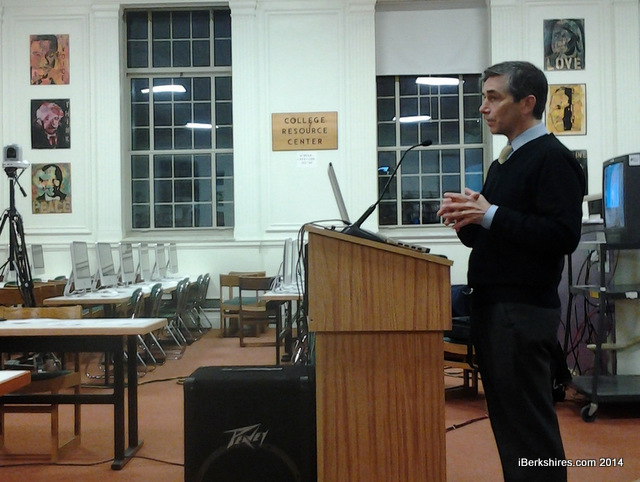 Carl Franceschi of Drummey Rosane Anderson architects introduced options and laid out a timetable for the Taconic High School feasibility study. Carl Franceschi of Drummey Rosane Anderson architects introduced options and laid out a timetable for the Taconic High School feasibility study. |
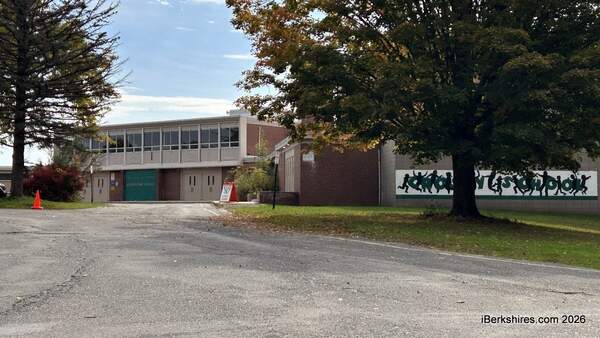
PITTSFIELD, Mass. — Work could begin on either replacement or major renovation of Taconic High School in spring 2016.
That's if all goes smoothly, according to the architects chosen to design feasible options for the high school project.
In its introduction to the city's School Building Needs Commission on Monday, representatives from Drummey Rosane Anderson Inc., chosen by the Massachusetts School Building Authority to handle the final study for the project, presented a broad-strokes summary of design approaches and an anticipated timetable for this phase of the process.
The city will have about six months to come to a decision on whether to redesign and renovate, demolish and rebuild, or some combination of these on a spectrum of possible innovations, said DRA President Carl Franceschi.
The first step is determining exactly what the school's career technical education will look like.
"You want to decide on programmatically what it is you need to build first before you start designing," said Franceschi, recommending that a finalized projection of the technical program curriculum be completed by April.
"What is it Pittsfield wants to do educationally with that space, and then what kind of building does that educational programming require," Franceschi told the commission will also need to be examined by the School Committee.
School Committee Chairwoman Katherine Yon, who also sits on the building commission, pointed out that a preliminary decision of its preferred programs had already been given to the MSBA, following extensive public input last winter.
While a study by the New England School Development Council indicated that 14 programs would be warranted based on current enrollment figures, the School Committee is pushing for a final selection of 15 programs, some of which differed from those in the NESDEC study.
Franceschi said the school department may need to revise its intended curriculum somewhat, based on labor market data, enrollment and feasibility of design, in order to make the plan palatable to the MSBA going forward.
He was "very confident" that the final project would qualify for the maximum 80 percent reimbursement possible from the state, but said the amount of reimbursement was capped at 8 percent for site costs outside the building - such as fields, parking lots and utility lines. That means some portion of these expenses would fall entirely on the city.
 "We do keep that in mind when we're evaluating alternatives," said Franceschi. "We look at not only what is the overall project cost, but what is Pittsfield's share of the cost, too."
DRA outlined some "families of options" for directions the project could take, illustrating with examples of some recent school buildings from its 60-year history designing educational facilities, including the innovative Putnam Academy, the most recent vocational technical school built in Massachusetts.
Once some fundamental decisions are made, through the commission and various "community workshops" that the firm intends to hold with the public, the firm will begin customizing design options to the specifications given.
"We don't approach it with a boilerplate," said Franceschi.
In a number of scenarios, classes could continue to go on in the current building, either through phased renovation of the school wing by wing, or through the addition of new wings followed by the demolition of some older sections.
Alternately, an entirely new structure could be built next to the current Taconic, and the old building demolished later and replaced by the athletic fields or other surrounding land features on the site displaced by the new structure.
While there were many nuances and particulars to be ironed out in the months ahead, Franceschi said the main three decisions to be made were what vocational programs the school will offer, what renovation or replacement option it prefers, and what the budget for the project will be, for review by the MSBA and final approval by the state and the city council in early 2015.
Mayor Daniel Bianchi and other members of the commission voiced enthusiasm that a discussion process that has gone on for many years is finally entering this key phase.
"I'm excited at the prospect," said Bianchi. "It's going to be some hard work, but it's certainly going to be worthwhile.
Tags: MSBA, school building committee, school project, Taconic High,