Feminist Activist Steinem Sees a Transforming Society
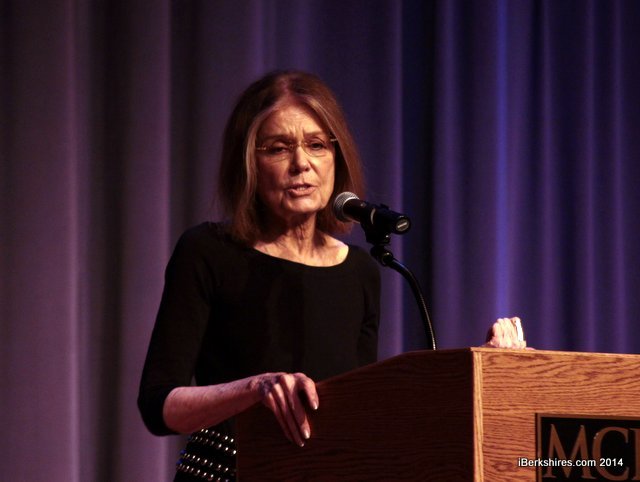 Gloria Steinem spoke to a capacity crowd at the Church Street Center on Tuesday night. Gloria Steinem spoke to a capacity crowd at the Church Street Center on Tuesday night. |
NORTH ADAMS, Mass. — Patterns exist in social justice movements.
Conciseness, and the realization that there are shared experiences between oppressed people, progresses movements, says Gloria Steinem.
"Saying what happened to us and discovering shared experiences is the beginning of every profound social justice movement I know of," she said. "It moves from individual experience, through naming, through organizing, and to changing public policy."
The feminist activist and writer discussed the progression of feminism and social justice movements at Massachusetts College of Liberal Arts on Tuesday night as part of its Public Policy Series on Equality.
Steinem earlier had spoken with students and local media.
Speaking to a packed house in the Church Street Center, Steinem discussed how a social justice movement can transform society by looking at categories and breaking them down, and that the aspect of groups or categories is what creates injustice in the world.
"Taking away these categories and understanding the uniqueness of the individual is questioning the hierarchy all together," Steinem said. "It is saying, 'Hey, wait a minute, maybe the fact that we are born into a group is itself wrong, and we are each individuals in this combination that could never happen before or again,' and that difference is bigger than the group difference."
She gave an example of this transformation in how the idea of domestic abuse has changed from a nameless occurrence into a crime and how it is proof of a positive change in the movement.
"When I was growing up, domestic violence didn't have a name, and it was the fault of the individual family and usually the individual women," she said. "It was either kept quite or if the police were involved, it was the only case in which their idea of success was getting the victim back together with the criminal."
Steinem added that there is no natural superiority in men and women and patriarchy only came out of parameters of society.
"It is absolutely not that women have any bit of superiority by birth, and it is not about biology," she said. "It is the fact that we have not been born or raised with masculinity to prove so we are more likely to reach out to each other and to lead in a communal way and be less hierarchical."
Steinem explained the importance in the transformation process of knowing that all categories and roles were created and have no natural beginnings. Native American men and women had equal roles in the community structure, she said, explaining that they based their culture around nature and how animals interact. Patriarchy was introduced by the spread of European culture.
"At least what is probably 95 percent of human history we didn't even have these kinds of ideas of division by gender or race," she said. "We didn’t have the idea that women's bodies must be controlled by someone other than women in order to control reproduction."
Steinem said she sees the recent past as a bad experiment, and she thinks Americans are on their way to a much more equal world.
 "We can begin to see that on this continent, that the last 600 years there been patriarchy, racism, nationalism and monotheism," Steinem said. "Maybe we need to declare this recent period in time as an experiment that failed, and we are now in the transformational post-patriarchal, post-racist, post-nationalist, and post-monotheist era of uniqueness of individual and community of human beings and all living things."
Steinem advocated the importance of finding humanity by breaking gender categories. She said men and women both share feminine and motherly qualities and once more men start raising kids, they will gain another aspect of humanity.
"A culture that dictates a masculine role represses those qualities," she said. "Just as in women, a culture that dictates a feminine role represses the qualities of leadership or the ability to deal with conflict."
Steinem ended by saying she was hopeful for the future but believes we still have a lot of work to do.
"Without lines, without hierarchy and without labels we are realizing new possibilities and transforming," she said. "We have gone through several stages together and we are reaching the stage of transformation."
Tags: celebrity, civil rights, lecture, MCLA, rights activist,