State Grants $25M for Mass MoCA's Final Phase
 The House has passed a capital spending bill that includes $25 million for Massachusetts Museum of Contemporary Art to complete the development of the complex. The House has passed a capital spending bill that includes $25 million for Massachusetts Museum of Contemporary Art to complete the development of the complex. |
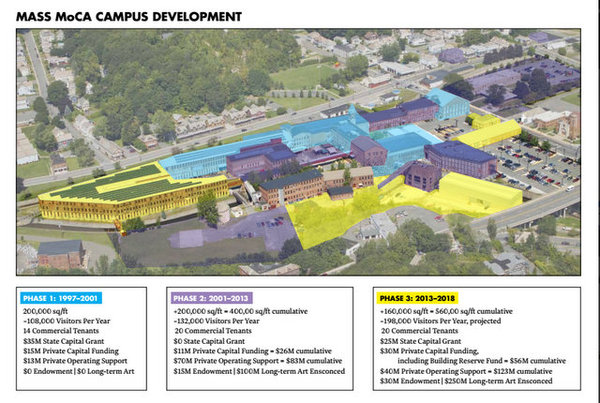
NORTH ADAMS, Mass. — A $25.4 million state grant will help add another 120,000 square feet of gallery space at Massachusetts Museum of Contemporary Arts and complete the major elements of the complex.
The funding toward the $55 million Phase III construction was in the omnibus capital improvement act passed Wednesday by the House of Representatives. It now goes to the Senate.
The plans include redevelopment of Building 6, increased accessibility to the former mill complex's interior courtyards, upgrades for security and performing arts facilities, and the occupation of the entire 16-acre site.
The grant will be supplemented by another $30 million in privately raised money, reserves and endowment funds.
The work will build on the initial Phase III components on the south end of the campus that connects to West Main Street. The 10,000 square-foot gallery exhibiting the art of sculpture Anselm Kiefer opened last September in collaboration with the Hall Art Foundation.
Much of the new gallery space will be devoted to long-term installations and partnerships on par with the Kiefer building and, particularly, the Sol LeWitt Retrospective partnership with the Yale University Art Gallery and Williams College Museum of Art.
Executive Director Joseph C. Thompson described the model as a "campus of museums."
"We are finding lots of interest in this new model of deep, long-term collaboration," Thompson said, in a press statement late Wednesday night. "For our partners and potential partners, co-locating within Mass MoCA provides access to a lively audience interested in new art and new ideas.
"There is something exciting about having these core 'proton-like' installations of art, around which our changing shows spin like electrons – each amplifies and informs the other."
The museum, the largest contemporary art museum in the world, has been slowly filling the 600,000 square feet in the complex's 26 buildings since 1999. The first phase included 200,000 square feet of space renovated for galleries, stages, rehearsal studios, and art fabrication facilities and sparked by $35 million in state bonding; Phase II was largely privately funded.
The economic impact of Phase III is expected to be substantial. Studies have estimated the regional economic impact of the museum at $20 million a year for its exhibitions, music festivals and leased space.
Mass MoCA projects a net gain in annual attendance of 65,000 associated with the Phase III project. According to the 2006 Center for Creative Community Development (C3D) study, every new 10,000 patrons to Mass MoCA translates to new regionwide economic activity of approximately $1.8 million, generating $160,000 in additional local and state tax revenues. The total impact of Phase III development could reach over $11 million per year, and over $1 million; combined with the nearly complete expansion at the Sterling and Francine Clark Art Institute in Williamstown, it could be much more.
"Based on our experience with the LeWitt and Kiefer installations, we expect that housing more long-term installations of milestone works of art will lead to increased visitation and longer stays at Mass MoCA, in the Northern Berkshires and indeed across the entire county," North Adams Mayor Richard Alcombright said. "Together with increased offerings at the Clark, cultural tourists will extend their stay a length of time, and day-trippers will increase the frequency of their visits, creating a significant economic gains for our region.
"There are countless cross-marketing opportunities across this area's cultural attractions. We are all just beginning to understand the power of collaboration in defining the Berkshires as a destination attraction, and North Adams wants to be a big part of that future. This will help us raise our flag even higher."
The statement did not indicate how long the redevelopment would take or what possible installations are being considered.
"With over 120,000 square feet of interior space still to be renovated, the ambitious endeavor will require a substantial investment in basic infrastructure – civil engineering, heating and cooling plant capacity, earthquake and fire code compliance work, accessibility enhancements, and basic structural repair – even before it is ready for gallery fit-out to be undertaken in conjunction with our programming partners," MoCA Chairman Hans Morris said.
State Sen. Benjamin B. Downing, D-Pittsfield, and Rep. Gailanne Cariddi, D-North Adams, have spent the past nine months shepherding the funding in the capital bond bill through various committees.
"There is widespread appreciation of Mass MoCA's effective economic impact – it is something of a national poster child for how the arts and creativity can be generators of jobs and economic growth – and of the project’s proven knack for bringing construction in on time and on budget. The discussions in the State House were very supportive," Cariddi said.
Downing said colleagues realized how "pivotal" Mass MoCA is to the Berkshires.
"More importantly, Governor Deval Patrick has shared his interest and enthusiasm for this project with me, which I believe will be the key to securing the release of these capital dollars," Downing said.
Tags: capital projects, mass moca, state grant,