Pittsfield's Cultural Director Whilden Leaving Post
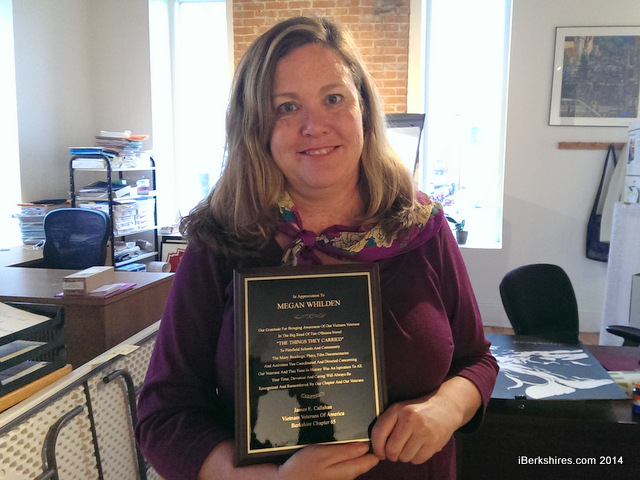 Megan Whilden shows off a plaque that was given to her by the local chapter of the Vietnam Veterans of America. Megan Whilden shows off a plaque that was given to her by the local chapter of the Vietnam Veterans of America. |
PITTSFIELD, Mass. — The city's cultural czar is stepping down after nearly a decade of cultivating arts and culture in Pittsfield.
Appointed by Mayor James Ruberto in 2005 to the newly formed Department of Cultural Development, Megan Whilden may well have fashioned the template for fusing creative arts onto an industrial-focused community.
Whilden announced her departure on Tuesday and will now head the Osher Lifelong Learning Institute at Berkshire Community College. She turned in her resignation to the mayor's office last week.
"For the past nine years, it has been my honor and passion to serve Pittsfield's community and beyond by increasing access to the arts for everyone, celebrating the amazing creative people and places here, and contributing to our community’s quality of life and economic vitality," she wrote in the announcement email.
Whilden's last day is May 16, the day after the season's first 3rd Thursday; she begins her new post on June 2. She will become OLLI's second executive director, following Barbara Hochberg, who is retiring.
"I was interested in the possibility of a new challenge. I wasn't actively looking for something else but the OLLI position interested me. So I applied for it," Whilden said Tuesday afternoon. "It's another organization that makes a difference in people's lives."
Whilden remembers when she first moved to the city in 2003: There dozens of empty storefronts, few young people staying around and North Street was "like a ghost town."
"People were always talking about 'there is nothing to do in Pittsfield.' There was a real culture of negativity in Pittsfield. People were down on the city, much more than they are now," she said.
Places like Barrington Stage, Spice Dragon, Crawford Square, Mission Bar and Tapas, Dotties Coffee Lounge and Circa were not there. So she began her efforts to transform the city by first just finding the various events that were going on and put them into a column. Meanwhile, she was working with the Storefront Artists Project with its founder, Maggie Mailer.
"There was more than two dozen empty storefronts, some of those had been emptied for more than two decades. It was a ghost town. The change is huge," she said.
As the city's first director of cultural development, her most notable accomplishment was starting 3rd Thursday. The street fair, now in its eighth year, sought to return Pittsfield's Thursday nights back to when the General Electric employees would go downtown to cash their checks and shop — so much that the sidewalks were barely passable.
"It just felt like the right time to do something that would bring people together after work hours," Whilden said.
After the first year, per request of the attendees, vendors were added. Five years into putting on the annual event, it had grown so much that the city began closing down all of North Street.
"The arts are in every single house in Pittsfield. In every single house there is somebody who is sewing, playing guitar, writing a poem, or sketching. There is creativity in everyone," she said of the concept for the event, which features music, performances, food and other vendors.
Meanwhile, she started the Cultural Pittsfield e-letter to let people know about other events going on around town. That triggered increased attendance at those events, which triggered more cultural institutes looking to call the city home. Her office serves as a headquarters to help those organizations.
This year, two new initiatives are starting in Pittsfield because of that cohesive arts focus — Berkshire Fringe and Shakespeare in the Park.
She continued the city's successful Sheeptacular with a citywide celebration of the game of baseball, emphasizing the Pittsfield's history as being the first place a record of the game is kept. She organized community book reads, concluding with the multifaceted "Moby-Dick" reading, which was coupled with various programs and events throughout the area.
One of those book readings earned her a plaque from the local chapter of the Vietnam Veterans of America, who appreciated the community reading and events around the book "The Things They Carried."
"I really enjoy helping people do something creative and enjoy creating experiences where people smile and interact," Whilden said.
Besides those major initiatives, Whilden has been integral in the collaborations that have brought diverse cultural venues together to create and promote events that celebrate the city, its arts and its history — from arts walks, to Word X Word, to 10X10 Upstreet Arts Festival to relocating the Farmers Market downtown.
And it has led to an eclectic mix of old and new, arts and dining, staid business and poet slammers. Whilden often refers to the city as "the Brooklyn of the Berkshires."
"It has been very fulfilling and very creative and interesting, exciting, and wonderful," Whilden said.
She says it has triggered "immense" economic value to the city as well as start creating an influx of young people moving in and becoming involved.
"I think that turning around the perception of Pittsfield both internally and externally may be my strongest legacy," she said. "I'd like to think that in some small I've helped instill pride, hope and happiness in our city."
The job is posted here for anyone hoping to follow in her footsteps.
Tags: creative economy, Cultural Pittsfield,