North County Residents Advocate for Hospital Restoration
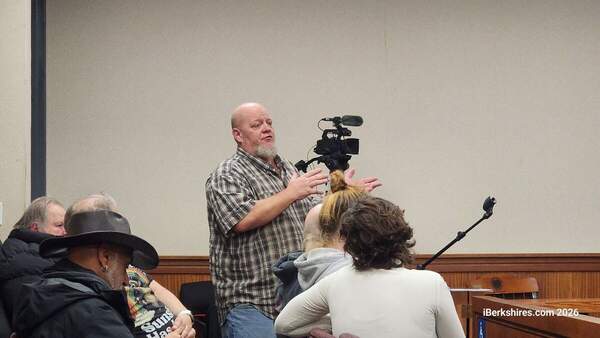
 Laura Vankin talked about her family's experience with the former hospital and the need for more medical services at Tuesday's comment session for a health-care needs survey for North Berkshire. |
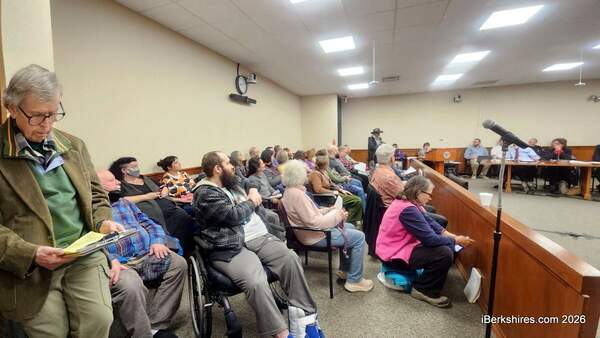
NORTH ADAMS, Mass. — Area residents and health-care workers lined up Tuesday to testify to the critical need for a hospital in North County.
"The hospital is not just a hospital, it's a community center. It's the heart and lungs of the community," said Ce Swanson. "To suggest that suddenly it is not needed is absurd."
Her comment was applauded by the more than 150 gathered to give input into the medical needs of the community.
The state has commissioned Stroudwater Associates, a Maine-based health consulting firm, to do a survey of health care needs following the bankruptcy closure of North Adams Regional Hospital in March.
Brian Haapala of Stroudwater, accompanied by Cathleen McElligott, director of the Office of Rural Health, said he expected to have a report in about six weeks.
It would be presented to the community for further discussion before being submitted to the state, he said.
The speakers told of their own good experiences at the former hospital or its importance in caring for family members. They told of people who had died for lack access to treatment, or who were stuck at hospitals an hour away, unable to find a way home.
Many of the concerns raised at weekly meetings over the past three months were reiterated on Tuesday:
• Transportation difficulties in accessing medical services 45 minutes or more away.
• The loss of psychiatric services for children and adults.
• Addressing health issues within the aging and low-income population, including cardiac care, diabetes and addiction.
• The return of a wound care center, also lost when the hospital closed.
• Preventative care such as a community wellness center within the hospital.
• The lack of speech and occupational therapy that also had been provided by the hospital.
• The pressure being put in large part on Berkshire Medical Center to treat North County patients.
• The economic impact of losing more than 500 jobs, about 160 of which have been restored.
BMC, in Pittsfield, recently opened a satellite emergency facility in the former hospital, easing immediate concerns.
Outpatient imaging services are expected to be available within the week, with mammography awaiting federal licensing.
Still, patients often end up at BMC or at Southwestern Vermont Medical Center, making it difficult for family members to see them - or for patients to get home.
"We have cobbled together ways to get people home, but it's not a system," said Anne Clark-Killam.
Time transport for patients depends on weather and traffic along twisty roads and can take up to 45 minutes to more than hour.
"That's a long time if you're struggling with an emergency situation," said one woman.
The consultants were encouraged to take an ambulance ride (preferably in winter).
Area resident Margo Luna, however, thought the ubiquitous signs calling for the restoration of the hospital a "false hope."
"The bottom line is that the health care facility needs to provide a service mix that addresses population-based need ... coupled with a business plan that incorporate realistic assessments of competition and market share," she said. "Our community needs an adequate and appropriate health care system whether or not this involves the restoration of inpatient services."
But the general tenor was that the restoration of the hospital - or least its most critically needed services - was the solution.
Resident Elizabeth Manns pointed out that Great Barrington has Fairview Hospital, a 25-bed center with a 24-hour emergency room and a long list of medical services.
"If South County can manage to sustain this, then certainly North County can sustain this and deserves no less," she said.
John Lipa, who's been involved in economic and workforce development in the county for years, believed a local hospital could be a "viable business."
Several pointed to the crowd and the continued attendance the weekly meetings as a sign of the community's resolve to restore medical services.
"This is not an aberration; this is the little community that could," said one woman.
Laura Vankin of New York City felt strongly enough to spend her birthday in her hometown to advocate with her mother, Jean, for the facility that had cared for her late father.
"It's more like family. You're taking care of people, not just bodies," she said.
Vankin believed her father might have lived longer with access to dialysis closer to home.
"We need more services not less services," she said. "A lot of these things are Band-Aids. We don't want Band-Aids."
Those who were unable to speak can send written comments to Haapala at
bhaaplaa@stroudwater.com.
Tags: health care, NARH, Save NARH, survey,