Mount Greylock to Again Take Up Regional Expansion
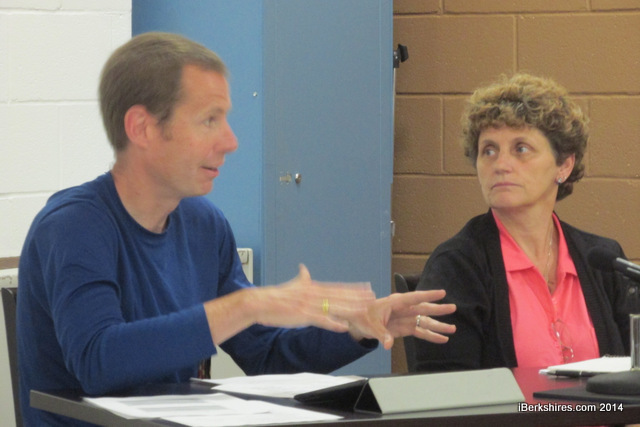
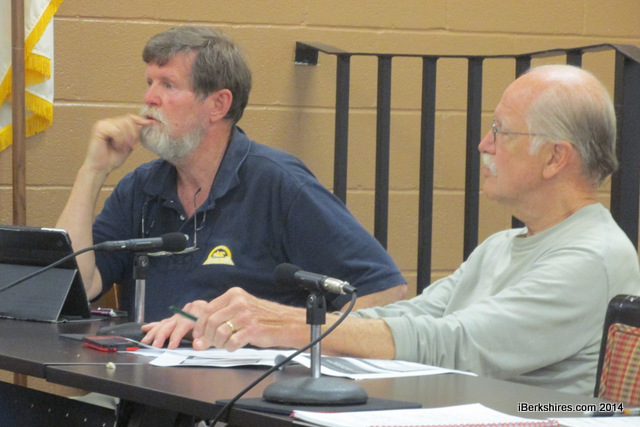 Mount Greylock Regional School Committee member David Langston, left, and Lanesborough School Committee member Robert Barton. Mount Greylock Regional School Committee member David Langston, left, and Lanesborough School Committee member Robert Barton. |
After a joint meeting Tuesday with members of the Lanesborough and Williamstown school committees, the Mount Greylock committee decided to reformulate a version of its Regional District Amendment Committee, known as RDAC and commonly pronounced "ReDAC."
The last RDAC was charged last year with developing a proposal to expand the two-town Mount Greylock school district to include both the junior-senior high school's "feeder" schools: Lanesborough and Williamstown.
The Mount Greylock School Committee put that effort on the back burner last fall after the district was invited to enter the Massachusetts School Building Authority's process — instead choosing to focus all of the committee's energy on garnering community support for the MSBA-ordered feasibility study.
On Tuesday, during the Mount Greylock panel's annual summer retreat meeting, the regional school committee consulted with some of its counterparts from the elementary school committees.
The joint meeting also heard a presentation from an official of the Massachusetts Association of School Committees, who said it was reasonable to try to hire a permanent replacement for outgoing Superintendent Rose Ellis in time to fill her chair when she retires on Dec. 31.
Glenn Koocher advised the committees they could try to hire a permanent replacement and fall back on an interim appointment if their choice as a permanent solution is not able to begin on Jan. 1, 2015.
"Glenn seemed to think it was doable," Mount Greylock Chairwoman Carolyn Greene said in recapping Tuesday's presentation for Ellis, who was unable to attend the first part of the retreat. "He thought starting the search early was to our benefit. If we said Jan. 1 or July 1 in our ad, we could then say it's an interim position.
"The people in the room seemed to think that was a good idea."
The one sticking point in the search process for a Tri-District superintendent remains the commitment of Lanesborough's School Committee to the Tri-District arrangement. Once again on Tuesday, Robert Barton, one of two Lanesborough School Committee members to attend the meeting, said that committee has agreed to "look at options."
Lanesborough Chairwoman Regina DiLego — a supporter of the Tri-District — was quick to downplay that consideration, pointing out the committee has received an opinion from the Department of Elementary and Secondary Education that indicated a single school district cannot easily pull out of a superintendency union like the one the two elementary schools share.
DiLego said the Lanesborough committee's legal counsel has indicated to her that he shares that opinion.
"I appreciate the preview," Barton told DiLego, "but I need to hear it from our school committee counsel on [Aug. 27]."
The third member of the Lanesborough School Committee, Jim Moriarty, did not attend Tuesday's meeting, which also drew two members of the five-member Williamstown School Committee, Chairwoman Valerie Hall and Vice Chairman Dan Caplinger.
Although neither elementary chairwoman was able to give a definitive answer about whether their committees would support expanded regionalization, everyone agreed that the topic has been in the public eye long enough that it deserves a final decision by voters in the two towns.
The Mount Greylock committee subsequently discussed the composition of a reconstituted RDAC and set a goal of bringing the issues to voters in 2015, preferably at Williamstown's and Lanesborough's annual town meetings in May and June, respectively.
One member of the Mount Greylock School Committee said he was not in favor of bringing the elementary schools into the Mount Greylock district under its current district agreement.
David Langston objected to the regional agreement's funding mechanism, which twice in recent memory put Mount Greylock in the position of accepting less money than was offered by the town of Williamstown.
In 2013, Williamstown's budget called for a 2.4 percent increase across the board to town departments, but Mount Greylock was forced to accept less than that figure because Lanesborough was not able to make as great a commitment. Since the regional agreement requires town contributions as a specific percentage of the whole budget, Mount Greylock declined some of the increase from Williamstown and actually cut its appropriation for fiscal 2014.
Langston on Tuesday argued that Massachusetts' funding mechanism for regional schools is the issue.
"The problem is, we have two independent taxing authorities," he said, referring to the towns. "Massachusetts has a very peculiar way of handling municipal finance. In an ideal situation, the school committee would tax.
"Right now, the funding stream for the elementary schools is more secure than that of Mount Greylock."
Langston characterized the regional agreement's funding mechanism as a "straight-jacket" and recommend that the school committee, from which he is departing after the November election, look at revising that mechanism when it revisits the agreement.
The committee on Tuesday discussed reconstituting the agreement committee in January — reserving the fall for the more pressing business of finding a superintendent. The new RDAC would draw from all three school committees, town government and the community, though it would be smaller than the RDAC that made a recommendation to the Mount Greylock School Committee just more than a year ago.
 Williamstown School Committee member Dan Caplinger makes a point as Lanesborough School Committee Chairwoman Regina DiLego looks on. Williamstown School Committee member Dan Caplinger makes a point as Lanesborough School Committee Chairwoman Regina DiLego looks on. |
One argument it likely is going to make: The Massachusetts School Building Authority encourages greater regionalization of school districts in the form of a higher reimbursement rate for any project — renovation or rebuild — that results from the feasibility study the towns' voters approved this spring.
In other business on Tuesday, the Mount Greylock School Committee reinstated one of the school's late buses.
The 4:15 bus (actually two buses — one to each town) was resurrected after the district learned it will receive more state reimbursement than it anticipated for FY15.
Committee member Colleen Taylor expressed concern that the 4:15 bus, aimed at students participating in clubs and tutoring, is too early to help students participating in varsity athletics practices, which end closer to 5 p.m.
But the committee was persuaded by Langston's assertion that it would be inappropriate for the committee to micromanage what time the school ran the bus. The committee's role is to authorize the expenditure, he said.
The committee also voted 5-2 to hire a part-time clerk to help handle paperwork during the MSBA process. The position is budgeted for about $10,000 per year at about $15 per hour.
Ellis told the committee that her office is unable to take on the additional workload necessary to keep up with the state paperwork.
"It's critically needed," Ellis said. "As of a month ago, we are playing catchup."
Langston and Robert Ericson objected to the new position for different reasons.
Langston argued that such a clerk should report to the owner's project manager that is required by the MSBA and which Mount Greylock is in the process of hiring. He said he thinks the time is not right to hire the new employee.
Ericson said he did not think such a position was necessary. He maintained that on the district's last MSBA project (the locker room roof and boiler room replacement), he handled the paperwork along with two regular district employees.
Greene said the paperwork in that project was mishandled and required correction. Ellis said the paperwork was an undue burden on office personnel.
"I know what a burden it was on [the employee in question]," Ellis said. "She never said anything because she's a professional.
"People don't realize all the extra hours our staff puts in. People work in that office well beyond 6 o'clock. We really, really can't do [more]."
Tags: LES, MGRHS, regionalization, superintendent, WES,