Williamstown ZBA OKs Phased Completion of Weston Field
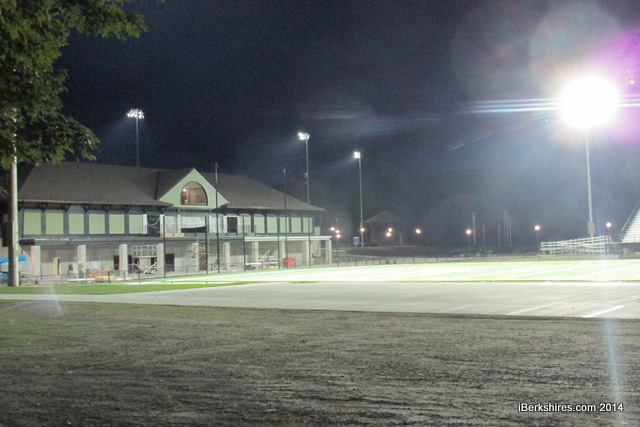
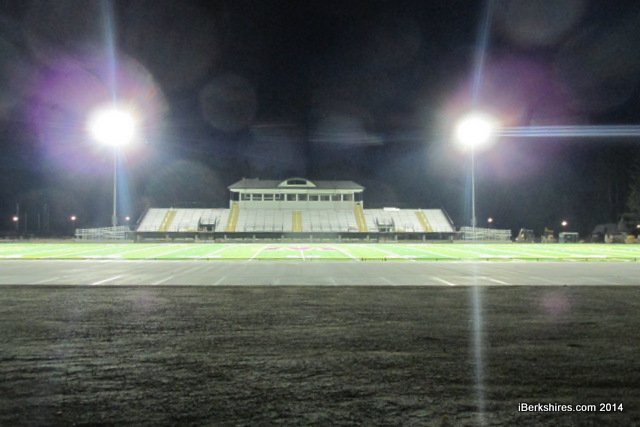 The lights came on at Weston Field for the first time on Thursday — college officials promise they won't be this bright the next time. The lights came on at Weston Field for the first time on Thursday — college officials promise they won't be this bright the next time. |
Although the athletic fields are on track to receive a certificate of occupancy on Sept. 5, college officials have asked the town to issue a temporary CO for one of the two fields, the Lamb Field used by the school's field hockey and lacrosse teams.
The athletic department wants to allow the field hockey team to begin practicing on its field starting Aug. 29.
"Right now we're running into trouble scheduling [practice] time at MCLA or in the bubble in Hoosick Falls [N.Y.]," said Jason Moran, a project manager for the college's Facilities Office. "The first home game is Sept. 6."
Town Building Commissioner Michael Card ultimately will have the responsibility for issuing the temporary CO, but he asked the ZBA for guidance since the phased use is a deviation from the original permit issued for the new Weston Field.
The board's questions centered on how the college is going to keep student-athletes safe as they practice on the field adjacent to an active construction site.
Moran assured the ZBA that the construction project is entering its final phases.
"Really, what we're doing is work on the surfaces," he said. "We're pouring the rest of the fire lane, putting down sod."
Moran said all the major connections like water, sewer and power are complete for the team support building that stands between the field hockey and football fields.
"There won't be huge open trenches because all that work has been completed already," Moran said.
The college has a chain-link fence separating the field hockey field from the unfinished areas and the team support building will be locked with keys available only to the contractors, Moran said. The team will have access to nearby portable toilets during their practices.
The ZBA's newest member, Jack Nogueira, asked that in addition to those steps, the college be required to keep a campus security officer on the site during practices to ensure the safety of student-athletes and provide a communications link in case any issues arise. Moran and college attorney readily accepted the condition.
Card attended Thursday's meeting and said that with the ZBA's approval and last week's approval of the Conservation Commission he is prepared to consider the request for the temporary CO.
After Thursday's meeting, at Moran's request, several members of the board traveled to Weston Field to observe the first test of the new lighting on the football field and Lamb Field.
Although the college has no plans to play night football games on Weston Field, it does plan to move evening football practices from Cole Field to the artificial turf varsity field. And in addition to practices, it will continue to play a limited number of field hockey and lacrosse games under the lights, as it has done at Lamb Field in the past.
Moran explained to the ZBA that Thursday night was the first time the new lights were turned on, and they were burning at the brightest of three settings; football practice will require the lowest setting, Moran said. In addition, the lights will be adjusted by manufacturer Musco Sports Lighting next week, he said.
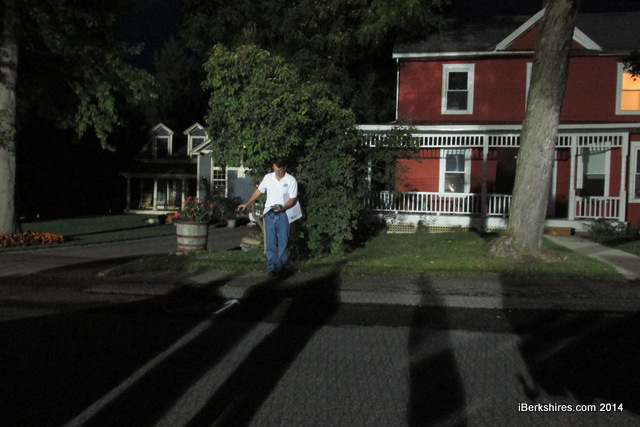
That information was welcomed by the members of the board, who noted that the football field lights fully illuminated houses across Meacham Street from the athletic field.
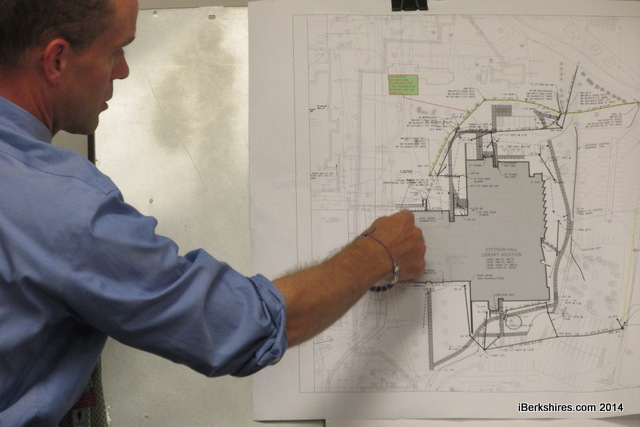
In other business on Thursday night, the ZBA approved modifications to the site plan for the college's Stetson-Sawyer Library project.
Again, Card brought the changes to the board's attention for guidance as the school moves toward acquisition of a certificate of occupancy in time for the new library's opening in the fall.
The changes involve changes in sidewalks to better take advantage of topography and the natural flow of foot traffic around the building, vegetation changes resulting from the death of a deciduous tree that expired in the 10 years since the planning for the project began and an alteration to storm water drainage at the site.
Tags: Weston Field, Williams College, ZBA,