Pittsfield Will Explore Mosquito Spray Alternatives
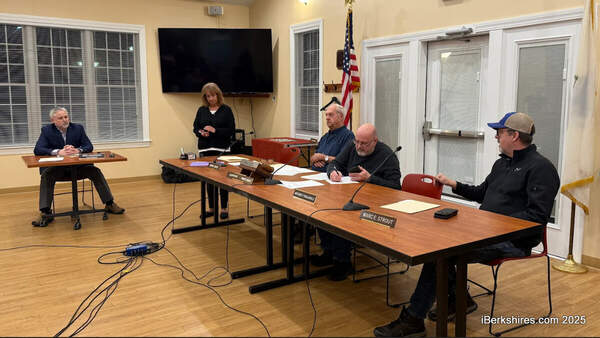
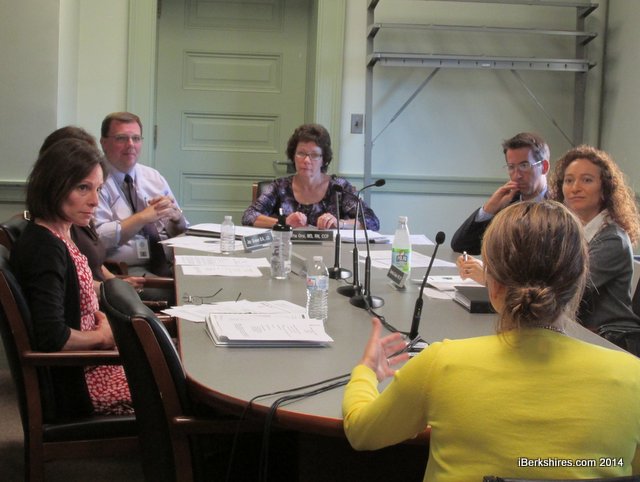 Julia Sabourin met with the Board of Health to discuss alternative ways to combat the mosquito population. Julia Sabourin met with the Board of Health to discuss alternative ways to combat the mosquito population. |
Administrative Assistant Julia Sabourin told the Board of Health on Wednesday that the mayor is interested in looking at new approaches to mosquito control.
Sabourin said the interest stems from a conversation with Joe Durwin — who is active in many city groups as well as being a freelance reporter for iBerkshires.com — to discuss the controversial way the city has dealt with controlling the insect.
"The mayor really wants to look into these innovative and new approaches," Sabourin said of Durwin's suggestions of "more natural measures" than the spraying.
The Board of Health has been faced with a mixture of both opposition to spraying chemicals to kill the insects and residents asking for their neighborhoods to be sprayed. The question of approaches hinge on two different concepts — controlling the mosquito population to reduce health threats or reducing the population because it is a nuisance.
The spraying is done when there is determined risk of West Nile or Eastern Equine Encephalitis, which includes high population numbers. The city is part of the Berkshire County Mosquito Control program, which makes those determinations and calls for the spraying.
According to Berkshire County Mosquito Control Superintendent Christopher Horton, this summer there were three adulticide spraying missions covering some 4,585 acres of the city. Those were in southeast Pittsfield, near Wahconah Park and on the west branch of the Housatonic River.
Those sites were chosen to be sprayed after flooding events. Horton said eggs are deposited in the flood plain and lay dormant until the next flooding event. With a flood, all of the eggs start developing at the same time resulting in large swarms of mosquitoes.
"They all generally hatch on the same day and they are extremely numerous," Horton said. "We knew the river flooded. We tracked the larval development. And we knew they were coming. I believed it was a hazard."
The program has also scheduled a spray application on streets within a one-mile radius of Lillybrook Road and West Street for Monday, Sept. 8, between 9 and midnight. It may be delayed until Tuesday night if it rains.
For the first time in three years, the city hasn't found a trace of virus.
"We have pretty good data to say that it wasn't here. We're looking closely at the mosquito populations in the city," Horton said, adding that the city hadn't seen a significant heat wave that typically triggers the findings.
Also during the summer, 574 acres of land had larvicide treatments and 550 catch basins were treated to reduce the population.
Throughout the summer, opponents of the treatment programs have said there are better ways to control populations. They've claimed the chemical treatments cause health problems, affect childhood development and cause havoc on wildlife habitats. Meanwhile, they say more natural ways, such as installing bat houses to attract the insect predator, will reduce the population numbers.
"We're getting pushed on both sides of mosquito spraying," Sabourin said.
The board's focus is on preventing the spread of the disease, and its members believe the spraying is effective so they are not willing to stop. Spraying is the last option and is only triggered when the population becomes a health concern, the board has said.
The Board of Health will be crafting a mosquito control program for next year and welcomes the public and the mayor's input. Board members were open to the idea of supplementing the program to reduce the chances of the population thresholds to be met for spraying. But the funds for that are lacking.
"He's going to have to find a funding source to handle that nuisance work," board member Jay Green said. "The health department has no budget. Our budget is down to the dime."
Sabourin said her appearance is only the beginning of the conversation and that the mayor hasn't laid out how he wants to move forward. At this point, budget lines or even forming a task force haven't been discussed, she said.
"During 2014 winter, 2015, we in some form — and that has yet to be decided — are hoping to look at the approaches with mosquito control," she said. "At this point, I am not specifically asking for a different process."
But, Sabourin said, "this is something we are looking into."
Chairwoman Roberta Orsi said she has certainly seen residents on both sides of the argument, as has the mayor's office.
"There has been a lot of controversy on how we choose to spray so maybe more public education would help," she said.
Tags: board of health, mosquito, mosquito spraying,