Biometric Lunch Scanners Raise Parent Ire in North Adams
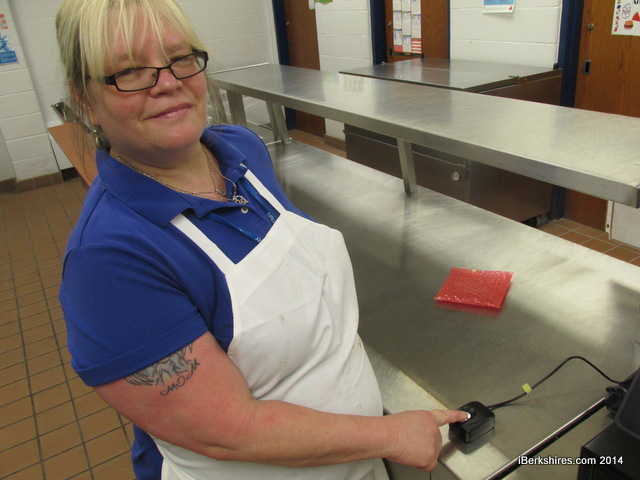 Drury High School cafeteria manager Trinity Spencer shows how easy the school's new biometric system is. Some parents, however, are concerned about privacy issues. Drury High School cafeteria manager Trinity Spencer shows how easy the school's new biometric system is. Some parents, however, are concerned about privacy issues. |
NORTH ADAMS, Mass. — The introduction of biometrics in the school lunch line has a number of parents concerned about privacy and big-government intrusion into their children's lives.
The school system is instituting the equipment at lunch lines this fall after more than a year of discussion about parents failing to pay delinquent lunch bills, the stigma surrounding free and reduced lunches and the need for student privacy.
But a notice sent home to parents informing them of the changes sparked a firestorm on Facebook, with some parents and community members decrying what they see as an invasion — not a protection — of privacy.
Corey Nicholas, food service director for the public schools, said the idea was to move students through the cafeteria line more efficiently and ensure parents could accurately track their children's lunch habits online.
The district's "point of sale" equipment, NutriKids, supports the new biometric readers from identiMetrics.
"It's definitely going to streamline the system and make the transactions more accurate," said Nicholas on Tuesday. "Those that participate are able to see all those little transactions ... we want to make sure those transactions are as transparent as possible."
The use of biometrics — from fingers to irises — has been proliferating across public schools and higher education institutions as a way to increase efficiency and security. It's even gaining traction on iPhones and automobiles. The state of Florida, however, banned the use of biometrics in schools in June, calling it an invasion of children's privacy and a civil rights issue.
"No child should have to have a body part scanned to get a meal! There was no problems with those swipe cards that we were ever made aware of," wrote one parent on Facebook, who said she'd send her child with bag lunch before allowing a fingerprint scan.
Parent Cara Roberts, in a letter to Mayor Richard Alcombright and to iBerkshires, raised concerns over security and health.
"Let us not allow our children to allow privacy to become a thing of the past. Our duty is to educate and protect them, not to catalog them like merchandise," she wrote. "Our duty is to teach them to protect and care for their bodies. What message are we sending when we tell them their body is a means of identification, a tool for others to use to track them?"
She included to links to an article on Justia.com that delved into privacy and civil rights issues related the growing reliance on biometrics and one on ScientificAmerican.com about the use of biometrics in surveillance. Both articles more broadly discuss the use of digital fingerprints, palm prints and iris scans.
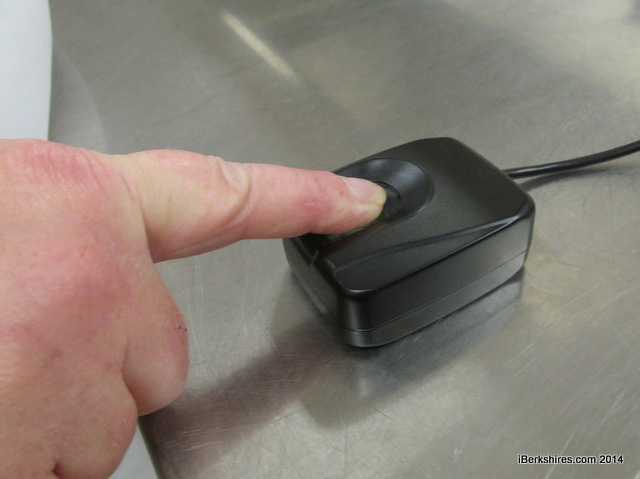
The technology being used in North Adams, from identiMetrics, does not register a fingerprint, but rather a pattern created by the intersection of unique elements of the print against a grid. The four points are then encrypted as binary numbers and that's what's stored and compared each time the finger is scanned later.
"The software cannot recreate the fingerprint itself because it does not store the fingerprint," said identiMetrics President and CEO Raymond J. Fry. In fact, the system doesn't have the server space to store hundreds or thousands of digital fingerprints, he said.
The former Chicago principal and administrator said he understood parent fears and it was because of his experience with children and concerns about safety that the company's product is designed to ensure their privacy and security.
"I've had these conversations for 10 years," he said on Wednesday. "It's not new technology, and it's not new to school districts."
Fry tells school districts to make sure parents are informed of how the technology works and to give them the option not to participate — both of which North Adams as done, although some parents are saying they should have been asked permission first, not after the fact.
North Adams may be the first in Massachusetts, but biometrics is being used by schools in more than 40 states, said Fry. Some 75 percent of schools in West Virginia use the technology to track usage in their libraries and cafeteria and for student attendance.
The reason the technology is catching on is because pressing a finger on a reader for a few seconds is both faster and more accurate than swipe cards or pin numbers, said Nicholas.
Swipe cards were difficult to use because they are constantly getting lost, damaged or traded, he said. "We have 300 or 400 kids going through cafeteria ... we were making them all the time. ...
 "You can't open a file to look at the unique point ... It's just an encrypted number."
Fry said that's far more secure than swipe cards that often have children's names or pictures or schools on them.
The scan device is similar in cost to the swipe card reader although the software is more expense; it should last five to eight years, or as long as 10. The student's number would only last as long as they're in the schools system and be deleted when they leave.
It takes about a minute to scan the fingers — only the index fingers on each hand. The schools have begun processing the students with the expectation of going online by the middle of next week.
"The kids are excited about it ... it's kind of a neat thing," said Nicholas.
Drury High School cafeteria manager Trinity Spencer is looking forward to using the readers. The cafeteria workers have been trained on the technology and have found it fast and easy to use. The student places their finger on the scanner and their account pops up on the register screen.
"Once it's in there — 'beep' — and that's it," she said.
Alcombright said on Wednesday he was aware of the concerns and had responded to Roberts' letter, explaining that many of the issues she had raised had been discussed by the committee and answered to its satisfaction.
"As for research, our School Lunch Program Director reviewed this product and several others — I believe he either visited or discussed with other districts, the platform we will be using and in all cases, there did not seem to be any issues either operationally or with respect to health or privacy," he wrote.
"It's one of those things that are new and people want to scrutinize," the mayor said on Wednesday.
Nicholas on Tuesday said he'd so far received three written requests to opt out. The mayor, who also serves as the chairman of the School Committee, said he didn't see a reason to abandon the devices because of a few complaints.
"We have 1,600 kids in the school system and this was thoroughly vetted by the School Committee. I respect their concern but the full fingerprint is not stored ... We weren't told [the print was stored] by our administration and we weren't told that by our vendor."
He was pleased that parents were reading the information sent home and asking questions. "It's good to say people are reading and being informed," he said.
Brayton School PTA member and parent Kaitlyn Cornell said she'd looked up the technology online to educate herself and noted where it was being used, including at Massachusetts Museum of Contemporary Art.
"I'm all for innovation and technology and moving forward," she said. "I didn't think it was depersonalizing so much as making [the cafeteria] run smoother. .. I know that the lines back up so much at lunch time.
"If people feel uncomfortable, give them the option out but I feel to take it all away, it just hinders the technology of moving forward."
Tags: biometrics, cafeteria, NAPS, school lunch, technology,