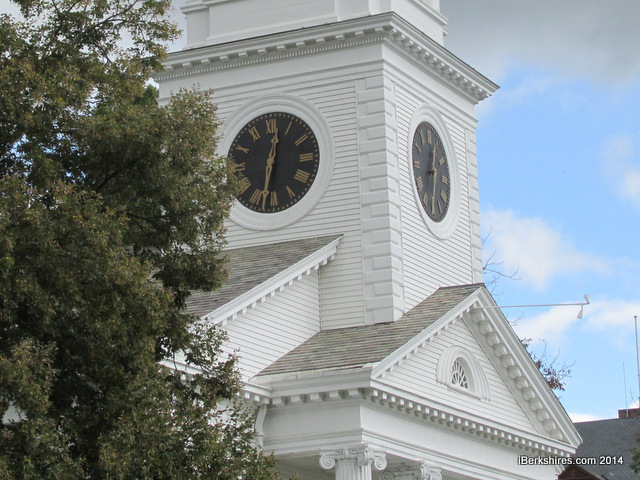
Williamstown's First Church Marks Building's Centennial
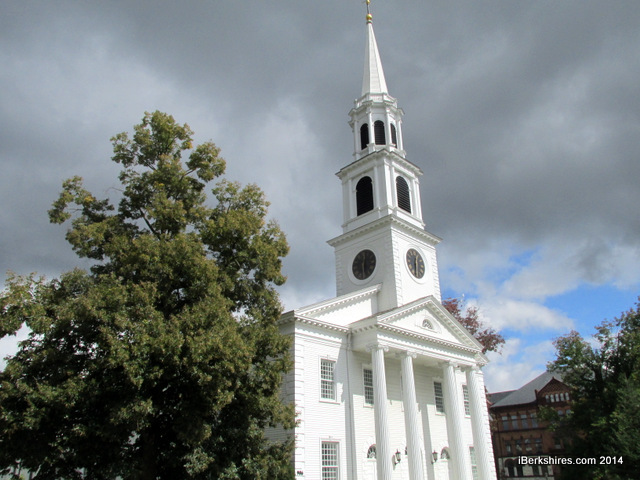
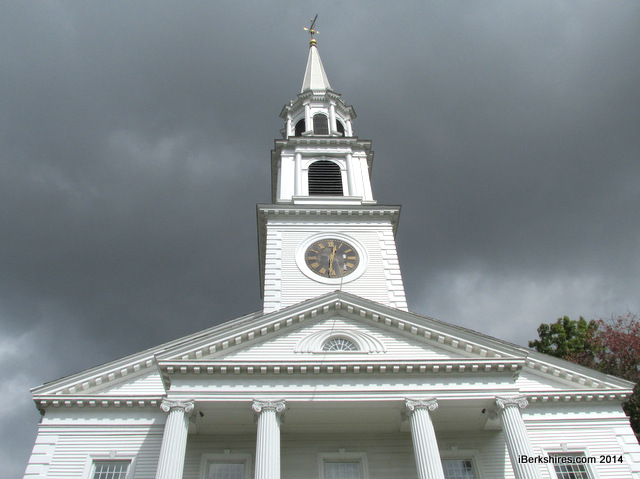 First Congregational Church is marking the centennial of its Georgian revival church. First Congregational Church is marking the centennial of its Georgian revival church. |
WILLIAMSTOWN, Mass. — First Congregational Church, one year short of its 250th anniversary, is getting a head start on the celebration by marking the centennial of its white clapboard church.
Church Moderator Moira Jones said the 100th anniversary will be "low key," although the congregation marched in the July 4 parade to let the community know about the anniversary.
A talk at the church has been scheduled and an exhibit at the Williamstown Historical Museum will be free and open to the public.
Jones will speak on the building Sunday morning, Sept. 21, around 11:15, following church services; Trevor Murphy will focus on the steeple's clock.
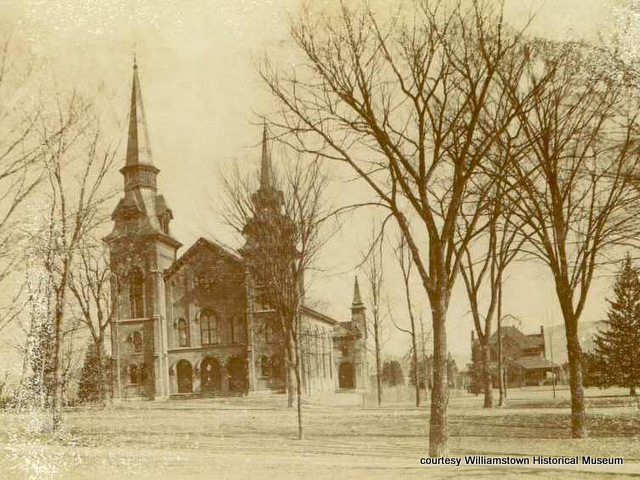
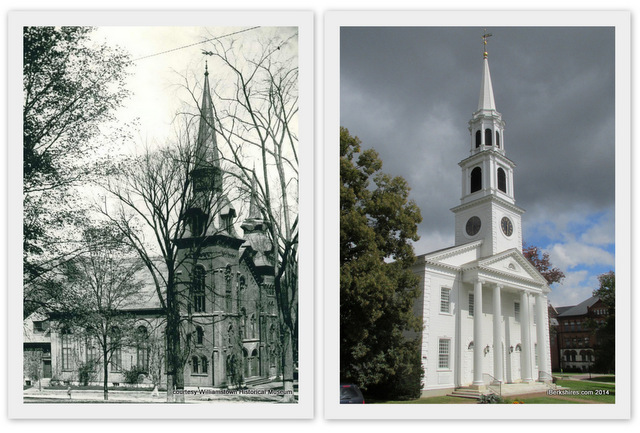
The white building with its soaring steeple, an iconic representation of a New England church, hides the remains of the original brick neo-Romanesque building behind its walls.
The remains of two spires that adorned the building are now only visible from the highest point inside the current church, where they were encased during extensive renovations.
For a century, the steeple clock, which can be seen from dorm-room windows, has motivated Williams College students to scurry to classes.
The church and college have always been linked, Jones said, and neither could have been established in Williamstown without the other.
Col. Ephraim Williams had bequeathed money for the establishment of a free school in West Hoosuck, with the condition that the hamlet be renamed Williamstown. But in accordance with the laws of the colony of Massachusetts at that time, "a town could not be incorporated without a minister being settled there," Jones said.
In 1765, the Rev. Whitman Wilson was called to West Hoosuck to organize and serve as pastor of its Congregational church. With town renamed, fulfilling the proviso in Williams' will, a free school was established in 1791 that two years later would become Williams College.
Initially, the church held services in a log meetinghouse built on the town square, what is now Field Park. A second meetinghouse built there burned to the ground in 1866.
"The church, unfortunately, had spent extra cash sprucing up for the 100th anniversary," Jones said, and lacked the funds to rebuild.
Primed with a $7,000 gift from college and local fundraising, a new church was built on Main Street a stone's throw from West College to serve both town and college.
"A brick Neo-Romanesque with stained-glass windows and sized to fit the whole college," said Jones. Several college presidents presided over the congregation during this period.
When Grace Hall, now known as Thompson Memorial Chapel, was completed in 1904, the Congregational church was no longer needed to seat 500 for students' worship or to conduct commencement ceremonies.
Other changes were on the horizon: In the early 1900s, Williams' architects, the well-known Olmsted brothers, suggested that the college should adopt the Georgian architectural style like that of East College.
"Our 1849 building was not in the least Georgian, and Williams decided it would nice if it was not there," said Jones. "They offered to buy it and help us settle somewhere else. We declined the offer."
The church remained standing on its current site but it was renovated.
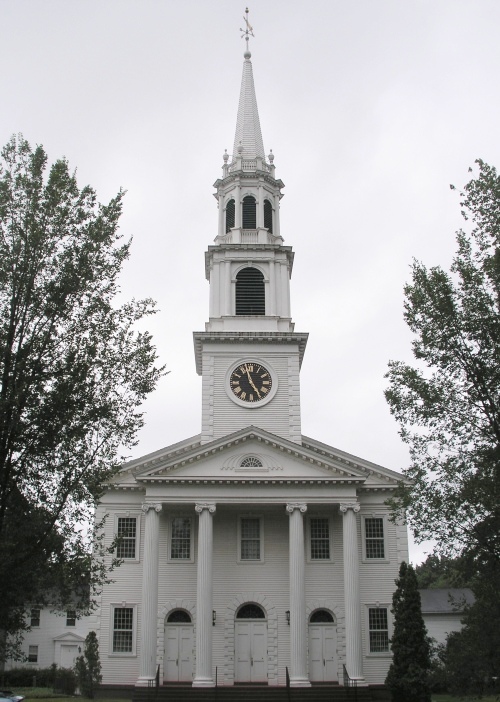 The renovation was based on First Church in Old Lyme, Conn., above, restored after a fire in 1907. The renovation was based on First Church in Old Lyme, Conn., above, restored after a fire in 1907. |
"Robert Cluett paid for the entire renovation," according to Jones. Cluett, a wealthy Troy, N.Y., businessman who summered in Williamstown, was very generous to the congregations he attended. The resulting white clapboard New England church has become a symbol of Williamstown, as pictured on postcards and websites. It was dedicated on Sept. 27, 1914.
The interior of the church was renovated "to make it less cavernous," Jones said. "We took out the gallery and stained-glass windows."
The number of congregants fluctuated over the years, and Jones attributed the need to put an addition on the back of the church in 1962 to the postwar baby boom.
But the membership began to decline shortly afterward and into the 1970s, which Jones noted happened in most churches.
"We found more and more space sitting empty, so we decided to make ourselves a center for local non-profits."
Space was first rented to the Counseling Center of the Berkshires. Now the Hoosic River Watershed Association and Higher Ground are also tenants.
"With an increase in the congregation and more ministries, we find we are now tight, and we have been approached by a nonprofit for rental space," Jones said.
The church is launching a capital campaign in hopes to raise enough money to finish a second story started in 1962 when the addition was put on.
Besides adding space, "we need to renovate our kitchen — things are beginning to fail — and fix the floor of the Fellowship Hall, where the tag sale and ABC linen and clothing sales, as well as fellowship dinners, such as the Williams College Chinese and Korean student dinners, are held," Jones said.
That's a lot of history to cover in Jones' Sept. 21 talk.
"I will talk about the 100th anniversary of our current building, which is in some ways backward," she said. "As we will next celebrate the 250th anniversary of the founding of the First Congregational Church in Williamstown."
Tags: church, historical building, lecture, local history,