Voters Asked To Expand Bottle Deposit Bill
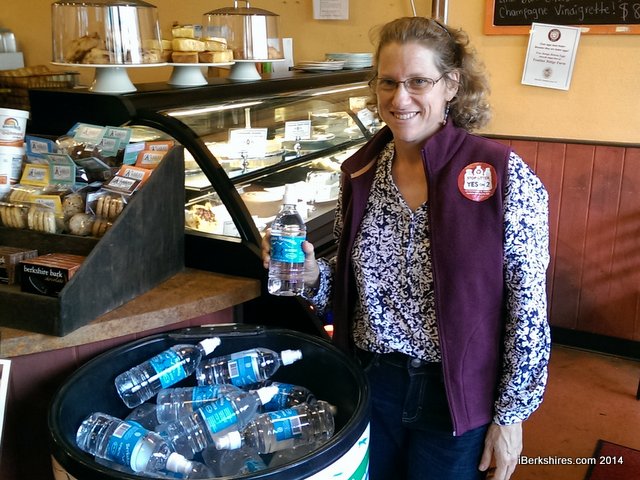 Jenny Gitlitz is pushing for a deposit on water bottles to encourage more recycling. Jenny Gitlitz is pushing for a deposit on water bottles to encourage more recycling. |
But each year, a bill expanding the deposit has sat at the legislative committee level.
In November, the groups are bypassing the entire Legislature and bringing the question directly to the voters.
The bottle bill expansion is Question 2 on the general election ballot, one of four ballot articles being presented to voters.
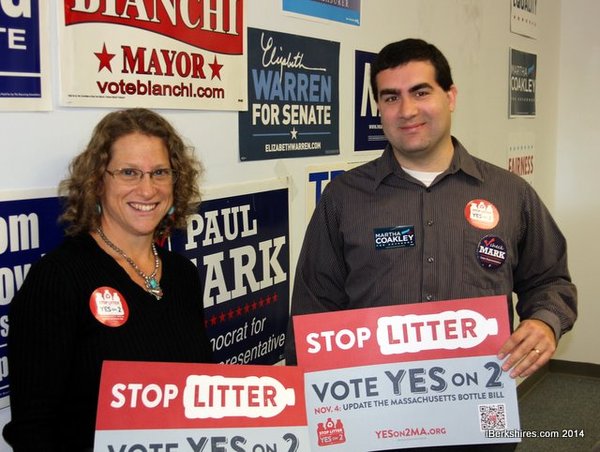
"The public will is being thwarted by industry money. So the ballot initiative process is seen as a way around that. Let's take it directly to the voters," said Jenny Gitlitz, who has taken on the role of the Berkshire's regional coordinator for the Yes On Question 2 campaign.
Gitlitz remembers testifying on Beacon Hill nearly 15 years ago in favor of expanding the bottle bill. But she says grocers and producers have fought against it. For Gitlitz, the bill is "the most effective recycling program" in the country.
"The largest category is water. It would extend the 5-cent deposit to them and basically it would bring the existing bottle bill in line with where the beverage market has gone," Gitlitz said. "When our bottle bill was enacted in 1982, there were no water bottles on the market."
Gitlitz says 80 percent of carbonated beverages are recycled in Massachusetts compared to only 23 of non-carbonated ones. The bill would put the deposit on those items except dairy products.
"The places we consume beverages is also different. We are not just consuming them at home with lunch and dinner but we are consuming them when we are mobile. When we are out and about, away from home, we're on the go. When you are on the go and you finish your drink, what are you going to do with it?" Gitlitz said. "If there is a 5-cent deposit, you think 'I'm going to bring this home and redeem it." If there is no 5-cent deposit, you just look for a garbage can."
Those non-carbonated beverages are taking up 40 percent of the beverage sales now, she said.
She said the environmental reason behind recycling is compelling. When a container is thrown away, the materials are wasted and the producers use energy and raw materials to manufacture more.
"There is a huge amount of material resources and energy resources that goes into production of bottles and cans," she said.
Not only are there resources being used to create replacement containers but many of the non-carbonated containers are ending up as litter. The campaign estimates some $6.7 million of taxpayer money for cleaning up litter could be saved with the passage of the expanded bill.
She added that charity groups and really low-wage earners go out and collect the bottles and cans thrown on the streets for the 5-cent deposit — boosting the number being recycled.
While financial incentive may increase the number of bottles being recycled, a coalition of grocers and beverage producers are opposing it. The companies have to pay a little more than half of the deposit to the redemption centers to process the recycled cans. Without the deposit, the companies aren't responsible for that recycling fee.
"You have to handle waste so who has to pay for it? Should it be the taxpayer or the industry themselves, who design it to be a one-way container and profit? They make billions of dollars on these. Somebody has to pay for the waste and we think it should be the producer," Gitlitz said.
The non-carbonated beverages are being disposed of by the taxpayers, who pay for curbside trash removal. Gitlitz said jobs will be created in the recycling field, paid by the companies that are profiting from the disposable containers, instead.
Opponents say the bottle bill will cost $60 million a year, far more than curbside disposal. They say more effort should go into making recycling easier and more efficient rather than imposing what they describe as another. The state has benefited far more from uncollected deposits on the bottles and cans (some $30 million) than consumers or distributors.
"When you pay your taxes to the IRS in April, do you get 100 percent of them back?" Gitlitz asked. "The deposit is fully refundable and if you choose to get your deposit back it is yours to have. It is not a tax," she said.
The producers have launched a counter campaign of their own including spending millions of dollars in advertising. Despite multiple attempts from iBerkshires.com to hear their viewpoint, calls have not been returned from the "No on Question 2" campaign. iBerkshires will update this story should they respond.
Litter is what drove the first bottle bill. After World War 2, disposal products were created as a convenience. When litter started to become a big issue, the bottle deposit was crafted. In 1972, Oregon passed the first, which has now expanded to several states.
Many states are being asked by the opponents of the deposit for repeals, which Gitlitz said could be threatened in Massachusetts. With the grocers putting up millions of dollars fighting the ballot initiative, Gitlitz said if the Yes campaign doesn't win, the companies have cause to push for a repeal of the existing law.
"They are going to outspend us by many, many times. They could spend $10 million fighting this. They could outspend us 20 to one. If Question 2 fails, they are going to say the voters of Massachusetts rejected the bottle bill. They are not going to say 'our side spent $10 million in negative TV ads and MassPIRG spent $200,000.' They're just going to say the citizens of Massachusetts rejected the bottle bill," Gitlitz said. "And that is going to give them leverage to push for a repeal."
In the Berkshires, which has a strong base of more progressive voters, Gitlitz is doing what she can to raise awareness of the issue and ensure voters get to the polls.
"This is our shot. This is our chance. You are not going to have a ballot initiative fail and the come back and do it again next year. It is not like the legislative process where there is an expectation that it is going to come back multiple years before it passes," Gitlitz said. "If we win, we win big. We have an expanded bottle bill. If we win and get the expanded bottle bill we will be joining other states that have already done this."
Tags: ballot, bottle bill, deposit, election 2014,