Architects Dive Into Detailed Designs For New Taconic School
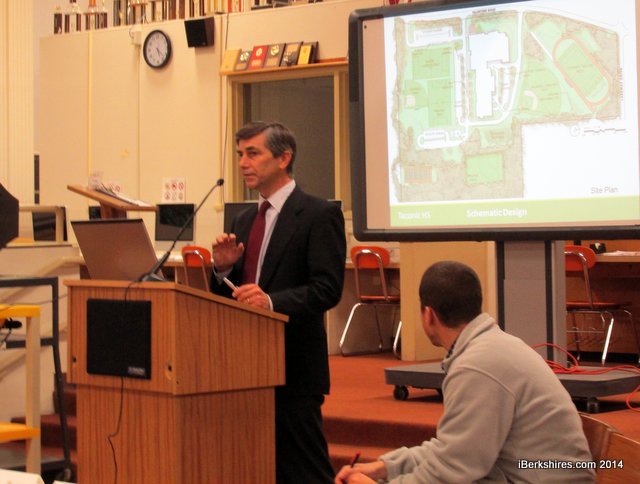 Carl Franceschi presented the School Building Needs Commission a series of illustrations of what he envisions for various spaces in the new school. Carl Franceschi presented the School Building Needs Commission a series of illustrations of what he envisions for various spaces in the new school. |
Drumney Rosane & Anderson Architects Inc. are starting to dig into the details of design — from the electrical infrastructure to the amount of glass used in the entrance.
The Massachusetts School Building Authority approved last month of the preliminary designs, studies and educational plan — moving onto to the schematic design phase.
Carl Franceschi, of DRA, says they have dug right into the designing work. They've met with the Department of Utilities, the Fire Department, Community Development, Conservation Commission, and the Buildings Department to sort out the details of permitting. And, they delved into designing the various rooms.
"One of the requirements of this phase of design is schedule. And part of the schedule is permitting," Franceschi told the School Building Needs Commission.
And so far, "everything is falling into place with this basic layout."
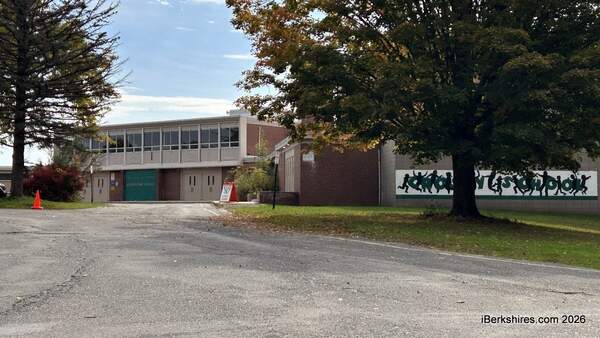
The plan on building the new structure on the north side of the current entrance hasn't change for the 247,700 square-foot, three-story building. The shops will be on the first floor and classrooms above.
"That can be done and acoustically, there is no problem with the sound going from the shop into the classrooms," Franceschi said.
Now the architects are getting into measurements such as the width of the hallways in order to firm up the exact square-footage of each aspect. And they recently met with school staff to help detail the needs of the shops.
The architects are also looking deeper into the parking situation, considering how many spots are wanted and needed — such as extra spots for playing fields. That has to be coupled with impervious surfaces, which causes more drainage work.
"We want to minimize the impermeable surface and not build overly excessive parking," Franceschi said.
Franceschi showed some ideas for spaces. On the front entrance, DRA is looking to use a lot of glass, facing south, to take in the sun. He said the backside of the building would likely have an "economical facade" in order to invest more in the front.
Most of the building will have flat roofs but some spots — like the library — will feature a large slanted roof, designed to be aesthetically pleasing.
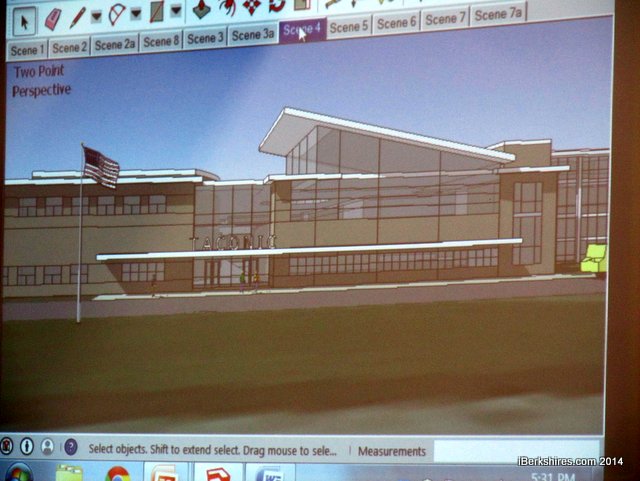 He also presented a 3D image of the envisioned building. He also presented a 3D image of the envisioned building. |
He said he's heard some concern over the roofing with many people suggesting leaks occur more often on the flat roofs. Franceschi said sloped roofs have more intersecting points where they could leak. And they cause more construction, more insulation and more utility costs to heat the extra space. Finally, he said slopped roofs could cause a dangerous situation with ice and snow in the winter.
Instead, he suggested that if leaking was still a concern that the committee could decide to use some of the money that would be spent on a sloped roof and instead hire a roofing engineer to oversee the installation of the flat roof to ensure top quality.
The library is where he suggests a sloped roof. There, he envisions a lot of glass separating rooms, a lot of technology and using the corridors for learning, too. The cafeteria is also being seen as a "multipurpose space" that can be utilized in a number of different ways.
Franceschi showed the committee a number of photos from other schools with similar spaces.
Tags: school building committee, Taconic High,