Pittsfield Proposes Raising Building Permits & Inspection Fees
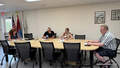
 As members of the Ordinance and Rules subcommittee Councilors Kathleen Amuso and Melissa Mazzeo reviewed the proposal on Monday. As members of the Ordinance and Rules subcommittee Councilors Kathleen Amuso and Melissa Mazzeo reviewed the proposal on Monday. |
The City Council is being asked to raise fees for the building, plumbing, gas and electrical departments as well as remove caps from some permits — caps that limited costs for larger projects.
"They are modest increases. They aren't high at all," said Building Commissioner Gerald Garner on Monday when he presented the increases to the City Council's Ordinance and Rules subcommittee.
"By next year, we may be behind the eight ball again."
Garner says the city hasn't raised fees for these services in five years and the new costs are "on par" with similar communities in the state.
"This will put us on par with Springfield, Holyoke and some of the gateway communities," Garner said.
Garner estimates the city will see an increase in revenues — which go back to the general fund — of some $180,000.
Permits for new construction, for example, had cost 35 cents per square foot up to $10,000. Now, the permit for new construction is 35 cents per square foot but does not stop when it hits $10,000. The cap for electrical work on commercial properties was also removed — it was $3,000.
The fee schedule also adds new fees for mechanical and sheet metal permits the city is now required to issue.
"There are several things that have changed over the years," Garner said.
Overall, Garner said the permitting takes in more than $300,000 each year and pays for the department's budget. Ward 5 City Councilor Jonathan Lothrop asked Garner to push for more staffing to improve the efficiency and speed in which permits are granted with the additional revenue.
The Ordinance and Rules Committee voted to recommend the changes to the full City Council.
For residents, most of the permits have increased by $10. Roofing, siding and insulation and replacement of windows would cost $6 per $1,000 of work, which is up from $5; the minimum building permit fee would rise $10 to $35; additions, alterations, repairs, decks, porches and three-season rooms would go from 20 cents per square foot to 30 cents per square foot with a $35 minimum; garages, barns shed and gazebos would rise from 20 cents per square foot to 25 cents per square foot.
Permits for stoves would go from $30 to $35, fences from $25 to $35 and tents from to $35 from $25.
Demolition for both residential properties and commercial would also increases. If the demolition is between 500 and 2,000 square feet, the permit would cost $70, up from $50, and over 2,000 square feet the cost is proposed at $140 from $100.
The city is proposing to add charges for three new certificates — a certificate of approval, zoning certificate and home occupation. Each of those would cost $35.
Commercial properties would see an increase in additions, alterations and repairs from 20 cents per square foot to 30 cents per square foot with a $50 minimum. The plan adds a section for roofing, insulation, siding and windows for a cost of $6 per $1,000 of construction costs. And certificate of occupation and zoning verification certificate is proposed at $35 and a certificate of approval at $50. The new mechanical and sheet metal permits are proposed at $6 per $1,000.
It will also cost businesses more for signs. They'll be asked to pay $75 for installation costs up to $750 and $200 above the $750 mark. This is up from $34 and $100.
As for utilities, plumbing and gas applications (the base permit) would both rise from $25 to $35.
The minimum electrical permit is proposed at $35, up from $30. Miscellaneous electrical work is up to $70 from $60. Modular home electrical inspections — four in total — would cost $140, which is up from $120. A new home or condo inspection would rise $25 to $175; hot tub inspections, oil or gas burner inspections and fire alarms and security systems would increase by $5 to $35; swimming pools to $35 for above ground (from $30) and $105 for in-ground (from $90).
The minimum for commercial electrical work would be $150, which is up from $100; the cap of $3,000 would be removed. New construction costs would be $6 per $1,000 worth of work, which is nearly double the previous price of $3 per $1,000. Commercial fire and security alarms and additions inspections would be $50, up from $40.
The full schedule of fees is available below.
Pittsfield Proposed Schedule of Fees
Tags: fees, inspections office, ordinance & rules , permitting,