Lanesborough Research Committee Weighs School Affiliation Pros & Cons
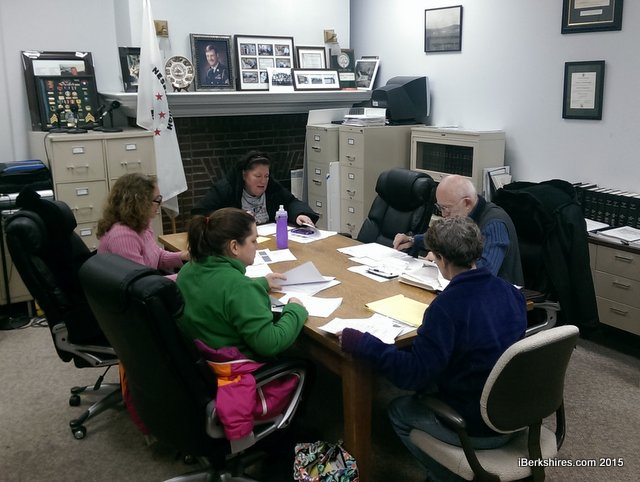 The research committee has been meeting weekly to discuss school issues. The research committee has been meeting weekly to discuss school issues. |
The task force formed in November to research the pros and cons of potential administrative structures for the school system.
The town had previously been in an agreement for elementary school services with Richmond and Hancock elementary schools through Union 69 but that ended some years ago. Now the town is in the Supervisory Union 71 agreement with Williamstown.
However, school officials in both Lanesborough, Williamstown and the Mount Greylock Regional School District are considering growing their relationship into a full regionalization — while at least one school committee member wants to look elsewhere.
The Selectmen appointed a nine-member committee in November to look at an array of options as major school decisions approach in the coming year, including the hiring of a superintendent for the so-called "Tri-District."
Personality clashes marked the nine-member committee's initial gatherings, but after three resignations, a smaller, more cooperative, group emerged. Since November, the committee has been meeting weekly to flesh out issues with current administrative system and has crafted a criteria matrix to assess eight different options.
On Thursday, the group weighed pros and cons of the Union 69-type model, the current Tri-District model and a model that would keep Union 71 and Mount Greylock Regional School separate.
Overall, the committee members say they like the quality of education the current system provides, the extracurricular activities, the sports, and the proximity of the three schools. But, they say the system doesn't provide equity — an issue that may not be solved with a new structure.
"It is about, why is there no communication? Why does it always break down? Why do we feel like the ugly stepchild?" said Carole Castonguay.
"I think that in Lanesborough, you have to fight for some of the things that Williamstown kids are automatically offered."
As an example, Castonguay said events like pasta dinners for sports are mostly held in Williamstown. And when they are held in Lanesborough, none of the Williamstown students attend.
Lanesborough School Committee ChairwomanRegina DiLego, who serves on the SU71 committee, said she has similar issues with flexibility with meeting times and locations. She is often asked to attend daytime meetings in Williamstown and she ends up being late because of her work schedule.
"We need to work to raise awareness. The onus is on us as much as it is on them," DiLego said.
DiLego's scheduling conflict to elected boards is similar to what Castonguay faced when she was part of the Parent-Teacher Organization. Because of the difficulty in making meetings, Castonguay was the only parent from Lanesborough in the group.
But it is not just issues with travel, it is the voice over the administration as well. Superintendent Rose Ellis stopped attending Lanesborough School Committee meetings while continuing to be focused on Williamstown issues. That "paralyzed" the Lanesborough School because it had no access to the top executive, said Castonguay.
If Lanesborough doesn't like the actions of the superintendent and Williamstown does, there is no recourse. Both towns have equal say, so one town can't discipline the superintendent without the other's agreement.
When it comes to budgeting, there is an issue with Mount Greylock Regional School, which children in both towns attend beginning in middle school.
The cost-sharing agreement determines how much each town pays: Williamstown has been willing to spend more, but in doing so, would raise Lanesborough's costs as well. If Lanesborough objects to the budget, a district vote is presumed to go in Williamstown's favor since it has greater population.
DiLego says that conflict could be resolved through re-negotiating the agreement.
While access to the superintendent may be a disadvantage with the current agreement, the committee was happy with its access under the previous agreement. The town paid a higher percentage of the cost for a superintendent in Union 69 but the superintendent's office was in Lanesborough School.
In judging the 32 issues identified in the criteria, an agreement like Union 69 had more cons than the existing one. Separating Mount Greylock from the agreement as had been the original case (the move toward regionalization and retirement of Mount Greylock's superintendent prompted the Tri-District) had the same number of pros and cons — though there were some that were undetermined.
After discussing and evaluating the three known structures, the committee will now focus on five other options — full regionalization, expand the school region to include other towns, reducing the superintendency agreement to only a shared services agreement, changing the union and region, and tuitioning high school students.
From there, the committee will rank the options in costs. Then they'll ask the Selectmen to narrow down their options for an investigation into the implementation issues.
Overall, the committee hopes to be done by the middle of February and will present the Selectmen an overview of the issues facing the various options.
Tags: regionalization, school system, SU71,