Remembering Savoy's 'Crooked Forest'
 |
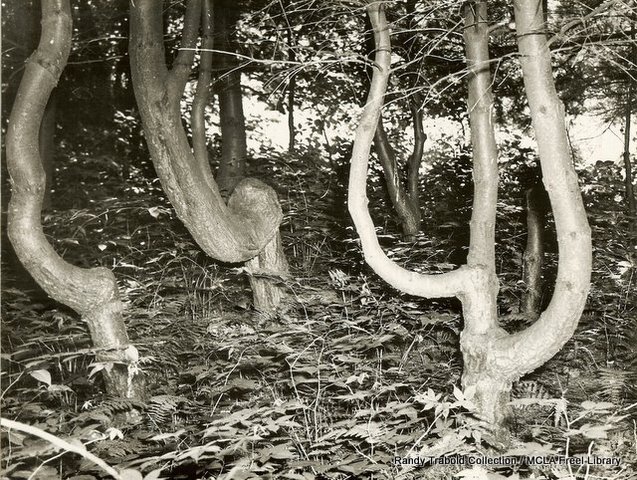
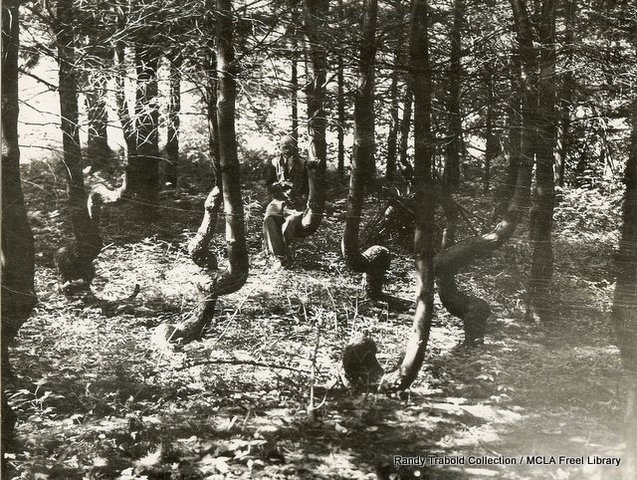
.jpg) All that's left of Savoy's Crooked Forest are archival photographs that forever captured the odd growth. All that's left of Savoy's Crooked Forest are archival photographs that forever captured the odd growth. |
Lost within the treeline of a Berkshire town that's become more forest than settlement, one curious patch of woodland has invited curious hikers for the better part of a century.
Once a would-be tourist attraction, the intriguing mystery of Savoy's "Crooked Forest" still calls out to some interested explorers, though this arboreal accident of nature is now more likely to be found in archival photos than in the dense acreage of Savoy Mountain State Forest.
Alternately dubbed the "Hansel and Gretel Forest" by Arthur Palme, founder of the longtime Berkshire Museum Camera Club, the story of this unusual grove began not unlike that of much of the region's forest, part of many thousands of acres of trees planted by the Civilian Conservation Corps in the 1930s. The results of most of the plantings are amply evident today throughout the large tracts of state land across the county, but the story of one small patch of white pines near Borden Mountain came with a twist – quite literally.
"Taking pictures at the Crooked Forest in Savoy was always an interesting assignment for me," longtime North Adams Transcript photographer Randy Trabold recalled, who took some of the first images of the bizarre growths in 1939, recalled in 1975.
About a mile down the treacherous Bannis Road from Tower Cemetery, an area of about a quarter acre held some 200 of these strange trees, whose shared feature consisted of a deep bend in their trunks, about a foot and a half off the ground.
"They all lean the same way," writes Arthur Myers in The Berkshire Eagle following a visit in 1957, "A few are shaped like lyres without the strings. There is one interesting little stump that's a dead ringer for a baby elephant ... one like a camel, if you use your imagination. Another looks vaguely like the Loch Ness Monster."
One story about its origins, relayed in an old pamphlet on Savoy history, is that some CCC workers backed over this portion of woods in a heavy truck, causing them to develop poorly.
The more plausible explanation provided by many past foresters of the state park, is that the Crooked Forest was created when harsh winter storms in their formative years piled snow and ice on the young saplings, bending them over with their weight. The trees grew horizontally for some time after that, but eventually righted themselves, responding to the inexorable call of the sun.
Such curved groves are rare, but not unknown, the most famous example being another "Crooked Forest" in northwestern Poland.
This grove numbers about 400 pines, enveloped within a larger forest of pine trees, bent at an even more pronounced angle even closer to the ground. Poland's Crooked Forest is also thought to have been distorted by weather conditions, though other theories have been proposed, from human alteration to unknown magnetic forces, and even aliens, that seemingly obligatory go-to for matters of historical speculation.
Savoy's "Crooked Forest" is believed to be the only such grove of its kind in New England, though, and during the early 1950s, a brief attempt was made by the Mohawk Trail Association and Adams Chamber of Commerce to establish it as tourist destination. This was met with some hesitation by state forest officials, who commissioned signs to the natural curiosity, but never installed them, as they were reluctant to lead many visitors down a problematic unpaved road where they might easily become stuck.
There was a more insurmountable problem, as well; the Crooked Forest was already dying.
Perhaps unbeknownst to early CCC workers, whose knowledge of forestry has often been called into doubt by later arborists, white pines do not fare well at such altitudes as this mountainous area of Savoy. This fact, no doubt further complicated by the circumstances of their distorted early development, left the lopsided bit of woods in poor health, and continued deterioration claimed many of the curved pines over the coming years.
An estimated 200 such trees had withered to half that number by the '50s, and in 1967 it was reported that only about a dozen or so survived. A decade later, the trees were virtually extinct, and the "Crooked Forest" had essentially vanished from sight.
Over the following decades, curious seekers have continued to look for Savoy's legendary Crooked Forest, in the hopes of finding a few of the bizarre plantings still alive. Daniel Boudillion, one of New England's most accomplished backwoods explorers, tromped the trails of Savoy in one such search as in 2002, and came up short.
This more or less closed the book on the once-legendary grove, of which only old stories and a handful of captivating photographs now remain.
The woods of Savoy still hold many stunning sights, though, from Tannery Falls to its two "balanced rocks," obscure relations of their more well known Lanesborough cousin. These features of landscape, along with the still-remembered stories of Crooked Forest, entreat us still to wander the woods, and remind us to look up, and look around – for who knows what new twists of nature will arise to fill us with wonder and curiosity.
This column is born out of an attempt to break new ground, or at least break out of a certain habitual mold of local history storytelling. While the Berkshires have enjoyed many great historians and much outstanding historical writing, it is my belief that there is a great deal that may have fallen by the wayside in its attempt to hammer out a unified narrative in its vision (and marketing) of itself.
There are tales that have become nearly lost in the crevices, and others which, though not totally unknown, remain to be rediscovered and shared with new generations. While there will still be some dabbling in the kind of social happenings, industrial innovation, cultural artistry, and luxuriant architectural fare that has helped place the region on the map, these will not be its primary province. Instead, themes of natural history, archaeological discovery, forgotten figures, Native American life, "true crime" of yesteryear, the occasional political scandal and the more eccentric slice-of-life stories of its residents will be far more prominent in its meanderings. It is my sincere hope that you will enjoy these varied snapshots from the many millions of transactions between places and personalities that went into making this thing called the Berkshires.