Williams Team Breaks Record on Lego Star Destroyer Build
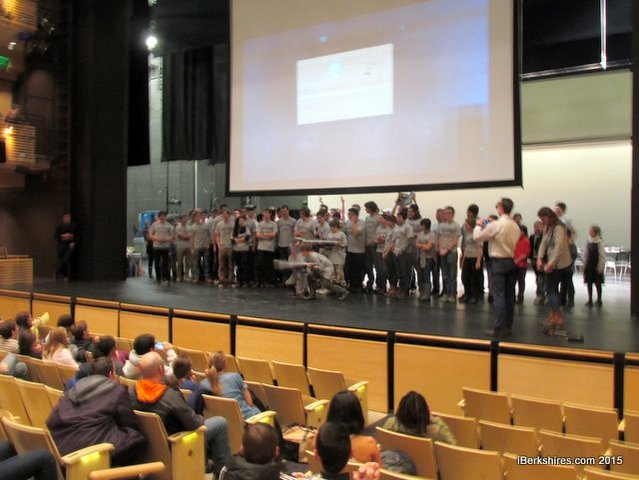
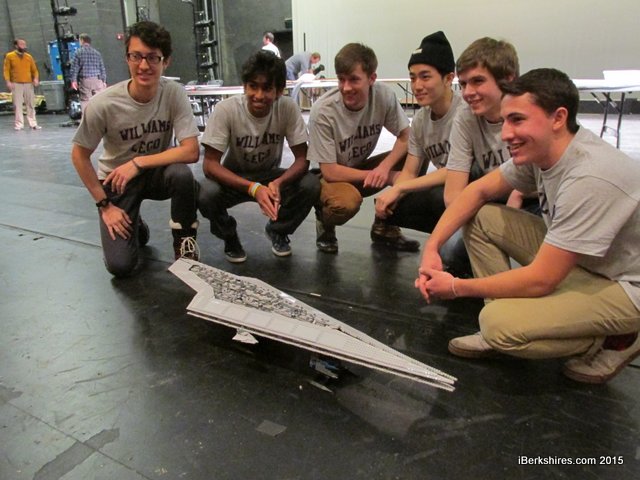 Some of the students pose with their creation on Wednesday. Some of the students pose with their creation on Wednesday. |
WILLIAMSTOWN, Mass. — The Lego "team" at Williams College proved a Force to be reckoned.
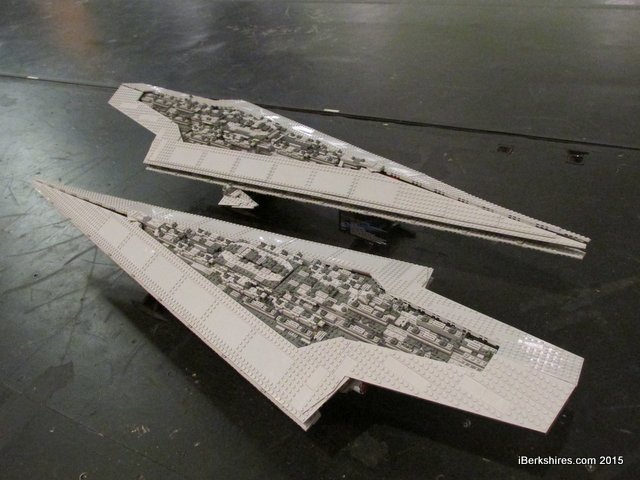
Some 70 students from the college and Williamstown Elementary School snapped more than 3,000 Legos together to create a Super Star Destroyer in less than 10 minutes.
In 9 minutes, 31 seconds to be exact.
That's nearly a minute faster than last year's attempt.
The record-breaking event took place Wednesday afternoon at the '62 Center as parents and the Williams community cheered them on.
Fifty-nine of the ship-building students had been taking "The Mathematics of Lego Bricks," a monthlong Winter Study class offered by mathematics professor Steven Miller. This culmination of the class set the goal to build the Lego set in under 10 minutes.
"The problem was to choose a time that was long enough to be possible, short enough to keep things interesting," said Miller.
The professor said Legos have a lot of ways to illustrate math and problem solving, starting at the most basic level: "How many ways can I put the Lego bricks together."
The program also gives students an opportunity to experience the need for efficiency and teamwork under stress — something they may not have had to deal with at this point in their lives.
"Over here, if something goes wrong you can learn a lesson, you learn 'how do we set up an organization to both congregate authority and responsibility, to keep everybody motivated?'" Miller said.
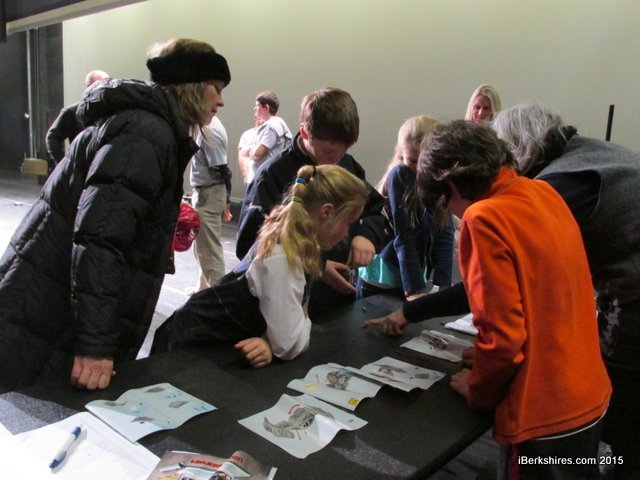
The students were very much in charge of the strategy for the build, from being in charge of the bags of specific pieces to building components so each was ready when needed. Almost a dozen Williamstown pupils participated.
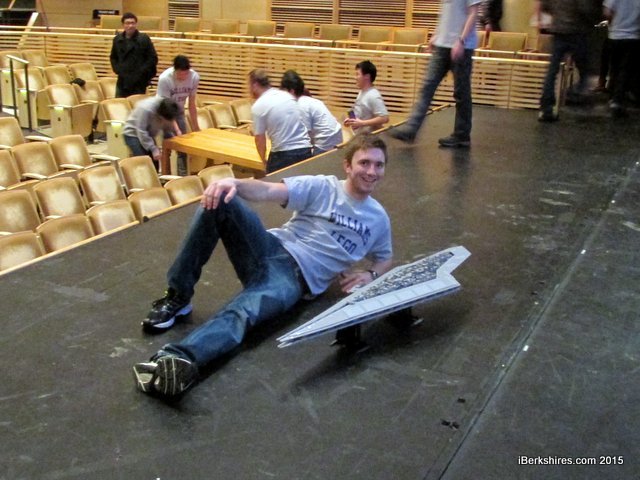
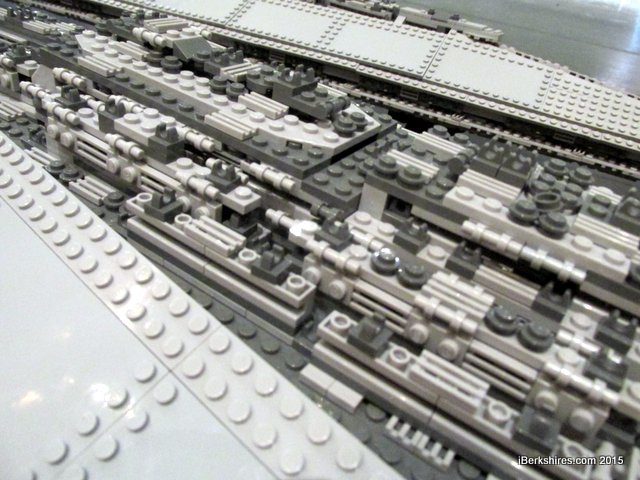
The result was 3,152 pieces combined to create the 50-inch long Star Wars Star Destroyer.
"The students were in charge of what they needed ... my job was to let them figure out how to do it," Miller said.
The event took place on the MainStage with a camera recording the action from above for the audience to follow along.
Miller hopes to involve Williamstown Elementary more next year with an "Adventures in Learning" program.
In the spring, he's planning to bring the community and college together for some inspirational building at Williams College Museum of Art with a more than 4,000-piece Lego London Bridge.
"The goal is to just get a bunch of pieces and give them to the kids to be inspired," he said. "I've done a lot of things in the '62 Center, I've done a lot of things in WCMA this year.
"This is one of the things that make Williams such an attractive place to be, this sense of community and crossing the boundaries."
As for the Guinness World Records, Miller said the cost is a couple thousand to be listed.
"It would be nice to be in the Guinness Book to show people, but I'd much rather use the money to buy things ... we can buy a lot more sets and can have a lot of fun."
Tags: community event, competition, math, Williams College,