Cheshire Passes School Budget, Pipeline Resolution, And Selectmen Membership Increase
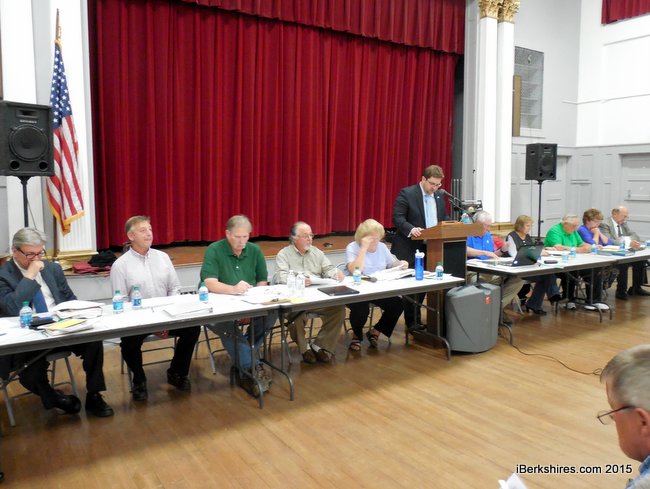 Voters at Monday's annual town meeting approved a resolution opposing the Kinder Morgan natural gas pipeline and a petition to increase the size of the Board of Selectmen. Voters at Monday's annual town meeting approved a resolution opposing the Kinder Morgan natural gas pipeline and a petition to increase the size of the Board of Selectmen. |
CHESHIRE, Mass. – After a near three-hour town meeting, Cheshire passed the entire budget, made a stand against the Kinder Morgan pipeline, voted to start the process of increasing the membership of the Board of Selectmen, and adopted a noise bylaw.
Nearly 170 voters were in attendance to decide the 18-question warrant at Cheshire Elementary School on Monday night.
The Adams-Cheshire Regional School District budget, which requested $2,586,477 from Cheshire and triggers a Proposition 2 1/2 override for $90,000, didn't pass easily.
A motion was made and seconded to cut $380,156 from the district's foundation budget, however, that was knocked down by school officials and supporters.
School Committee Vice Chairwoman Darlene Rodowicz said the district already has one of the lowest per pupil spending in the county and even if the district received the full $480,000 originally requested, it would still remain at the bottom. She said the proposed cut would translate into a $1 million reduction when Adams' share is taken into account.
"You cannot expect a good education if you continue to cut, and I can't imagine what this community will look like if you don't think education for our children isn't a priority," Rodowicz said. "We have children that need us to be thoughtful, accountable, and mature adults and to slash the $380,000 out of the foundation budget ... is irresponsible."
Resident Gary Trudeau, who made the motion, said he found numbers on the state Department of Education's website that show Adams-Cheshire overspends on its educational salaries. He also referred to dropping scores in math, English, science, as well as standardized state testing in the district.
"That is just ridiculous for us to be spending an extra million a year on salaries for educators, which is over our budget," Trudeau said. "At some point we have to put an end to this wasteful spending and start getting people on track."
He said one of his children has had a difficult time getting into certain colleges because of Adams-Cheshire's record and cutting the budget would "send a strong message to the schools to start straightening itself out."
Superintendent Kristen Gordon responded that more than 50 percent of the children Adams-Cheshire receives in kindergarten are well below grade level and are "starting in a hole." She said there is direct correlation between how much communities spend per pupil and student success.
"If you keep making us the lowest per pupil in all of Berkshire County, with class sizes of 26 and 28, and a low-income population of over 60 percent of our elementary school students, these are the scores you are going to continue to get," Gordon said.
"I personally have never been so insulted for the district and these hard-working teachers in all of my career with those comment you have just made," she said.
 Voters hold up yellow cards to indicate their vote. Voters hold up yellow cards to indicate their vote. |
She said lower per-pupil spending makes it difficult to share resources with other schools and nullifies any plans to improve the district because they do not have the money to implement new programs. She added it will also become more difficult to attract quality educators and keep staff.
Advisory Board Chairman William Craig said cutting more money form the school will be bad for the town and dissuade families from moving in and make it more difficult to sell property.
"If we don't take action to keep the town moving forward we are going to be in a death spiral because people are not going to want to move to the town," Craig said. "We have and we need to support this and move forward."
The override vote will take place by ballot on Monday, June 15, from 9 a.m. to 7 p.m. at the Community Center. If the vote fails, the budget will return to the School Committee for reconsideration. This could translate to 28 cuts in the teaching staff.
The rest of the $5,492,693 budget passed with little opposition except for an increase in the Water Department superintendent from $15,191 to $57,500. This change did not affect the bottom line of $279,484.
Water Department Director Francis Waterman said the Department of Environmental Protection has placed pressure on the part-time staff to include a full-time position.
Residents asked for a clearer job description, the need for the position, and whether there would be enough work to warrant a full-time position.
Waterman said there should be plenty to do and if there is isn't, the employee can help the Department of Public Works. He said it would allow the department to contract out for some services for less.
Town meeting also accepted a non-binding resolution opposing the proposed Kinder Morgan natural gas pipeline expected to pass through Cheshire.
Resident Eileen Quinn, who place the article on the warrant via citizen's petition, said the resolution would state that Cheshire felt the pipeline is a danger to the health and well-being of the town and that the town should focus on green energy. It would align the town with other communities that are against the pipeline, she said.
"This pipeline will threaten the identity of our area that is a community with clean air, land, water, and the beauty and accessibility of our natural landscape," Quinn said.
Some residents opposed the resolution because Cheshire already has a pipeline.
Quinn said the proposed pipeline is 36 inches and much larger than the current one.
"This pipeline moves more gas at a higher pressure and sets us up for a greater risk," she said. "The difference is like a dirt path versus a super highway."
Town meeting passed another citizen's petition article on expanding the Board of Selectmen from three members to five. Voters will have to pass the question again at the next annual town election to implement it.
Some residents felt it would be hard to fill the board because of a lack of interest and it will only add to the budget; others felt the board does not need any more help.
Resident Richard Scholz, who submitted the article, said he felt many people who may be interested do not run because it is difficult to remove current members, who although dedicated, have been there a long time.
"The comment saying that nobody in town wants to run for this position is a little like saying nobody is swimming across the river and using that as justification to not to build a bridge," Scholz said. "You will never be able to decide how many people are going to cross the bridge by having everyone swim across the river."
He said he felt five members would add a diversity in opinion that sometimes disappears when selectmen have been working together for years.
.JPG) Eileen Quinn explains the difference between the current natural gas line and the proposed Kinder Morgan one. Eileen Quinn explains the difference between the current natural gas line and the proposed Kinder Morgan one. |
Selectman Paul Astorino said 154 towns in the commonwealth have three-member boards and only one with a population less than 3,500 has a five-member board.
He added that Town Hall is simply not big enough to support a larger board and moving to a new location would only cause complications.
Selectwoman Carol Francesconi agreed with Astorino and said she felt a three-member board offers plenty of diversity in opinion.
"I think people are diverse enough and I have had my opinion changed multiple times," she said. "But I think five members is not going to improve the government of this town."
Selectman Robert Ciskowski disagreed and felt more members would create more diversity and put Cheshire in a position to plan more ahead instead of just "reacting to emergencies." He added that residents "deserve better from the select board."
"I think with five members, we will have more turnover on the board, and I think we will have more diversity," he said. "I think we will have more ideas, and I don't think any of those are bad things."
Town meeting also passed a noise bylaw that allows the police or the Board of Selectmen to penalize offenders who make excessive noise that could cause health hazards or affect quality of life. Violators will attend a public hearing before the fine is issued.
Some resident felt the bylaw was too subjective and had no measurable standards to decide what is too loud.
Francesconi said the town never had the ability to punish violators and the Selectmen often receive complaints they cannot do anything about.
Town meeting turned down a citizen's petition article asking to appropriate $25,000 to create a master plan.
Although many agreed the plan would be beneficial, Town Administrator Mark Webber said they simply have no more money to spend and the money cannot be added to the override vote because the ballot is already set.
All other articles on the warrant passed with little or no opposition.
Tags: ACRSD, Prop 2 1/2, school budget, town meeting 2016,