Williamstown Con Comm Clears Way for Solar Project
By Stephen DravisiBerkshires Staff
Print Story | Email Story
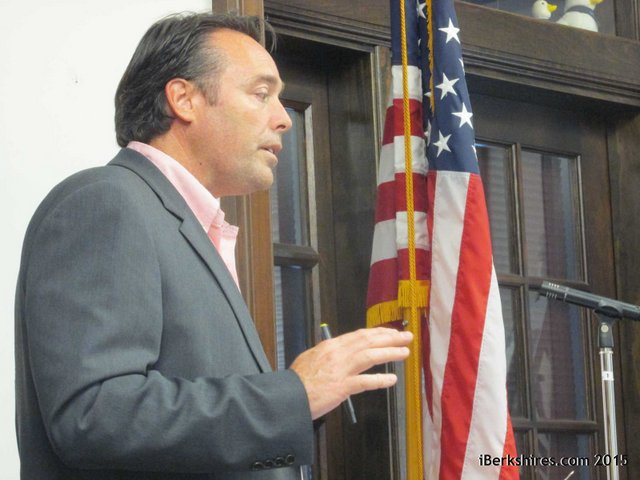
Steven Wiehe of Peabody's Weston and Sampson addresses Williamstown's Conservation Commission about the landfill solar project.
WILLIAMSTOWN, Mass. — The Conservation Commission on Thursday OK'd plans for a 1.9-megawatt solar project on the town's capped landfill.
 
The commission reviewed plans for the project with engineer Steven Wiehe of Peabody's Weston and Sampson.
 
Wiehe explained that the project will include about 6,000 solar photovoltaic panels on about 7 acres of the 12-acre site.
 
In order to avoid harming the liner that covers the landfill, the work will be done above ground, and the area with the panels will be covered by 4 inches of stone gravel, Wiehe said.
 
And to prevent the growth of vegetation through that gravel layer, the developers of the solar project asked the Con Comm for permission to treat the area — which borders a resource area — with an herbicide.
 
The commission took little time to approve the project but added the condition that the herbicide be applied with a hand sprayer on a spot basis.
 
The solar project, on which the town is a co-applicant, was approved by the Planning Board earlier in the week.
 
Wiehe told the Con Comm that developer Brightfields Development of Wellesley anticipates about a four-month window for start to finish of the project once all permitting is in place.
 
In other business on Thursday, the Con Comm reorganized itself. After serving as chairman for three years, Philip McKnight stepped down from the post, and Richard Schlesinger was elected to take his place. Sarah Gardner will serve as the body's vice chairman.

Tags: conservation commission,   landfill,   solar array,   

If you would like to contribute information on this article, contact us at info@iberkshires.com.

Letter: Vote No on 'Jungle' Primaries

Letter to the Editor

To the Editor:

They don't call them "jungle primaries" for nothing.

Question 3 on the November ballot would trash two-party primary elections and replace them with California-style, chaotic — and extraordinarily costly — "jungle" primaries that would destroy the very political parties that have kept America stable since Alexander Hamilton, Thomas Jefferson, and James Madison created them in the 1790s.

Jungle primaries put all candidates, regardless of party, on one ballot with the top two vote-getters facing off in the general election — even if they're from the same party. That would create chaos, but the real issue is money: Jungle primaries give a distinct advantage to candidates backed by corporate money and the super wealthy. In short, jungle primaries move our primaries from the ballot box to big donor meetings long before campaigning even begins.

When something this radical is proposed, you have to look at who's behind it, who's funding it, and ask "why" they are doing it.

Their philosophical guru is Danielle Allen, a Harvard professor who ran for governor in 2022 but couldn't get 15 percent of the Democratic Convention vote to win the party's endorsement.

The money behind this extreme attack on small "d" democratic politics tells us more. With over $5 million in the bank as of Aug. 28, this is a very well-funded campaign — the lion's share of which came from wealthy Boston-area private equity individuals.

Twenty-two private equity executives gave $3.99 million, or 77 percent of all the money from individuals. Current and former Bain Capital executives contributed $1.92 million, and Berkshire Partners executives put up $1.32 million. In short, 22 rich people put up nearly $4 million to change how five million of us vote. Yes, it seems the ultra-wealthy want to destroy the two-party system that has kept our politics stable for 200 years.

View Full Story

More Williamstown Stories