Berkshire School Committees Considering District Consolidations
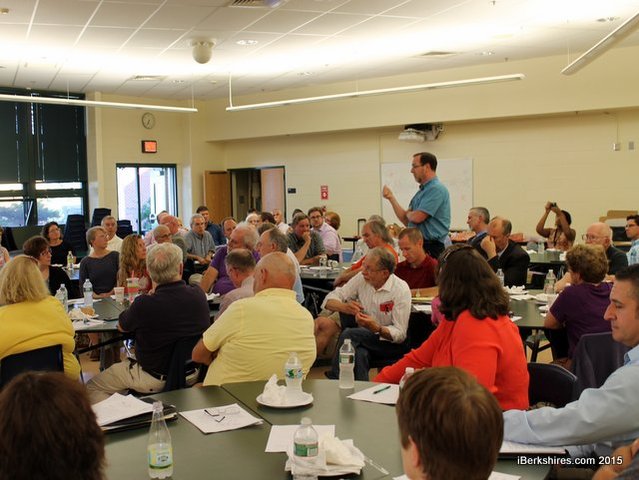
 The panel of legislators at Lee Middle and High School met with educators from various school districts. The panel of legislators at Lee Middle and High School met with educators from various school districts. |
LEE, Mass. — This year more than 60 teachers countywide could lose their jobs because of budget cuts.
School districts from Great Barrington to North Adams are struggling to support the ever-growing costs of public education.
With high school enrollment decreasing to what is eyed to be about 4,689 in just 10 years, school committee members across the county are wondering if now is the time to consolidate the more than a dozen high schools.
A coalition of school committees met with state legislators Monday in forum about what needs to be done to curb the cost of education spending.
"This is a conversation we probably should have had five years ago," said state Rep. William "Smitty" Pignatelli of Lenox. "Don't be intimidated by boundary lines. ... We have an opportunity to do something now across every school district. Let's not get hung up on the parochialism."
State Sen. Benjamin Downing, D-Pittsfield, said if the county started from scratch right now, without any school debt or obligations, the districts wouldn't be crafted the way they are. Downing said there should be fewer than eight high schools in the county. Even if the state boosted its regional transportation and special education aid, and changed the charter school reimbursement, towns would still eventually be facing a cost crisis.
"Where we are right now isn't sustainable or right," Downing said, and called for an "intentional regional planning process." "I think we need to be working countywide. There needs to be a planning process."
Monday's conversation at Lee Middle and High School grew out of an ad-hoc grouped in Central Berkshire and expanded to the rest of the county. In South County, a similar group is looking into sharing services to reduce costs. School officials from north to south are now taking a careful look at what the entire educational picture will look like in the future.
"We are shrinking in population. We are aging in place. We have small school systems and rising school budgets," Pignatelli said. "I'm tired of talking about it. We know there is a problem so let's solve it."
Dennis Sears, of the Southern Berkshire Regional School district, however, says recreating district lines won't be easy.
"What hasn't changed is the basic home-rule nature of the county. It is very difficult to try to approach this on a countywide basis," Sears said. "We have to chop this into pieces."
Sears says consolidating schools will be a difficult political sell. Residents won't want to give up control of their own high school and merge with another. Sears wants to first improve shared services. A group in South County has already begun that effort and the state officials say more should be done in partnership with a group looking at the big picture.
Downing said he wants school officials to share what they've already done with sharing services with other districts. But, he also wants a group to re-envision the county's education organization. Downing said schools need to have 600 to 800 students in them for towns to be able to provide a full education. He said he didn't get elected on a platform of closing schools but that has to be considered.
"We shouldn't be proud of the fact that we can't get our act together countywide," Downing said. "I don't think the problem is at a scale where we have the luxury of not looking at it countywide."
School committee members said this not something they can do on their own, while state officials say the population issue is unique in the Berkshires so a statewide policy won't work. The focus is now to draw a map and start to plot out a plan. From there, Downing said the state might be able to help enact a new districting plan through funds to reuse or renovate buildings or even forgive school debt.
Adams-Cheshire Regional School Committee member Edmund St. John IV said the current situation isn't improving education. His district is on the verge of laying off 28 staff members, so St. John doesn't expect the district's Level 3 state ranking on standardized testing to improve. He urged the legislators to vote in favor of a moratorium on testing to help those districts.
Pignatelli responded by saying they all support the moratorium but they fear up to $100 million in federal funding could be jeopardized by implementing one.
Downing pointed out that the current system is designed in a way that sets towns up for failure or success based on their income. The county's per pupil spending ranges from $12,000 per student to $19,000.
Meanwhile, Peru has some 14 students opting to go to Smith Vocational and Agricultural High School in Northampton. Opting out of a district can cost a town as much as $40,000 a student. In coming up with a new plan, many school committee member emphasized the importance of vocational and agricultural programming to help keep the Berkshire students here.
Egremont Selectman Charlie Flynn suggested that McCann Technical in North Adams act as the vocational hub and expand its programs into the small hilltowns. Others called for partnership with colleges to bring agricultural education to the county.
State Rep. Paul Mark of Peru said there needs to be a driver to expand vocational offerings. He used two examples: an employer in Franklin County had difficulty finding workers and had to strike a partnership with the community college to teach the job training skills it needed. The other example was when the phone company he had worked for paid for him to take additional courses. Mark said to include that emphasis in the new plan, a driving force needs to be identified.
 State Sen. Benjamin Downing took over as the emcee of the event. State Sen. Benjamin Downing took over as the emcee of the event. |
"These are important trade jobs with real-world applications," Mark said.
Lanesborough Finance Committee member Al Terranova charged the group to pull out a map and draw new districts - whether that means three or seven total - and then go from there.
Others also called for changes to the school-choice reimbursement of $5,000 - though other district that lose a lot of students — Pittsfield's loss is pegged at $2 million — opposed that idea.
"I think a lot of people are using that because they don't like the teacher or the superintendent," Lee School Committee member Nelson Daley, who questioned the intent of school choice.
Downing said school choice was part of the 1993 education reform and the arguments made in favor of choice were that it would force schools to fix problems when they start see increases is leaving students.
For two hours, representatives from various school committees kicked around ideas with Downing, Pignatelli, Mark, state Rep. Tricia Farley-Bouvier, state Rep. Gailanne Cariddi, and Ryan Chamberland from Gov. Charlie Baker's Springfield office.
Tags: public education, redistricting,