Environmentalists, Solar Industry Push For Net Metering Increase
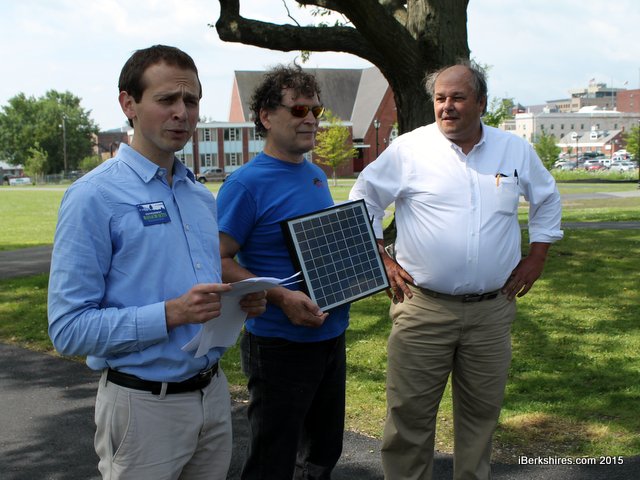 Ben Hellerstein, Bruce Winn, and Chris Kilfoyle spoke on the importance net metering has on the green economy at an event on Monday. Ben Hellerstein, Bruce Winn, and Chris Kilfoyle spoke on the importance net metering has on the green economy at an event on Monday. |
Net metering is a program that requires utility companies to buy unused energy produced by alternative or sustainable energy. The cap limits the amount the utility is required to buy from the sources and is currently around 5 percent of the total generation.
Photovoltaic energy has been the most popular use of net metering and, in 2008, the state has several times over the past half-dozen years increased the power generation eligibility for net metering.
With utility companies buying all that they are required to now, the financial incentive to build a large array has all but disappeared, leaving many proposed solar projects in limbo. Utility companies no longer need to buy the excess energy produced from large solar arrays, making the projects less financially feasible.
Berkshire Photovoltaic Services owner Chris Kilfoyle says the expiration of that incentive is a threat to the industry and its growth. Kilfoyle says local firms, like his, employ more than a dozen people each and solar installations require architects, engineers, electricians, and even concrete workers. The industry has a "multiplier effect" on the local economies.
Ben Hellerstein, state director of Environmental Massachusetts, estimates the state could have 25 percent of its energy usage by 2025 come from solar sources. The solar industry produces some 12,000 jobs currently, he said, and will grow with additional projects.
"These numbers are growing fast," added Bruce Winn of the Berkshire Environmental Action Team, in speaking about both the environmental and economic benefits of solar.
Winn, Hellerstein, and Kilfoyle on Monday held a press conference at the Common. They are hoping the state will raise the caps to continue to support the solar industry's growth and provide incentives to bring currently proposed projects to fruition. A number of bills have been filed related to the topic.
"This bill and new goals for increased solar is good for the economy," Winn said.
The net metering cap has been a heated debate in the state house. The utility companies say the system pushes additional costs onto those users who do not have access to solar projects. Solar producers are being paid by the utilities for what they produce at the same rate the company is selling it. However, utility companies factor in the maintenance of transmission lines, poles, and staff to run it. Essentially, that pushes an additional burden of paying for the transmission solely onto the rates of customers without solar arrays.
A report from the state's Net Metering Task Force in May supports the goal of reaching 1,600 MW production over the next six years with two caveats: "Any future credit and incentive must be at the appropriate levels to continue driving the solar industry forward. At the same time, ratepayers who fund the programs through electric rates should be paying more than is necessary to reach the installation goals."
The costs could run $2.5 billion to $4 billion for non-participating ratepayers over the next six years. The Baker administration says any program must take those issues into consideration, and "does not support raising the net metering caps in the short term absent a long-term sustainable solution," the report states.
The costs could run $2.5 billion to $4 billion for non-participating ratepayers over the next six years. The Baker administration says any program must take those issues into consideration, and "does not support raising the net metering caps in the short term absent a long-term sustainable solution," the report states.
Additionally, companies say a certain minimum level of power needs to be produced at all times to keep the system operating and solar only produces when the sun is shining.
Hellerstein, Winn, and Kilfoyle reject those arguments, saying the utilities aren't hurting for money and need to adapt. Electric rates have recently increased with the most cited reason as the shutting down of nuclear and coal producers. Those shutdowns have trigger the debate over a controversial natural gas pipeline proposed to run through the Berkshires..
Solar "makes better sense than digging a trench across Massachusetts," for Kilfoyle. The three say between energy efficiency and encouraging renewable energy, the state could be 100 percent powered by renewable sources. Hellerstein said in states like Vermont, the cap is upward of 15 percent and the utility companies are still making a profit as they "rethink" their role.
"There is no reason Eversource and National Grid can't adapt," Hellerstein said.
He added that "there is no reason for us to put caps on clean energy" at all because of the benefits of renewables.
 Kilfoyle owns Berkshire Photovoltaic Services and said firms like his not only create more than a dozen jobs but also give additional work to other contractors. Kilfoyle owns Berkshire Photovoltaic Services and said firms like his not only create more than a dozen jobs but also give additional work to other contractors. |
The town of Adams recently completed a project that provides lower energy costs for town buildings and creates additional tax revenue. The town would support additional projects but the cap removes one of the key incentives to doing so, according to Town Administrator Tony Mazzucco, who sent a prepared statement to be read at Monday's press conference.
"The Town of Adams is deeply concerned about the net metering cap," Mazzucco wrote.
"We recently concluded a solar project here in town that has brought much-needed tax revenue, economic and job growth, and green energy to the community. We would like to continue developing more solar projects in town of all scales to foster economic growth while promoting sustainability. Not adjusting the net metering cap effectively ties our hands and denies us a crucial avenue for economic and job growth, tax base growth to provide critical municipal services like schools and public safety, and essentially stops dead our best avenue for a truly sustainable community and region."
Another project in Williamstown may not move forward because of the cap.
Environmental Massachusetts is planning to hold 10 events across the state to urge the Legislature to up the cap.
"We should be doing everything we can to soak up the sun," Hellerstein said.
Tags: net metering, photovoltaic, solar array, solar project,