Mount Greylock Building Project's Tax Impact Discussed
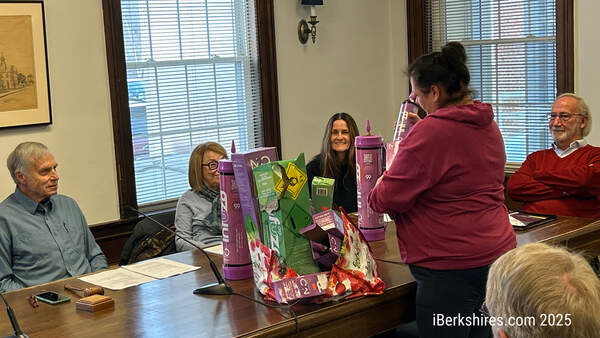
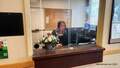
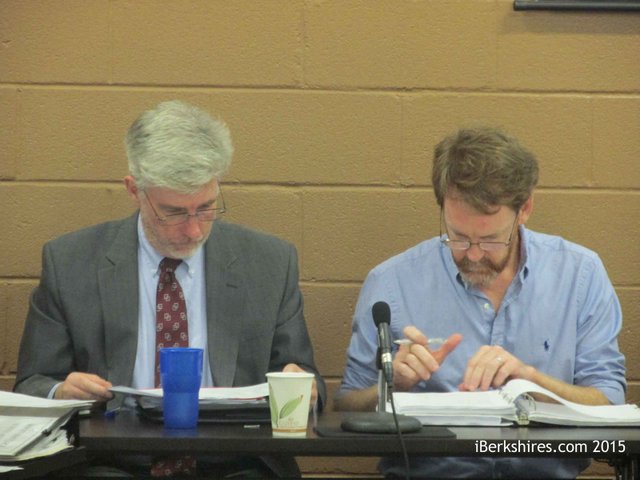 Superintendent Doug Dias and Selectman Hugh Daley, a member of the School Building Committee, review minutes from a prior meeting. Superintendent Doug Dias and Selectman Hugh Daley, a member of the School Building Committee, review minutes from a prior meeting. |
The School Building and School committees held their second straight joint meeting in the meeting room of the junior-senior high school.
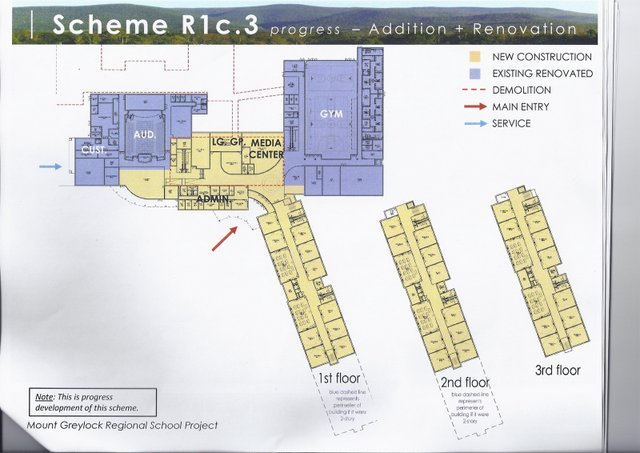
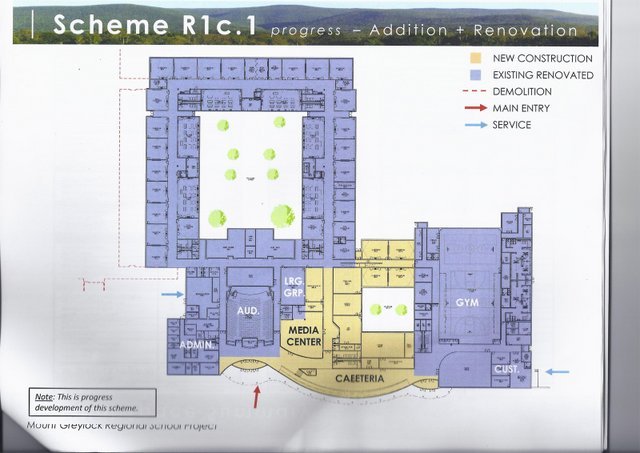
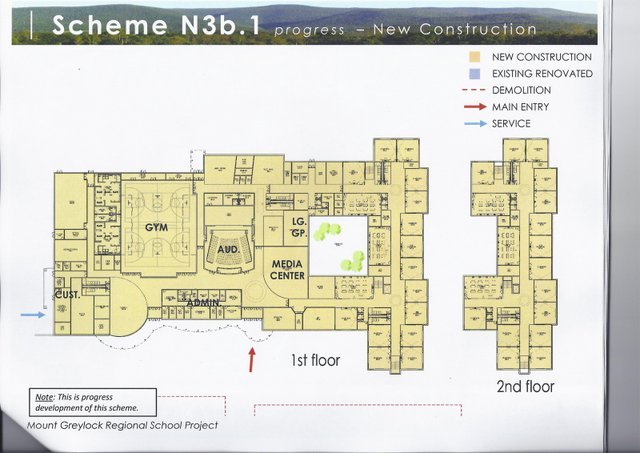
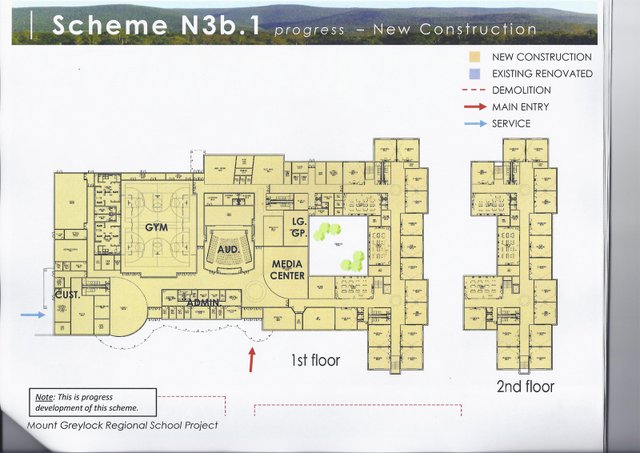
Although the largest part of the meeting was focused on the three designs that the School Committee hopes to narrow to one choice in one week's time, the cost estimates gave residents their first, preliminary idea of what it might cost to either renovate or rebuild Mount Greylock.
Building Committee Chairman Mark Schiek reported the projections developed by the committee's Finance Working Group.
All of numbers are based on rough estimates of a number of different variables, including the cost of the project, the level of compensation from the Massachusetts School Building Authority and the interest rates that the district will be able to get if and when it issues bonds for the project.
Schiek and Hugh Daley, a Williamstown selectman and building committee member who serves on the Finance Working Group, repeatedly cautioned that the numbers are preliminary.
But after the meeting, Schiek noted that residents of both Williamstown and Lanesborough continue to ask committee members about cost, so it was time to get the numbers out there. And impact to taxpayers is one factor the building committee and School Committee will consider on July 30 when the former recommends a preferred design option and the latter, in theory, votes an option to advance to the MSBA.
Not surprisingly, the most expensive option for taxpayers would be a new building, but the impact would not be that much higher than the more expensive of the two addition/renovations currently being considered.
|

In addition to the previously mentioned unknowns, tax bills in each town could also be affected by the retirement of current long-term bonds being paid by taxpayers in each community. Daley said those potential savings were not taken into account.
"We're estimating what market rates [for bonds] will be in the future," Daley said. "Today's rates are lower than what we're projecting in the future.
"I think it's very conservatively estimated. I hope this is a 'no greater than' number. That was our goal."
One variable — the estimated total cost of the project — will come into sharper focus before the School Committee takes its vote next Thursday.
On Tuesday, the district's owner's project manager, Dore & Whittier Management Partners of Newburyport, will meet with two independent project estimators, reconcile their cost estimates and give the committees the most up-to-date projections it can for all three designs under consideration.
The tax impacts discussed on Thursday were based on initial project cost estimates developed by Dore & Whittier.
Technically, there is a fourth option still under consideration by the committees: a base repair to the existing building.
Schiek on Thursday explained why it is highly unlikely to win the approval of the School Committee.
The base repair, which would make systems upgrades and bring the current 1960 building up to code, is estimated to cost $58 million. But that cost would be borne entirely by the district.
"Often the base repair will not comply with your educational goals and plan moving into the future," Schiek said. "When that occurs, MSBA will not participate. ... If that happened, it would be up to the two towns to support the base repair."
Dore and Whittier's Trip Elmore confirmed that the district's Preliminary Design Program, an MSBA-mandated document that takes into acccount the school's educational programming needs, concluded that the current building is inadequate for those needs.
"And [MSBA] agreed with us," Elmore said. "If they had not agreed with us, they would have sent back comments."
Tags: MGRHS, MSBA, school building committee, school project,