image description
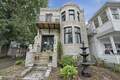
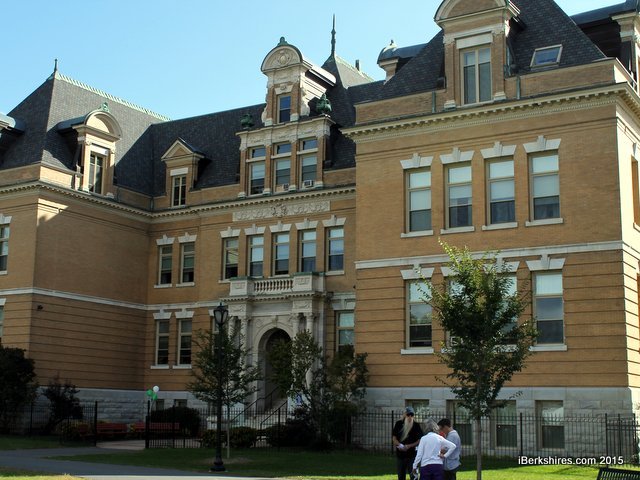
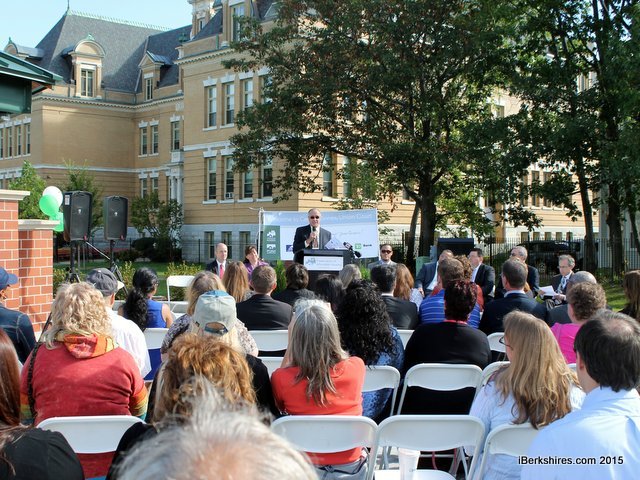
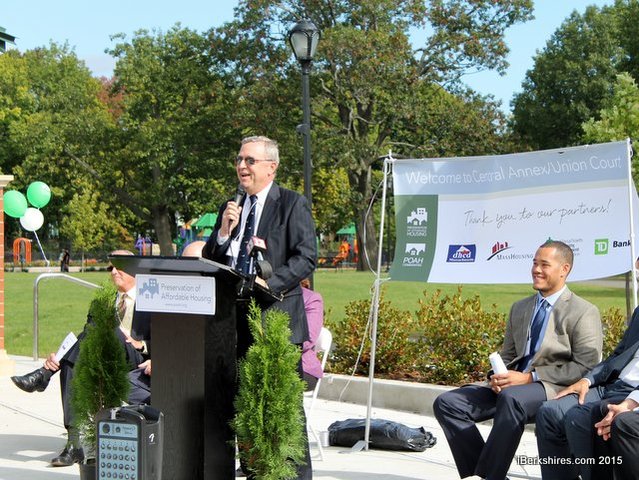
The Central Annex, facing the First Street Common, recently underwent renovations to maintain its 69 low-income apartments.
image description
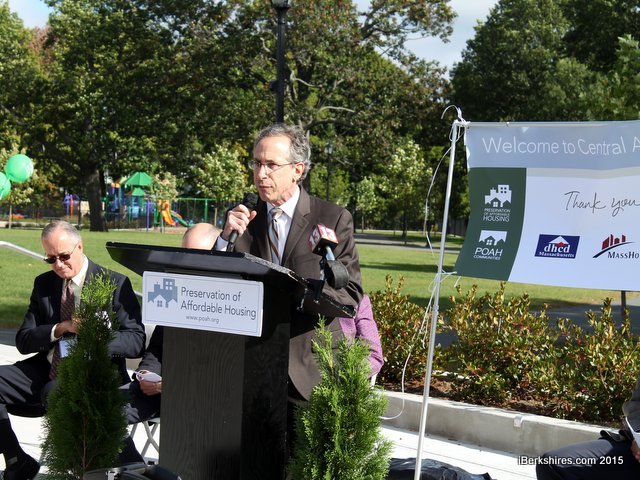
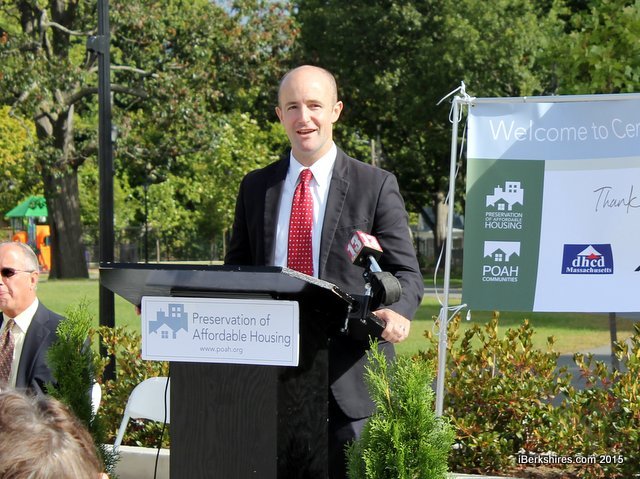
Aaron Gornstein, formerly undersecretary with the Department of Housing and Community Development, is now CEO of Preservation of Affordable Housing.
image description
Mayor Daniel Bianchi speaks to the building's historic nature.
image description
State Sen. Benjamin Downing says renovation is an investment in the community.
image description
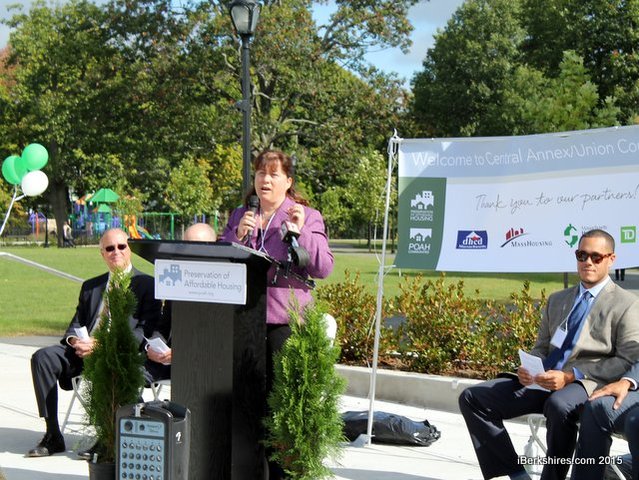
State Rep. Tricia Farley-Bouvier says the housing will also provide access to services.
image description
MassHousing spends some $1.2 billion on such projects statewide each year, according to Deputy Director Timothy Sullivan.
image description
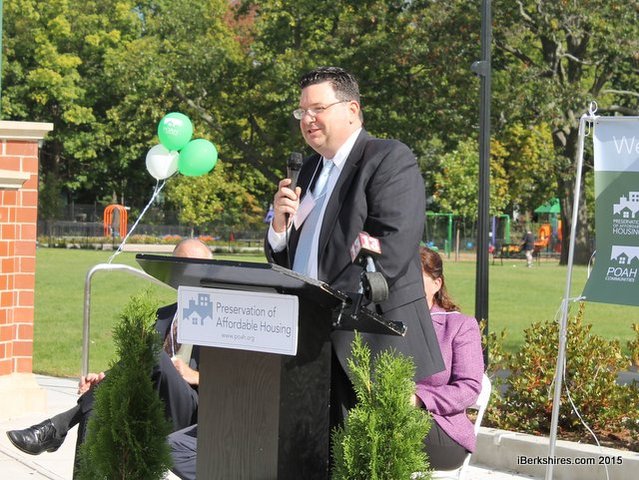
Peter Sargent, director of capital development with the Mass Housing Investment Corp., explains how that program works to promote affordable housing.

Pittsfield Celebrates Restoration of Central Annex, Union Court Apartments

By Andy McKeeveriBerkshires Staff
Print Story | Email Story
Mass. Housing Investment Corp.'s Director of Capital Development Peter Sargent, state Sen. Benjamin Downing, Mayor Daniel Bianchi, Project Manager Charlie Dirac, POAH CEO Aaron Gornstein, POAH's Managing Director Rodger Brown, state Rep. Tricia Farley-Bouvier, and MassHousing Deputy Director for Finance and Rental Progreams Timothy Sullivan.


PITTSFIELD, Mass. — There is a shortage statewide for subsidized housing and Berkshire County is no different.

Now more than 101 affordable housing units eyed for low-income residents have been saved with the recent $16 million investment in two city apartment complexes.

The nonprofit Preservation of Affordable Housing celebrated the completion of renovations to the Central Annex and Union Court apartments on Monday morning.
 
"[Central Annex] was at risk of being converted with a loss of the subsidized units," said the non-profit's CEO Aaron Gornstein on Monday when the companies joined state and local officials.
 
"It is a gem of a property. We will be here for the long term."
 
The annex abuts the newly renovated First Street Common. The historic building was constructed in 1895 as the city's first high school.
 
Pittsfield High School was built on East Street some 40 years later and Central Annex went through a series of uses, including as a middle school and the state's first community college.
 
Union Court, just a few blocks away, was constructed in 1905 as the Berkshire Motel. In 1980, both properties were turned into housing for elderly, low-income, and disabled residents by Pittsfield Neighborhood Associates, and managed by Berkshire Housing. Central Annex has 62 units and Union Court 39.
 
"You don't see this kind of architecture anymore. You don't see this craftsmanship," said Mayor Daniel Bianchi of the historic buildings.
 
POAH purchased the buildings in 2007 and, over the last 18 months, made renovations included new roofs, windows, doors, unit improvements, plumbing, heating and cooling systems, and fire suppression. The units will continue to serve the low-income and disabled population through Section 8 housing.
 
"The combination of affordable housing and market-rate housing is making our community special and vibrant," Bianchi said, citing a number of other market-rate housing projects recently completed in the city's downtown.
 
POAH officials said the project wouldn't have been possible if it weren't for loans from MassHousing: $4.5 million in low-income housing tax credits, and $1.75 million from the state's Affordable Housing Trust Fund, which is managed by the state Department of Housing and Community Development.
 
According to Timothy Sullivan, deputy director for finance and rental programs with MassHousing, the agency finances some $1.2 billion in projects statewide each year. This recent renovation is part of 16 projects in Berkshire County preserving or creating 725 affordable housing units. He said the Affordable Housing Trust Fund has helped save 25,000 units in the last 15 years.
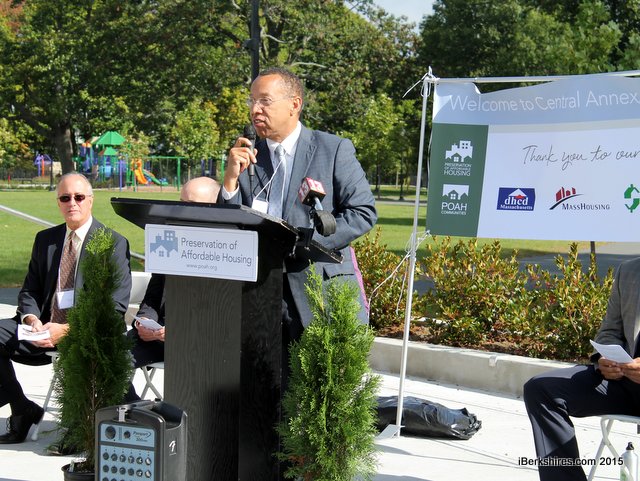
 
POAH's Managing Director Rodger Brown vowed to be a partner with the city for the long term.
Massachusetts Housing Investment Corp. also partnered with POAH for the project to administer the low-income tax credits, which were bought by TD Bank. That nonprofit is a consortium of banks aimed to attract developers for affordable housing projects.
 
"It's all about the people at the end of the day. That's why we do what we do," said Peter Sargent, director of capital development with the Mass Housing Investment Corp. 
 
For state Sen. Benjamin Downing, the Central Annex renovation is a sign of hope. He said while the city has seen "up and downs" throughout time, that building continued to stand "through the test of time."
 
The new investment is helping the city preserve neighborhoods in which people of all types can be part of a community, he said.
 
"It is another piece in the puzzle in making sure Pittsfield is all we believe it can be," Downing said.
 
State Rep. Tricia Farley-Bouvier said the renovation is more than just providing housing, what happens inside the building is what that matters. That includes bringing access to needed services such as mental health or financial literacy to the residents.
 
"We're making sure the services are based right there in the building," Farley-Bouvier said. "We're going to address poverty one family at a time."
 
Rodger Brown, managing director for real estate development with POAH, credited teamwork with completing the project and vowed to be long-term partners with the city of Pittsfield. 

Tags: affordable housing,   ribbon cutting,   subsidized housing,   
If you would like to contribute information on this article, contact us at info@iberkshires.com.

BRTA Looks to Another Year of Fare Free

By Breanna SteeleiBerkshires Staff

PITTSFIELD, Mass. — The BRTA is expecting another year of fare free rides.

Berkshire Regional Transit Authority Administrator Kathleen Lambert told the advisory board recently that she expects to receive $1.3 million in state funding to remain fare free. She said RTAs may be given up to $40 million this year statewide, which is $5 million up from last year.

While the state budget is not formally approved yet, the effect will take place on July 1.

The news came at the same time the board approved the BRTA's budget of $13.6 million, which is an increase of 11 percent since last fiscal year.

Some of the increases were in the fixed route area which jumped from $9 million to $12 million. Lambert said this is due to the contractual agreement between the union where they have a five percent raise for all of the drivers and other union members, as well as a seven percent raise for paratransit fleet operators.

Lambert said much of the costs raised were fuel costs because of the ongoing war in Iran. The authority uses about 8,000 gallons of fuel a month and has planned for $5.75 per gallon.

The customer service desk, which currently staffs two employees, will be shut down, she said. The two employees were given notice months in advance and one showed interest in becoming a bus driver and will plan to interview for that. Lambert said two new drivers have started and that the new transit company Keolis, which is taking over for Transdev, will continue to hold recruiting events. The new manager is Mark Moujabber, taking over for Bobby Quintos. 

Lambert told the board she believed there are discrepancies in ridership data. Deputy Administrator Benjamin Hansen, who was in operations before his current role, said the authority has been seeing low ridership because of route cancellations, however, this past month, the numbers did not make sense as demand has stayed the same but ridership seemed exponentially low.

To get the figures, bus drivers must manually push a button on the farebox to record passengers, wheelchairs, and bikes, which might have errors. There are automatic passenger counters (APCs) installed, but they are not certified, so are only used as a rough comparison tool as they are not accurate.

Board member Stuart Lawrence asked if there has been any investigation on if this might be deliberate. Hansen said there is not as he does not know how they could watch for that to happen.

Lambert said she has been working with professor Paula Consolini at Williams College, who will have a group of samplers who will ride the bus and gather a week's worth of data.

In the last meeting, the board spoke about anonymous emails from drivers, and a letter iBerkshires received spoke of unhappy drivers who were considering quitting because of decisions being made without "input from frontline staff," frustration and falling morale, and the removal of the former general manager shortly after Lambert came in.  

Multiple employees had also signed on to a vote of no confidence letter in the BRTA administration spearheaded by Raymond Killeen who is a bus driver and represents Cheshire on the advisory board. Killeen said losing Quintos was hard, stating he was an excellent general manager and not having him there led to hardships on accomplishing many things.

"Once the removal was there, it was difficult to accomplish certain things, because we had lost the general manager. So, the letter was an attempt to get things moving a little bit quicker, so we could provide a better service for the residents of Berkshire County. I don't know if it accomplished that. We were able to do some things, though, but the concern amongst rank and file here is that we're not providing the best service we possibly could, and we're hoping that when the new management team comes in, that can be accomplished," Killeen said.

Killeen said he was unhappy with the progress to a revised driver schedule. The day after the meeting, Lambert and the team had a meeting to discuss and negotiate run schedules, Lambert said it was a very good and productive meeting.

View Full Story

More Pittsfield Stories