Pittsfield's 2015 MCAS Scores: Good, Bad, Ugly
 |
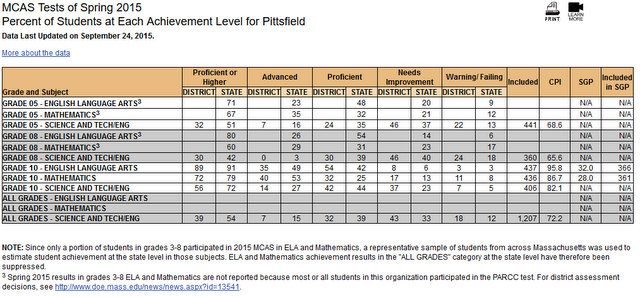
The good: city students are on par with state's averages when it comes to teaching English. A total of 89 percent of the students were proficient or advanced, which is compared to 91 percent statewide in grade 10 scores.
However, in relation to urban districts, Pittsfield did better. The average of all urban schools was 83 percent on the Massachusetts Comprehensive Assessment System tests.
The numbers among students with disabilities scored better than the state average, showing the special education programs are making an impact. Among students with disabilities in Pittsfield, 61 percent were proficient or advanced compared to only 57 percent in the statewide average.
"We are slightly ahead of the state average but clearly some work to do there," Superintendent Jason McCandless said this week.
For black or African-American students, 92 percent were proficient or advanced.
"This is a real highlight of our data this year. We are above the state average in number proficient or advanced," McCandless said.
Among Hispanic or Latino students, 78 percent were advanced or proficient. And those who were categorized as economically disadvantaged 83 percent were advanced or proficient compared to 84 percent statewide.
"We're very close in the state averages in number of students who need improvement or are failing," McCandless said, pointing out that the city has fewer students in that subgroup in the advanced category than the state average but more in the proficient category.
But teaching English is much different from teaching mathematics, the superintendent said. With English, once a student can read the lessons, he or she can use the same skills but grow in depth. With math, it is a new skill being added on top of a new skill throughout a child's educational career.
"ELA scores tend to be better across the state because it is repetition," McCandless said.
Pittsfield's math scores are the bad. Only 40 percent of the students scored in the advanced category compared to 50 percent being the state average. Overall, 72 percent of city students were advanced or proficient, which was below the state's 75 percent average.
Among students with disabilities, which account for 18 percent of the student population, some 38 percent scored in the advanced or proficient categories compared to the state's 39 percent.
"Across the board, mathematics instruction, which is crucial to many jobs ... we really need to be looking at doing something different with our special-needs students," McCandless said. "We have to own parts of this but it is a challenge across the commonwealth."
The good news is, students aren't scoring any worse. McCandless said the scores are not that much different, compared to other years.
Among black and African-American students, 60 percent are advanced or proficient compared to the state average of 62 percent. Among Hispanics and Latinos, which accounts for just 3-4 percent of Pittsfield's student body, only 34 percent are proficient or advanced compared to 56 percent statewide.
"This is probably the one where we are the most drastically off from the commonwealth," McCandless said.
Among the economically disadvantaged group, 56 percent were advanced or proficient compared to the state average of 63 percent.
The ugly: science.
"Our elementary schools are so busy preparing students for the reading and math test that everything else is a shade of pale," McCandless said. "Reading and math are really the absolute biggies."
Among Grade 5 students, only 31 percent were advanced or proficient in science. That is compared to the state average of 51 percent. In middle school, 30 percent of the students are proficient with only one scoring in the advanced category. The state average in middle school is 42 percent advanced or proficient with only 3 percent scoring in the advanced category.
"These scores are basically mirror copies of each other from year to year and the state averages are as well. They are well below what you'd want to see," McCandless said.
Among high school biology scores, 49 percent of city students taking the biology test were advanced or proficient. That is below state averages. In physics, however, 80 percent were advanced or proficient compared to the state average of 71 percent.
"These physics students represent the students a vocational school would accept and a charter school would keep," McCandless said. "When you compare our highest performers against the highest performers in the state, we do well."
He said he was happy with the scores overall, considering the variables in the test. He said the schools with the top scores tend to be in areas with mostly two-parent household, with more household structure, with parents who have more education, and more comfort. Or, the schools are ones such as charter schools or vocational schools that can pick which students are accepted.
"I believe it is excellent in that it does measure the degree of excellence a student has achieved in mastering the Massachusetts curriculum," McCandless said of the curriculum.
But, he said it isn't fair to compare among districts because its like a running a race with different starting lines. In Pittsfield, the graduation rates and advanced placement scores show that many students are exceeding expectations.
"This is an indicator of how we are doing but it is not the end all and be all on education in Pittsfield," said School Committee Chairwoman Katherine Yon, who said the test helps administrators focus efforts on weak points but shouldn't be considered the only measure of performance.
When asked, McCandless said he'd give this year's performance a B grade.
"We definitely saw some good. We definitely saw some bad. We definitely saw some ugly," McCandless said. "I think we are doing B work in a world that is not setting us up for B work."
Some of those weak spots, however, McCandless expects to improve under the new district improvement plan the department is undergoing this year.
"The bottom line is that we are on the right path and we know that," said School Committee member Anthony Riello.
Tags: MCAS, pittsfield schools,