image description
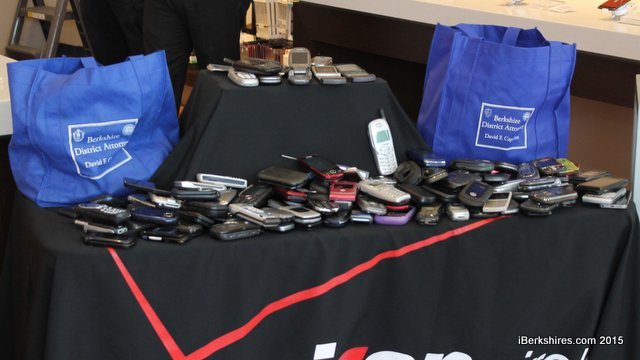
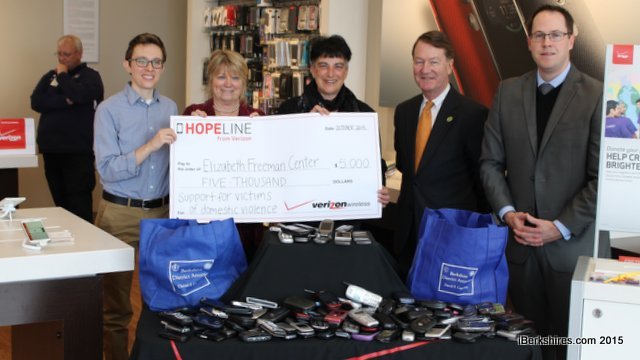
The office donated hundreds of cell phones to be recycled.
image description
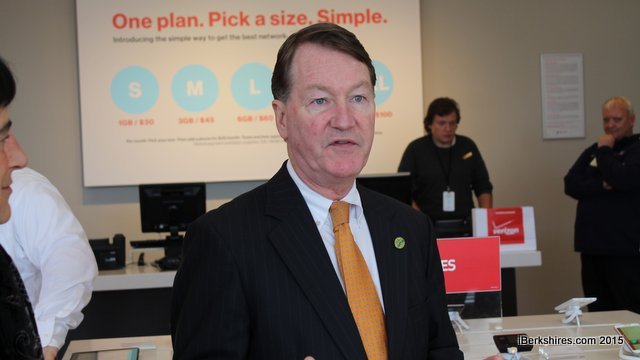
District Attorney David Capeless.
image description
The company presented a check to the Elizabeth Freeman Center on Thursday.

Verizon's Hopeline Program Protects Domestic Abuse Victims

By Andy McKeeveriBerkshires Staff
Print Story | Email Story
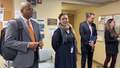
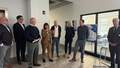
Becca Bradburd, Linda Strassell, Janis Broderick, David Capeless, and Mike Murphy at the Verizon Wireless Store on Hubbard Avenue on Thursday.

PITTSFIELD, Mass. — With today's technology it can be pretty easy to track someone down. When it comes to domestic abuse victims, Verizon wants to make sure that isn't the case.

Each year, Verizon donates boxes of secure cell phones to the Elizabeth Freeman Center to give to victims — getting them off the family plan and onto a secured line.
 
"The Hopeline gives us a safe phone to give folks so they can call for help or call for services," Elizabeth Freeman Center Executive Director Janis Broderick.
 
"They really do save lives. We give out at least 100 phones per year."
 
The phones given to the center is part of the company's 'Hopeline' program. On Thursday, District Attorney David Capeless turned over hundreds of old cell phones to the company. Verizon will now recycle the parts and use the proceeds to send new phones and a cash donation to the Freeman Center. The new phones are all stocked with minutes and texts for victims to use.
 
We couldn't do these grants or Hopeline phones without the community's help," said Verizon spokesman Mike Murphy. "Through the revenues we generate fro this program we can give grants to our partners."
 
In its 10th year, Verizon gifted the Freeman Center a $5,000 check. Broderick says that'll go to support the organization's 24-hour emergency services. That response gives families whatever emergency needs the family has at the time. Broderick said the needs vary on a case by case basis.
 
"We're confident our resources are being put to good use," Murphy said.
 
The money is generated from Capeless' collections in which hundreds of old cell phones are collected and shipped to the company. Capeless said the partnership among the three agencies isn't just finances but the collection process sheds light on the problem of domestic abuse.
 
"It reminds them that this is an ongoing issue," Capeless said. 
 
He credited Verizon with putting in the effort to make it happen because "for Verizon this is not simply a public relations event" but a program requiring a significant amount of work.
 
"This is such a great program," the district attorney said.
 
Broderick said the Elizabeth Freeman Center operates on a "bare bones" budget so it relies on community partners like Verizon and the district attorney's office.
 
"I think our partnerships in Berkshire County make our work more effective," she said. 

Tags: cell service,   district attorney,   donations,   elizabeth freeman center,   Verizon,   
If you would like to contribute information on this article, contact us at info@iberkshires.com.

PCTV Turns 40, Anniversary Celebration This Friday

By Breanna SteeleiBekshires Staff

PITTSFIELD, Mass. — Pittsfield Community Television is turning 40 this week, and it's celebrating with its viewers and listeners.

This Friday, Sept. 18, PCTV will celebrate at the Berkshire Hills Country Club. Ryan Peterson, WTEN News10 ABC anchor and Pittsfield High School graduate, will give the keynote address. 

Executive Director Shawn Serre, who has been with the station for over 32 years, said it's their chance to celebrate all they have been able to bring to the community.

"It's a chance to reflect on everything that the organization has done over those years, all the people that have been involved. From board members to volunteers to producers to crew people to staff members, and all the different programs that we've produced," he said. "Everything from public programming to education, sports, graduations, parades, government meetings and forums, and election night coverage, and all kinds of other things that just year upon year of history that we've been able to create and document here for the Pittsfield community over those years." 

Serre took over as executive director about nine years ago. Originally a volunteer fresh out of college.

The original board included former mayor Edward Reilly, Dan Dillon, Diane Morgenstern, Bernard Avalle, and John Fukes of the Berkshire Athenaeum. The operation was all-volunteer until PCTV hired the first executive director in January 1989.

PCTV has operated out of its station on Federico Drive since 1999. But originally they worked out of a basement. 

"The first location that we ever had, we had all of our equipment stored in cardboard boxes in the basement of the Berkshire Athenaeum, because the Berkshire Athenaeum at the time was very gracious and allowed us to have some space while we sort of got our feet on the ground and sort of got things organized," he said. "But we had no location. We had no studio. We just had this equipment that was ordered with the money that we had from the original cable franchise grant."

"So that lasted a couple of years, and then we signed and got a lease over in our first studio location, which was over on Fourth Street in Pittsfield," Serre continued. "That was around the time that I first got involved, just before we moved to Fourth Street. So I was there in the basement of the library, opening those boxes up and seeing what we had for equipment. So we stayed there at Fourth Street for about 10 years, and then this building that we're currently in now, over on Federico Drive, was constructed in 1998. It was built kind of custom-made for the cable company and for us and for one other company." 

Serre said one of their proudest moments was saving the radio station WTBR-FM back in 2018. PCTV made space for them so they could continue operation.

"We carved out some space here in our facility for that, and we've been operating that radio station ever since. So those are some of the big milestones of growth of the organization over the years, and the things that we've done," he said.

They have also invested in advanced technology to keep their programming accessible to all.

"Technologically, there's another whole series of things that we've gone through," he said. "We've started out with a single cable TV channel. We grew to three cable TV channels. We started out as standard definition on videotape, and we grew to digital, and then to high definition, and then everything went to the internet. So we're able to offer video on demand and live streams and video on social media. And then with the radio station, we also have a live stream there and podcasting. So we've seen a lot of technological change and tried to roll with that over the years."

Serre said that PCTV strives to keep people informed while also allowing space for people to create their own media.

"The whole idea behind PEG [Public Education and Government Access]...the whole idea behind that back in the 70s and 80s was that people could be left behind with the technology that's available to the big corporations," he said. "So, if you had a cable system at the time, ordinary people maybe they had camcorders at home, but they didn't have access to a TV studio; they didn't have access to the kind of technology that we had to allow them to create programs and share it with the community. So we filled that gap, and that was one of the main things that we did. And then also to be able to create programming for viewers and for the city, so that the municipal meetings can be shown, and so school committee meetings can be shown, and it really brings people in and involved."

View Full Story

More Pittsfield Stories