Lanesborough FinCom Supports New Capital Agreement With Williamstown
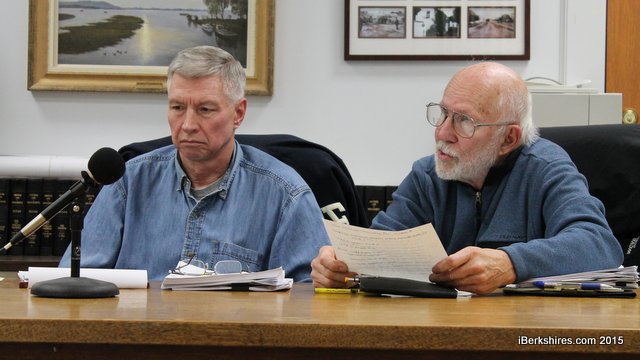 Steven Wentworth, on the left, was part of the team negotiating the agreement. Ronald Tinkham voted against recommending voters approve it because he didn't feel he had enough information. Steven Wentworth, on the left, was part of the team negotiating the agreement. Ronald Tinkham voted against recommending voters approve it because he didn't feel he had enough information. |
Voters will be asked to approve the new method for splitting the cost of capital projects for Mount Greylock Regional High School on Dec. 1 at a special town meeting.
The major change is that instead of the costs for each town being locked in for the life of a bond at the time of its issuance, the split will be determined by a five-year enrollment average.
The split is currently at 33 percent for Lanesborough and 67 percent for Williamstown, which would stay in place for the life of any loans issued now.
The projections show Lanesborough is expected to see a population drop over time; the new agreement is projected to lower Lanesborough's proportion.
"If this does not pass, this would be detrimental to the town," Town Administrator Paul Sieloff said, particularly emphasizing that soon the two towns will be looking to borrow to renovate and expand the high school.
The Board of Selectmen, however, doesn't feel the same. The Selectmen did not feel the agreement went far enough. They had wanted tax-exempt properties to be factored into the equalized value of the two towns — a factor that is coupled with student population to determine the split — and for school-choice students accepted at the elementary school level to count into the population ratio when the students reach high school. One selectman didn't like language that limits the towns from leaving or others from joining in the middle of the fiscal year.
"Some of the other stuff that was brought up, was discussed and in the end there wasn't support for it," said Finance Committee member Steven Wentworth, who sat on the negotiation committee. "Do the two towns want to stay with the current agreement and be locked in or do we want a dynamic agreement that is recalculated each year?"
Wentworth said the only real change is the five-year average. The basics of the formula remain in place. Sieloff said there is some eight pages of changes that are mostly language changes suggested by the state — including the state adding the language restricting towns from leaving the district in the middle of a budget year.
"We are going to compromise. We are not going to get everything we want," said Finance Committee member Christine Galib.
Finance Committee member Ray Jones, however, suggested Lanesborough should have pushed harder to get tax-exempt properties included in the valuations. He says the non-profits in Williamstown brings in money to the town, which is not factored into the equations.
Wentworth, however, said those non-profits raise property values in Williamstown, which then raises the valuation. But, those nonprofits don't pay taxes to directly contribute to the town's finances. Including those properties would force Williamstown residents to "pay twice" for them. He said if the tables were turned, Lanesborough wouldn't support it.
"If those assets were here, wouldn't we say the same thing," Wentworth said.
Jones ultimately supported the deal because he believes it is more equitable than the agreement currently in place. Ronald Tinkham, however, voted as the only vote in opposition. Tinkham felt he didn't have enough information.
Tinkham noted that if put in place right now with the last five years' numbers, Lanesborough's share will go up. Wentworth said the agreement doesn't use "retroactive years." It starts with just one year and builds as each year goes on until there are five years to average.
Tinkham wanted to hold off on the vote and have members of Mount Greylock Regional School Committee present the agreement to the Finance Committee. But, there isn't much time before the warrant will be approved for the special town meeting.
"If we don't accept the agreement, we accept a higher rate and I don't know how we'd possibly do that. It seems like this is the best we could do," Chairman Al Terranova said.
The Board of Selectmen still need to set the warrant for the special town meeting. Sieloff said there will likely be a few other articles added to create ordinances but the capital agreement will be the most important of the items.
Tags: assessment, bonding, Finance Committee, MGRHS, school project,